

[Japanese page]
[Previous article]
[Next article]
“Which way should I face for Ehomaki this year?”
“What time are we actually supposed to do the bean-throwing?”
Do you find yourself asking these questions every year while just going through the motions?
Setsubun is a special tradition, and it’s a real shame to just do it halfway without knowing the right way or the history behind it. If you miss the chance to clear out the “bad energy” that comes when the seasons change, you might end up starting the new spring feeling gloomy instead of refreshed.
That’s why this article covers everything from how to find the correct “South” direction for 2026, to the true story of bean-throwing that goes all the way back to the Heian period. I’ll even explain some unique local traditions!
By reading this, you’ll be able to get ready for Setsubun with confidence. You can turn it from “just another event” into a real luck-boosting ceremony for your family’s health and happiness. Don’t just throw beans for show—let’s actually bring in some good vibes this year.
The bottom line is: the secret to a great Setsubun in 2026 is throwing beans at night and eating your Ehomaki in silence while facing South. Let’s get ready to bring good luck to your side!
Introduction: Setsubun 2026
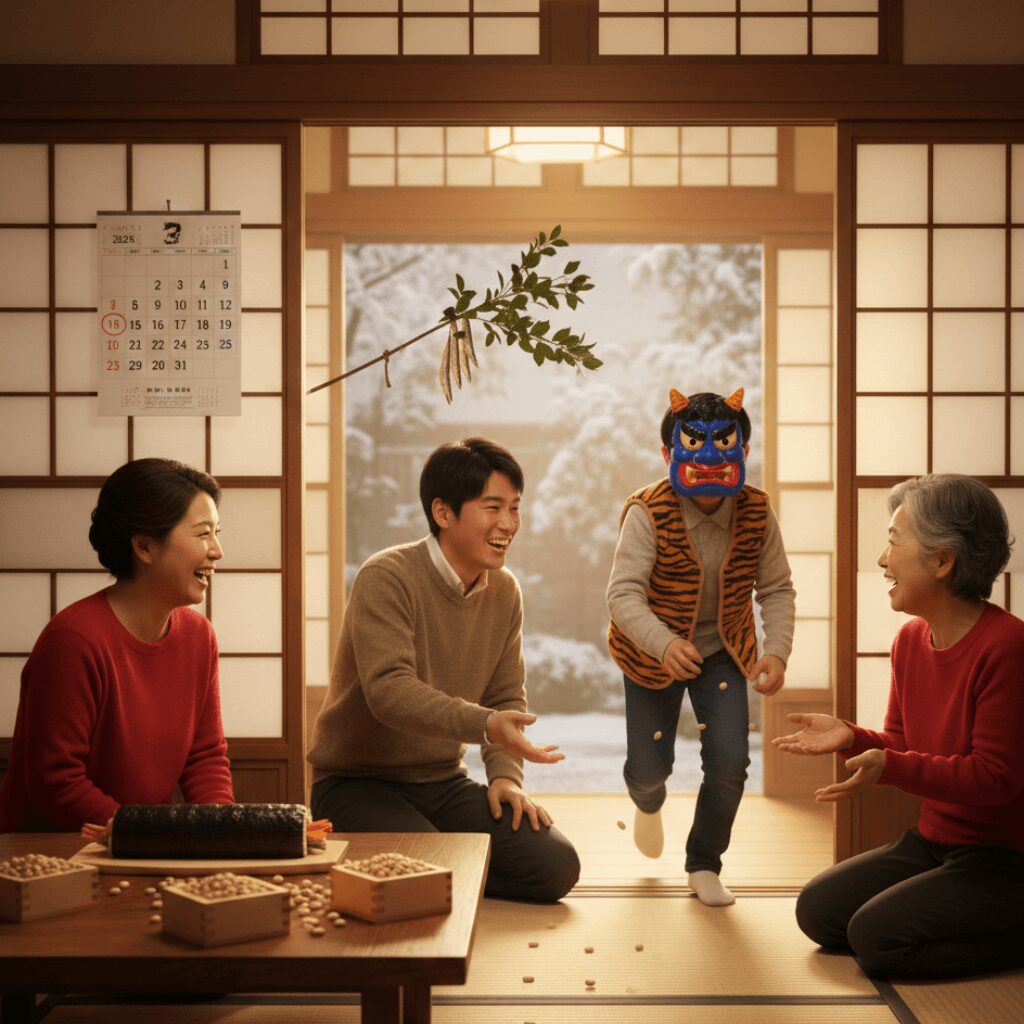
When we think of the first big traditional event of 2026, Setsubun is the one!
This year, Setsubun falls on February 3rd.
It is the day before Risshun (the first day of spring), marking the important boundary where winter ends and spring begins.
Most of us are used to tossing beans while shouting, “Oni wa soto! Fuku wa uchi!“ (Demons out! Fortune in!) and enjoying lucky sushi rolls.
But did you know that every single part of this tradition has a deep meaning and a long history? Setsubun isn’t just a fun “bean-throwing event.”
It is a special ceremony that Japanese people have cherished for centuries to drive away “evil spirits” that appear during the changing of seasons, allowing us to welcome the new year with a fresh, clean heart.
In this article, I’ll look at everything from the roots of Setsubun—starting with an ancient ceremony called “Tsuina” from the Heian period—to the correct way to throw beans today.
I will also explain why we eat Eho-maki (lucky sushi rolls) while facing “South,” which is the lucky direction for 2026.
By the time you finish reading, your usual Setsubun will feel much more meaningful.
It will become a special time to wish for the health and happiness of your family.
Let’s get ready to make 2026 a year of safety and good health!
Reference: Vocabulary & Cultural Notes
- Setsubun (節分): A Japanese festival held the day before the beginning of spring.
The word literally means “seasonal division.”
- Risshun (立春): The first day of spring according to the old lunar calendar.
In the past, this was considered the true start of a new year.
- Oni (鬼): Often translated as “demons” or “ogres.”
In Setsubun, they represent bad luck, sickness, and “evil spirits” (Jaki).
- Jaki (邪気): Negative energy or bad vibes that were believed to cause illness and disasters during the change of seasons.
- Tsuina (追儺): An ancient ritual performed in the Imperial Court over 1,000 years ago to drive away evil spirits.
This is the ancestor of modern Setsubun.
- Eho-maki (恵方巻): A long, uncut sushi roll eaten for good luck.
“Eho” means the “lucky direction” where a god of fortune resides.
- Mubyo-sokusai (無病息災): A traditional phrase meaning “to live in good health without any illness or accidents.”
Key Point: Why We Drive Away “Evil Spirits” at the Change of Seasons
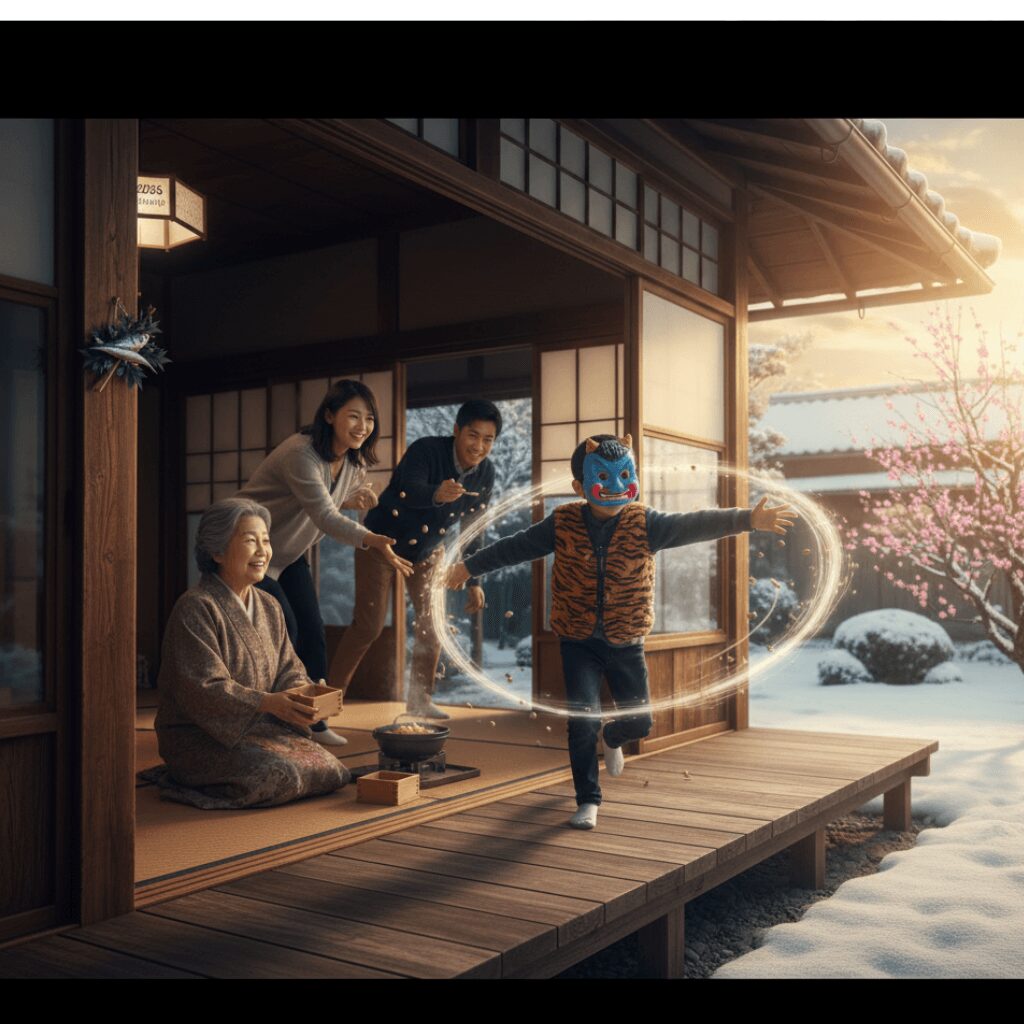
The most important thing to know about Setsubun is that it’s not just a yearly event.
It is a special day to “reset” and clear away invisible bad luck (called Jaki) at the boundary between two seasons.
The word “Setsubun” actually means “dividing the seasons.”
Originally, it referred to the day before the start of spring, summer, autumn, and winter.
However, today, we usually only use it for the day before Risshun (the first day of spring).
This is because, in ancient times, the start of spring was considered just as important as New Year’s Day—it was a fresh start for the whole year.
So, why do we need rituals like throwing beans at this specific time?
It’s because people believed that when seasons change, the energies of “Yin” and “Yang” (dark and light) shift violently.
During this unstable time, it was thought that “Oni” (demons), representing sickness and disasters, could easily sneak into our lives.
Especially the transition from winter to spring was a time to be very careful, as people often got sick from the changing weather and had to prepare their farms for the new year.
For us living today, Setsubun has three main goals:
- Destroying “Evil” (Mamé = Ma-me): The Japanese word for beans is mame, which sounds like the words for “destroying demons.”
We treat our negative feelings or bad habits from the past year as “demons” and throw them out.
- Praying for Health: By eating the same number of beans as your age (plus one), you take in the “life energy” of the beans to stay strong during the new season.
- Inviting Happiness (Fortune In!): We pray for the safety of our homes and create a happy environment where the whole family can smile.
In short, Setsubun is like a “spiritual spring cleaning.”
It’s a day to completely cut off the “dirt” of the old season and start fresh for spring. Understanding this will help you see why the history and traditions I’ll talk about next are so important.
Reference: Vocabulary & Cultural Notes
- Jaki (邪気): Negative energy, misfortune, or “evil vibes” that people believed caused bad things to happen.
- Risshun (立春): The traditional first day of spring. It was once seen as the true beginning of a new year.
- Yin and Yang (陰陽): An ancient philosophy describing how opposite forces (like cold and heat, or dark and light) interact.
- Oni (鬼): Often shown as horned ogres in stories, but in this context, they represent anything bad, like viruses, bad luck, or even a grumpy mood.
- Mamé (魔滅): A Japanese wordplay. Mame means “beans,” but the characters for “Ma” (demon) and “Me” (destroy) sound exactly the same.
- Kegare (穢れ): A state of being “unclean” or “spiritually tired” that accumulates over time. Setsubun is meant to wash this away.
Reasons: History and the Spiritual Power of Beans
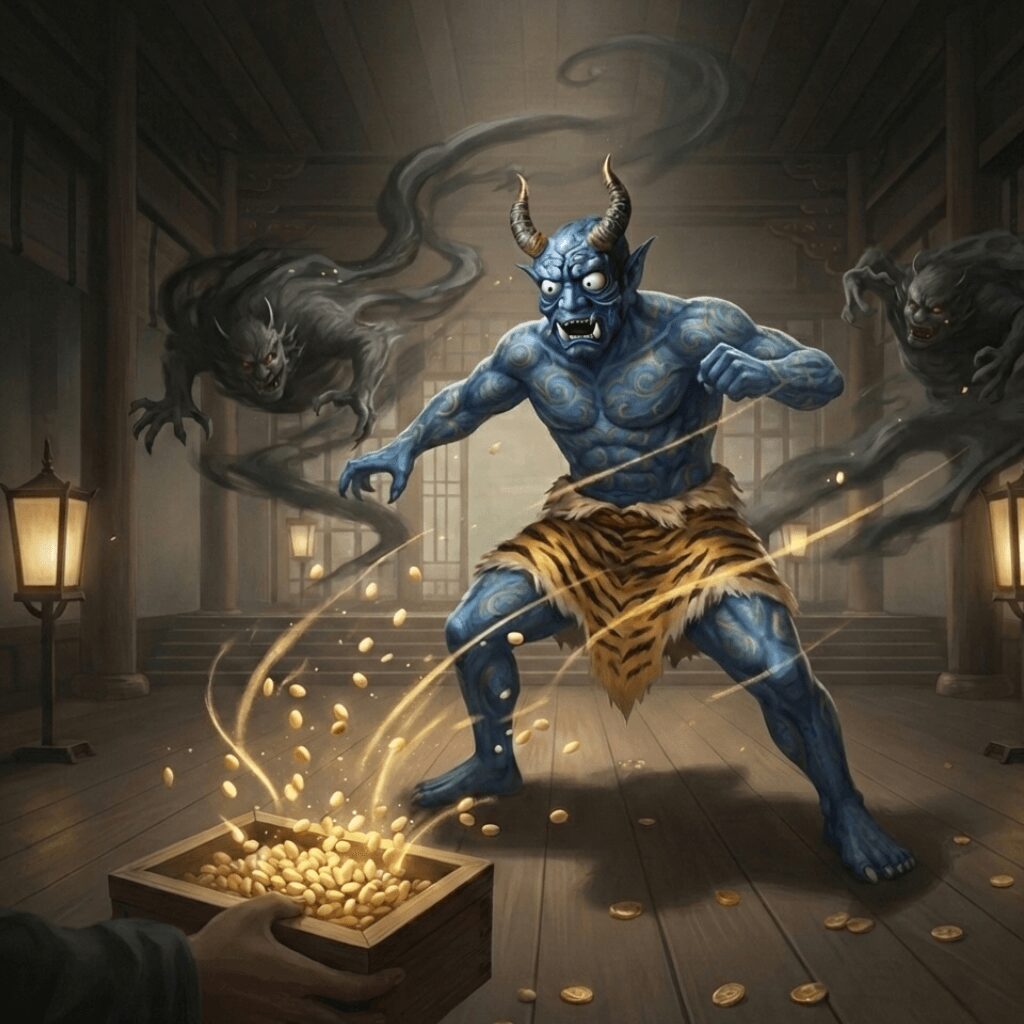
Why did the custom of throwing beans to drive away demons become so popular?
The reason lies in the mix of an ancient Chinese court ceremony and Japan’s traditional belief in the “power of grains.”
Roots in the Heian Period: “Tsuina”
The direct origin of Setsubun goes back to a ceremony called “Tsuina,” performed in the Imperial Palace over 1,000 years ago.
Tsuina was a ritual to drive away evil spirits on the last day of the year.
An official called “Hososhi” wore a scary mask with four golden eyes and carried a shield and spear.
He would march through the palace to chase away invisible diseases and disasters (represented as demons).
Over a long time, this ceremony spread from nobles to temples, and finally to ordinary people.
By the 1400s (Muromachi period), records show people throwing beans much like we do today.
By the 1600s (Edo period), it became a common yearly event for everyone.
Why did it have to be “Beans”?
Soybeans were chosen as the tool to fight demons for a few symbolic reasons:
- Faith in Grain Spirits (Kokurei Shinko): Long ago, Japanese people believed that grains like rice and soybeans held a “spirit” that is the source of life.
Soybeans are large and were believed to have strong spiritual power to push away bad energy.
- The Power of Words (Wordplay): In Japanese, the word for bean is “mame.”
This sounds exactly like the words for “destroying demons” (ma-me).
It also sounds like “demon’s eye” (ma-me), suggesting we are hitting the demon in the eye!
- The Importance of “Roasting”: You must use roasted beans.
In Japanese, the word for “roasting” (iru) sounds like the word for “shooting” an arrow.
Also, people believed that if you threw raw beans and they started to sprout later, it meant the bad luck was coming back!
To prevent this “bad omen,” the beans are roasted so they cannot grow.
Who are the “Oni” (Demons) really?
The “Oni” in Setsubun aren’t just make-believe monsters.
To people back then, they were symbols of things they couldn’t control: deadly diseases, famines, and natural disasters.
They imagined these invisible threats as scary creatures with horns and tiger-skin clothes.
By physically throwing beans (charged with grain power) at them, people gained peace of mind and felt they had protected their community.
For over 1,000 years, Setsubun has been a way for people to say, “We will protect our home and our friends from any trouble that comes from the outside.”
Reference: Vocabulary & Cultural Notes
- Tsuina (追儺): The ancient “demon-purging” ritual that started in the Imperial Court.
- Hososhi (方相氏): A ritual performer from ancient times who acted as a demon-hunter to protect the Emperor.
- Kokurei Shinko (穀霊信仰): The belief that spirits or divine energy live inside grains like rice and beans.
- Mame (豆/魔滅): “Bean.” It is a pun on “destroying demons.”
- Bad Omen (縁起が悪い): A sign that something bad might happen in the future.
- Famine (飢饉): A serious shortage of food, which was a huge fear for people in ancient times.
Examples: The “Right Way” in 2026 and Modern Fun
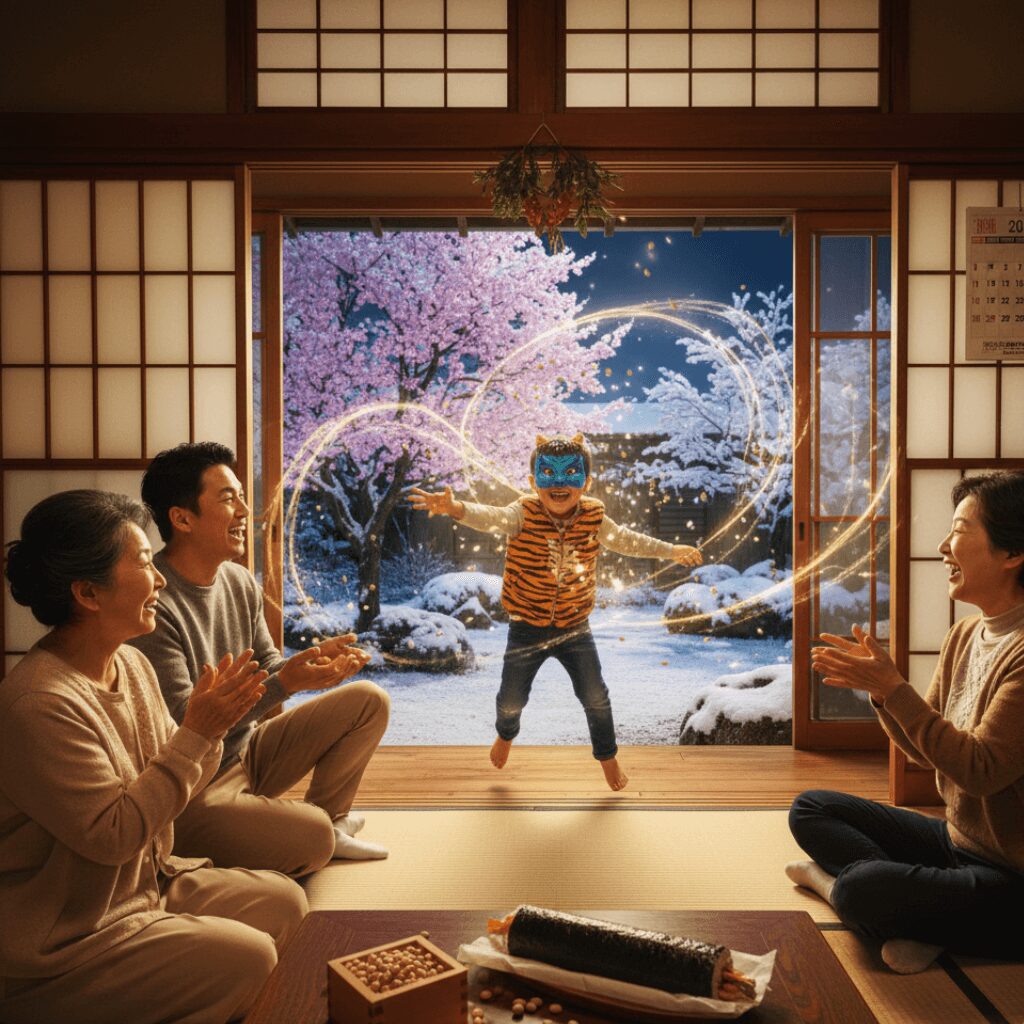
Now that you know the history, let’s look at how to actually do it!
Here are the steps for a perfect Setsubun in 2026.
The Correct Steps and Timing for Bean-Throwing
There is a traditional way to make bean-throwing most “effective.”
- Time: It is best to do it at night (around 8:00 PM to 10:00 PM) because that’s when evil spirits (Oni) are believed to appear.
- Preparation: You must use roasted soybeans (called Fuku-mame or Fortune Beans).
It’s a good idea to place them in a high spot or on a family altar to purify them before starting.
- The Procedure:
- Open your front door and windows. Start from the back of the house and throw beans toward the outside while shouting, “Oni wa soto!” (Demons out!).Quickly close the windows and throw beans inside the room while saying, “Fuku wa uchi!” (Fortune in!).
- Repeat this until you reach the front door.
- Eating: After throwing, everyone eats the beans.
The tradition is to eat the same number of beans as your age plus one extra.
This extra bean is a wish to stay healthy for the coming year.
The 2026 Lucky Direction is “South”: Eho-maki Rules
Eho-maki (lucky sushi rolls) are a huge part of modern Setsubun.
Here are the rules for 2026:
- 2026 Lucky Direction: South (specifically South-South-East). This is the direction where the lucky god of the year resides.
- The 3 Rules of Eating Eho-maki:
- Don’t cut it: Eat one whole roll per person. Cutting it might “cut” your good luck or relationships.Face the lucky direction: Look toward the South while eating and don’t look away!
- Stay silent: Make a wish in your head and eat the whole thing in total silence. If you talk, the luck might escape!
Different Traditions Across Japan
Depending on where you go in Japan, the traditions change in interesting ways:
- Peanuts instead of Soybeans: In snowy areas like Hokkaido and Northern Japan, people throw peanuts in their shells.
They are easier to find in the snow and stay clean inside the shell—a very smart and hygienic idea!
- Shouting “Demons In!”: In areas where “Oni” are treated as gods or in families with “Oni” in their last name, they might say “Oni wa uchi!” (Demons in!) to welcome them as protectors.
- Sardine Heads and Holly: In Western Japan, people decorate their doors with “Hiiragi-Iwashi” (a grilled sardine head on a holly branch).
Spirits hate the smelly fish and the prickly leaves, so it keeps the house safe!
Reference: Vocabulary & Cultural Notes
- Fuku-mame (福豆): “Fortune beans.”
These are specially roasted soybeans used for the ritual. - Kazei-nen (数え年): An old way of counting age where you are “1 year old” the day you are born. That’s why we eat age + 1 beans.
- Eho (恵方): The “lucky direction” that changes every year based on the Chinese zodiac.
- Toshitoku-jin (歳徳神): The beautiful goddess of luck and virtue who moves to a different direction each year.
- Hiiragi-Iwashi (柊鰯): A unique charm made of holly (hiiragi) and sardine (iwashi) used to scare away bad luck with smell and thorns.
Conclusion: Taking a Strong Step into the New Season
We have explored everything from the deep history of Setsubun to the specific ways to celebrate in 2026.
Finally, let’s think about what we should take away from this tradition.
The true meaning of Setsubun isn’t just about the rules of throwing beans or eating sushi.
At its heart, it is about the spirit of “renewal.“
This is a time to reset your mind, clear away invisible bad luck or worries, and welcome the new spring with a fresh, clean heart.
This is a value Japanese people have cherished since ancient times.
The prayers to drive away sickness and disasters, which started with the “Tsuina” ceremony 1,000 years ago, are still alive in our modern lives today.
On the night of February 3rd, 2026, when you shout “Oni wa soto! Fuku wa uchi!” in the quiet air, it is a ritual to shake off your own weaknesses or “stuck” feelings and bring in positive energy.
Let’s review the key points for Setsubun 2026:
- The date is February 3rd. It’s an important day to prepare your mind and body before the start of spring (Risshun).
- The lucky direction is “South.” Face the god of fortune and eat your Eho-maki while wishing for a year without sickness.
- Throw beans at night, from the back of the house to the front. Believe in the power of the “grain spirits” to purify your home.
- Eat your age plus one extra bean to gain the strength to stay healthy all year long.
Even as times change and our lifestyles evolve, the wish for family health and peaceful days remains the same.
Whether it’s throwing peanuts or hanging sardine heads, every local custom is a beautiful expression of this sincere prayer.
I truly hope that Setsubun 2026 becomes a wonderful turning point for you and your family to shed your old self and step into a new version of you.
So, get your fortune beans ready, and let’s welcome the bright spring with a big smile!
Reference: Vocabulary & Cultural Notes
- Renewal (再生- Saisei): The act of starting over or making something new again.
In Setsubun, it means refreshing your spirit for the new season.
- Purify (浄化- Joka): To make something clean by removing “bad vibes” or evil spirits.
- Risshun (立春): The first day of spring in the traditional calendar.
It’s like a “second New Year’s Day” in Japan.
- Grain Spirits (穀霊- Kokurei): The ancient belief that divine energy lives inside essential foods like beans and rice.
- Turning Point (転機 – Tenki): A time when an important change happens.
Setsubun is seen as a perfect day to start something new.
Career advancement
2026年2月3日に行われる行事。
An event taking place on February 3, 2026.
今日は節分についてお伝えしたいと思います。
Today, I’d like to talk about Setsubun.
もし怖い鬼が、架空の妖怪ではなく、自分の弱さや病気の化身だったらどうしますか?
What if a scary demon wasn’t a fictional monster, but the embodiment of your own weakness or illness?
ぜひ想像してみてください。
Please try to imagine.
夜の帳が下りる頃、玄関先の向こう側に潜む「目に見えない悪霊」が、煎った豆の香りに驚いて逃げていく姿を。
As night falls, an “invisible evil spirit” lurking on the other side of your front door is startled by the smell of roasted beans and runs away.
実は、節分の豆まきは子供向けの行事ではありません。
In fact, the Setsubun bean-throwing ceremony is not just for children.
平安時代から続く「追儺」と呼ばれる、伝統的な国家レベルの魔除けの儀式がルーツなのです。
Its roots lie in a traditional national-level talisman ritual called “Oino-nan,” which has been carried out since the Heian period.
なぜ「生きた豆」ではなく「煎った豆」を使うのか、不思議に思ったことはありませんか?
Have you ever wondered why “roasted beans” are used instead of “live beans”?
理由は2つあります。
There are two reasons.
1つは「魔を滅する」という語呂合わせ。
One is a pun on the meaning of “destroying demons.”
もう1つは、拾い忘れた豆から芽が出て、追い払ったはずの厄災が再び根付くのを防ぐためです。
The other is to prevent beans that are forgotten to be picked up from sprouting and re-establishing the misfortune that was supposed to have been driven away.
自然の「再生の力」まで計算に入れた、先人の知恵が詰まった儀式です。
It is a ritual packed with the wisdom of our ancestors, which even takes into account nature’s “power of regeneration.”
2026年の恵方は「南」。
The lucky direction for 2026 is “south.”
虎の皮をまとった鬼を追い払った後は、その年の福を司る歳徳神がいらっしゃる方角を向き、静かに恵方巻きをいただきましょう。
After driving away the demon clad in tiger skin, face the direction of Toshitokujin, the deity in charge of bringing good fortune for the year, and quietly eat an ehomaki.
年齢+1の数の煎り豆を食べることは、単なる食事ではなく、あなたの体に新しい春の生命力を取り込む、神聖な儀式となります。
Eating roasted beans equal to your age + 1 is more than just a meal; it is a sacred ritual that absorbs the new vitality of spring into your body.
今年の節分は、心に潜む鬼を綺麗に掃除して、最高の春を迎えましょう。
This year’s Setsubun, why not clear away the demons lurking in your heart and welcome the best spring yet?
自分らしいスローライフをお楽しみください。
Enjoy a slow life that suits you.
朝食に感謝。
Thank you for breakfast.
応援と評価、宜しくお願い致します。
Thank you for your support and rating.