
[Japanese page]
[Previous article]
[Next article]
- Information about this article
- Introduction
- The Origins of Sinulog and Devotion to the Santo Niño
- The History Told Through the Sinulog Dance
- The Festival’s Structure and Highlights: Where Faith and Celebration Converge
- Modern Sinulog: Between Tourism and Faith
- A Visitor’s Guide to Experiencing Sinulog
- Conclusion
Information about this article
1. Basic Information about the Sinulog Festival
The Sinulog Festival is one of the largest religious and cultural festivals in the Philippines, held annually in Cebu Island around the third Sunday of January. During the festival period, Cebu City comes alive with the powerful sounds of drums and music, attracting large numbers of visitors from both the Philippines and around the world.
2. Origins, History, and Religious Significance
The festival originated in the 16th century, following the arrival of the Portuguese explorer Ferdinand Magellan, who introduced devotion to Santo Niño (the Holy Child Jesus) to Cebu. The celebration evolved through the fusion of indigenous ritual dances and Christian beliefs, forming the unique cultural and religious tradition seen today.
3. Highlights and Unique Attractions of the Festival
The biggest highlights of the Sinulog Festival are the grand street parades and vibrant Sinulog dance performances, where participants dance through the city to the rhythm of beating drums. A defining feature of the festival is its blend of solemn religious ceremonies—such as prayers and Masses—with lively, celebratory events, creating a powerful and unforgettable atmosphere.
Introduction
Every January, the city of Cebu, located at the heart of the Visayas in the central Philippines, is swept up in an atmosphere of excitement and devotion. At the center of it all is the Sinulog Festival. This event is far more than a tourist attraction or a lively dance celebration. Sinulog is one of the Philippines’ largest religious festivals, where history, faith, and ethnic culture intertwine in powerful ways.
Throughout the festival, the steady beat of drums echoes across the city. People dance while holding images of the Santo Niño—the Holy Child Jesus—offering prayers with each step. The crowd is not made up only of dancers and devotees. Hundreds of thousands of pilgrims, along with visitors from around the world, gather in Cebu, transforming the city into a vast space of shared faith.
What makes Sinulog truly special is the deep spiritual heritage that lies beneath its vibrant surface. For the people of the Philippines, who have endured centuries of colonial rule, war, and natural disasters, this festival is not merely an annual tradition. It stands as a symbol of perseverance and the act of continuing to believe through hardship.
In this article, we will explore the origins of the Sinulog Festival, the meaning embedded in its dances, its role as a religious observance, and its significance in the modern era. Through this lens, we will examine why Sinulog continues to move the hearts of so many people today.

The Origins of Sinulog and Devotion to the Santo Niño
At the heart of the Sinulog Festival lies a deep devotion to the Santo Niño, the Holy Child Jesus. The origins of this faith trace back to the early 16th century. In 1521, the Portuguese explorer Ferdinand Magellan, sailing under the flag of the Spanish crown, arrived on the island of Cebu. There, he baptized the local ruler, Rajah Humabon, and his queen. On that occasion, an image of the Santo Niño was presented to the queen.
This small statue would come to symbolize the beginnings of Catholicism in the Philippines. Although Magellan was later killed in battle, the story of the Santo Niño did not end there. Several decades later, when Spanish forces returned to Cebu, the image was discovered intact amid the ruins of a burned settlement. Seen as a miraculous survival, the statue quickly became an object of deep veneration among the local people.
Over nearly three centuries of Spanish rule, Catholicism gradually spread throughout Philippine society. Yet this process was not simply imposed from the outside. Local communities blended Christian beliefs with indigenous traditions and values, shaping a form of faith uniquely their own. The portrayal of the Santo Niño not as a distant or stern figure, but as a gentle and approachable child, reflects this cultural integration.
The Sinulog Festival emerged from this layered history. Acts of gratitude and prayer offered to the Santo Niño became intertwined with music and dance, eventually evolving into the large-scale festival seen today. Even now, many participants dance not to perform for an audience, but to make an offering. As they march holding the Santo Niño close to their hearts, the living memory of more than five centuries of faith can still be felt.
The History Told Through the Sinulog Dance
The name Sinulog is believed to come from the Cebuano word sulog, meaning “the flow of water.” Like the movement of a river or the tide, the dance is based on motions that move forward while occasionally stepping back. Its signature rhythm—two steps forward and one step backward—has become the defining movement of the Sinulog dance.
This motion is far more than simple choreography. It is widely understood as a symbolic expression of the history of the Filipino people. Moving forward represents hope and progress, while stepping back signifies trials and hardships. The act of advancing once again, despite setbacks, reflects the resilience of a people who have endured and survived through faith. The way history and a philosophy of life are woven into the dance is one of Sinulog’s most distinctive features.
The origins of the dance are believed to trace back to ritual performances practiced by indigenous communities before the arrival of the Spanish. These early dances, closely connected to nature worship and belief in spirits, later merged with devotion to the Santo Niño, gradually evolving into the form of Sinulog seen today. In this sense, Sinulog is not simply an imported religious tradition, but a uniquely Filipino expression born from the intersection of local culture and Christianity.
As they move to the rhythm of drums and chants, dancers raise images of the Santo Niño high above them. Their movements can be seen as a “prayer in motion,” expressing gratitude and personal wishes through the body itself. To spectators, the performance may appear as a vibrant and colorful dance, but for those who participate, it is an act of reaffirming their faith and their connection to God.
In this way, the Sinulog dance embodies both entertainment and religious devotion at the same time. It is this balance that has allowed the tradition to be passed down through generations and continues to draw people to it even today.
The Festival’s Structure and Highlights: Where Faith and Celebration Converge
The Sinulog Festival is not a one-day event. It begins well before the main celebration, unfolding gradually as religious observances and festive activities overlap. At the heart of this period is the novena, a series of nine days of prayer. During this time, devotees gather at the Basilica of the Santo Niño, attending Mass each day and offering prayers of gratitude and hope. It is this quiet and solemn preparation that gives even greater depth to the excitement of the main festival.
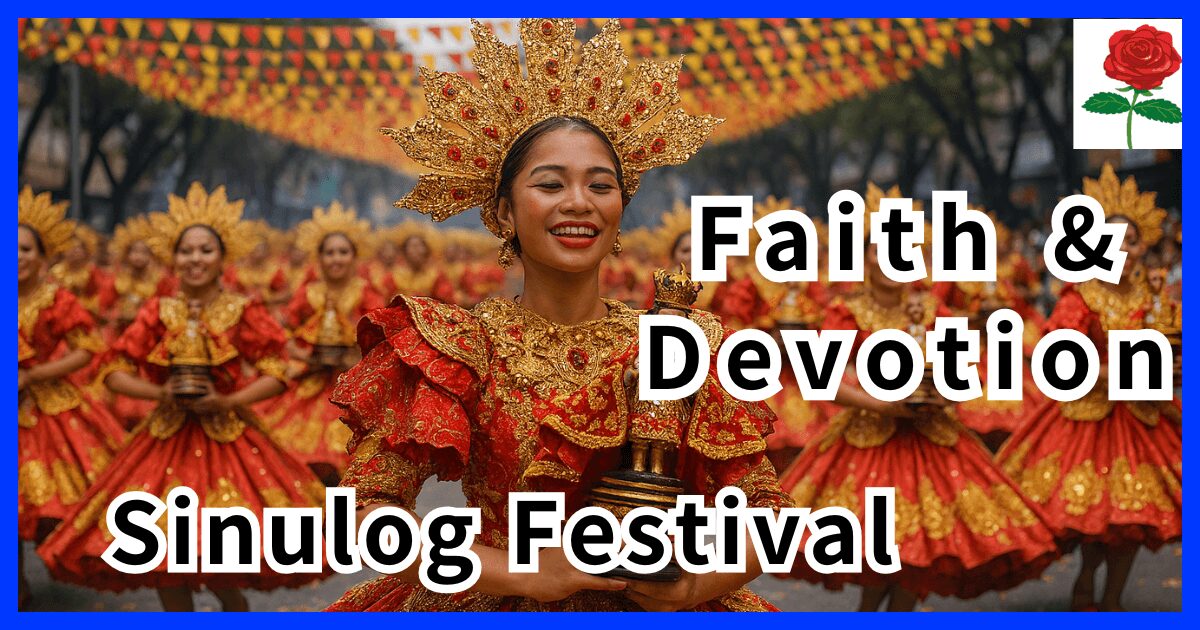
The celebration reaches its peak on the third Sunday of January, when the Grand Parade takes place. Set along Cebu City’s main streets, the parade features dancers in brilliantly colored costumes, massive floats, and powerful drum ensembles appearing one after another. Each participating group presents a performance inspired by devotion to the Santo Niño or by episodes from Cebu’s history, turning the dance itself into an act of offering.
What is especially noteworthy is that no matter how elaborate the staging may be, the image of the Santo Niño always remains at the center. Dancers hold the image in their arms, lift it high, or press it close to their chests as they move. Their actions convey a clear intention: they are dancing not to put on a show, but to offer their devotion.
At the same time, music events and rows of food stalls fill different parts of the city, adding to the festive atmosphere. This seamless coexistence of religious devotion and celebration is one of Sinulog’s greatest appeals. Anchored in faith while serving as a space for shared joy, the festival continues to draw participants from all generations and walks of life.
Modern Sinulog: Between Tourism and Faith
As times have changed, the Sinulog Festival has gradually evolved as well. What was once a deeply religious celebration centered mainly on local devotees has grown into an international event that attracts large numbers of visitors from both within the Philippines and abroad. In some years, the number of people who gather for the festival far exceeds the population of Cebu City itself, and its economic impact and influence on the city are significant.
With this growth, concerns have often been raised that the festival’s religious essence might be diluted by commercialization. In reality, however, many participants and local residents continue to hold firmly to the belief that Sinulog is, above all, an act of prayer. Behind the dazzling performances of the Grand Parade, there is a constant presence of people quietly offering prayers at the Basilica of the Santo Niño.
In recent years, efforts to preserve traditional dances and costumes have existed alongside attempts to incorporate more contemporary forms of expression. While new elements have been added to music and choreography, the core purpose—offering devotion to the Santo Niño—has never changed. It is precisely this adaptability that has allowed Sinulog to remain vibrant across generations.
Sinulog can take on an especially profound meaning in the aftermath of natural disasters or periods of social hardship. When the festival is held after such trials, expressions of gratitude for survival and hopes for renewal become more strongly pronounced. Within the rhythms of the drums and the movements of the dance, one can sense not only joy, but also the urgency and sincerity of prayer.
Today’s Sinulog continues to evolve while carrying both identities: a major tourist attraction and a deeply rooted religious celebration. It is within this balance that the resilience of Philippine society and the depth of its faith traditions are most clearly revealed.
A Visitor’s Guide to Experiencing Sinulog
To fully experience the Sinulog Festival, there are several key points to keep in mind. The main celebration is usually held on the third Sunday of January. However, as mentioned earlier, Sinulog does not begin and end on that single day. Novenas—nine days of prayer—as well as related events start more than a week in advance, so planning a stay with some flexibility is ideal.
One of the highlights for visitors is the Grand Parade, which winds its way through the streets of Cebu City. Along the main roads, spectators can watch the dancers up close and feel the power of the drumbeats and chants resonate throughout their bodies. Because the crowds can be overwhelming on the day of the parade, securing a viewing spot early is essential. Traffic restrictions are widespread, so planning to get around on foot will make the experience much smoother.
When it comes to clothing, comfort and protection from the heat should be top priorities. Even in January, Cebu’s climate is hot and humid. Light clothing, a hat, and plenty of drinking water are strongly recommended for long hours outdoors. At the same time, when visiting religious sites such as the Basilica of the Santo Niño, it is important to dress modestly and avoid overly revealing attire as a sign of respect.
Above all, visitors should remember that Sinulog is a religious observance. Photography and sightseeing are welcome, but care should be taken not to disturb those who are praying. Understanding the faith that underlies the dances and processions will deepen your appreciation of the festival and make the experience far more meaningful.
Conclusion
The Sinulog Festival is often described as a vibrant and colorful celebration, marked by the powerful sound of drums and dazzling costumes. Yet its true essence goes far beyond surface-level spectacle. At its core, Sinulog is a gathering of memory and prayer—an expression of devotion to the Santo Niño that reflects more than five centuries of lived history.
The rhythm of the dance—two steps forward and one step back—symbolizes the history of the Philippines itself. Faced with repeated trials such as colonial rule, war, and natural disasters, the people have continued to move forward, supported by their faith. Through Sinulog, this journey is expressed through the body and passed down from one generation to the next.
In the modern era, Sinulog has increasingly taken on the role of a major tourist event. Even so, its strength lies in the fact that the heart of the festival—faith—remains intact. Whether dancing, praying, or simply observing, people come together around the Santo Niño, and in those moments, a genuine sense of unity emerges.
If you ever have the opportunity to visit Cebu, experiencing the Sinulog Festival is highly recommended. In the echo of the drums and in each movement of the dance, you will feel the soul of the Philippines and the quiet yet unwavering faith of its people, alive and enduring.
Career advancement
2026年1月18日。
January 18, 2026.
本日は、フィリピン最大の宗教祭典、シヌログ・フェスティバルについてお伝えします。
Today, we’ll be reporting on the Sinulog Festival, the Philippines’ largest religious festival.
赤と金の衣装をまとったダンサーたちが、太鼓のリズムに合わせて通りを埋め尽くします。
Dancers in red and gold outfits fill the streets to the rhythm of drums.
彼らは幼子イエスを象徴するサント・ニーニョ像を抱きしめながら踊ります。
They dance while embracing statues of the Santo Niño, symbolizing the infant Jesus.
この祭典は、16世紀にマゼランによってセブ島にもたらされたサント・ニーニョへの信仰から始まりました。
This festival originated from the belief in the Santo Niño, brought to Cebu by Magellan in the 16th century.
「二歩進んで一歩下がる」という独特のシヌログの踊りは、フィリピンの人々の苦難と希望の歴史を表しています。
The unique Sinulog dance, which involves “two steps forward and one step back,” represents the history of the Filipino people’s struggles and hopes.
想像してみてください。
Imagine that:
何十万人もの人々が、祈りと感謝の気持ちを胸に、一斉に地面を踏み鳴らします。
Hundreds of thousands of people stomping their feet in unison, filled with prayer and gratitude.
これは単なるお祭りではありません。
This is more than just a festival.
信仰、文化、そして生き抜く力を祝う、フィリピン人の魂の鼓動なのです。
It’s the heartbeat of the Filipino soul, celebrating faith, culture, and resilience.
自分らしいスローライフをお楽しみください。
Enjoy your own slow life.
朝食に感謝。
Thank you for breakfast.
皆様のご支援と評価、宜しくお願い致します。
I appreciate your support and appreciation.