[Japanese page]
[Previous article]
[Next article]
Information about this article
1. About the Anichi Fair at Kōtaijingū Shrine
The Anichi Fair at Kōtaijingū Shrine is a traditional fair held in Obuse Town, Nagano Prefecture, during Koshōgatsu (the Little New Year, mid-January). It is an event where local residents pray for good health and family safety throughout the year, and it has long been cherished as a symbolic closing event of Japan’s New Year celebrations.
2. Origins and Meaning of the Anichi Fair
The Anichi Fair is a traditional event in which people receive New Year decorations and auspicious items to purify misfortune from the previous year and welcome good fortune for the year ahead. Because it is held during the Little New Year, the festival is also closely connected to beliefs surrounding agriculture and the stability of everyday life.
3. Atmosphere of the Fair and Local Community Culture
The shrine grounds are lined with stalls selling lucky charms and traditional goods, creating a simple, warm, and welcoming atmosphere filled with families and local residents. Visitors can also experience local Little New Year traditions firsthand, highlighting the fair’s role as a community-centered cultural event.
Introduction
Obuse Town, located in the northeastern part of Nagano Prefecture, is renowned nationwide as the “Town of Chestnuts and Hokusai.” Although small, the town is rich in sophisticated culture and history, attracting many tourists throughout the year and establishing itself as a unique and charming area. However, hidden in the shadows of its glamorous tourist attractions, the town cherishes a vital traditional event that has deep roots in the lives of its residents and has been quietly passed down through generations. This is the An’ichi Market, held annually during the period of Koshōgatsu (Little New Year).
The An’ichi is not an event conceived merely for tourism; it has continued as a deeply spiritual fair—a prayer-focused ennichi (temple or shrine festival day)—that honors Koshōgatsu, a pivotal milestone in Japan’s agricultural culture. The true stars of this festival are not dazzling decorations or extravagant performances, but the sight of the people themselves: gathered in the cold winter night within the grounds of the Kōtai Shrine, purchasing lucky charms while holding quiet wishes for the new year in their hearts.
This event garners particular attention because it is counted as one of the Three Great Markets of Nagano Prefecture (Sandai Ichi). Standing alongside Matsumoto City’s “Ame-Ichi” (Candy Market) and Ueda City’s “Yōkadō Ennichi,” Obuse’s An’ichi is an indispensable, important tradition when discussing the history and culture of Nagano. In a region where commerce and agriculture have long thrived, these “markets” transcended the simple function of exchanging goods; they became the spiritual pillars supporting the local populace.
The Obuse An’ichi continues to fulfill its role as a place to pray for a bountiful harvest (gokoku hōjō) and thriving business (shōbai hanjō), and as a symbol of the community’s resilience as they endure the harsh winter of Northern Shinano while awaiting spring. In this article, we will delve deeply into the historical background, the core traditional rituals, and the ties to the local culture that define the An’ichi. We aim to present the charm of “Obuse of the An’ichi“—the other face of the “Town of Chestnuts and Hokusai”—in detailed, polite Japanese. We sincerely hope that through this festival, readers can glimpse the origins of the Japanese reverence for nature and their hope for a prosperous new year.

The Cultural Climate that Nurtured An’ichi
To truly grasp the essence of the An’ichi traditional event, it is essential to understand the history and climate of Obuse Town—the land where it originated and flourished. Obuse is located on the eastern bank of the Chikuma River in the Hokushin region of Nagano Prefecture, a fertile area blessed with a mild climate.
Economic Power Fostered by Chestnut Cultivation
One cannot talk about Obuse Town without mentioning its representative local specialty: the chestnut. The history of chestnut cultivation in Obuse is ancient, with records indicating that chestnuts were being presented as gifts as far back as the Muromachi period. Entering the Edo period, Obuse Chestnuts became highly prized as offerings to the Shogun’s family due to their superior quality.
This flourishing chestnut industry provided the town with a stable economic foundation. This economic prosperity did not merely enrich daily life; it laid the groundwork for cultural development. It was this financial abundance that allowed the townspeople of the time to pursue spiritual wealth through arts, learning, and cultural exchange.
The Artistic Soil for Katsushika Hokusai
The greatest event symbolizing Obuse’s cultural maturity was its deep connection with the Ukiyo-e master of the late Edo period, Katsushika Hokusai. Hokusai was invited by Takai Kozan , a wealthy local merchant and cultural figure, and visited the town a total of four times in his life. Despite being 90 years old at the time, Hokusai stayed in Obuse and produced a collection of masterpieces that survive to this day, such as the Higashimachi Festival Float Ceiling Painting and the Kammachi Festival Float Ceiling Painting.
This proves that Obuse was not just a provincial farming village, but a place with a high cultural standard and the financial capacity to warmly welcome, engage with, and support cultural figures and intellectuals from central Japan. The stalls selling daruma dolls and other lucky charms at the An’ichi Market symbolize the economic activity of praying for business prosperity. At the same time, they represent a cultural legacy, much like the ema (votive plaques) and festival decorations painted by Hokusai, giving physical form to people’s “wishes” and “sense of beauty.”
The Tradition of the “Market” Rooted in History
The direct roots of the An’ichi are believed to lie in the Rokusai Ichi, or Six-Day Market, of the Edo period. The Rokusai Ichi was a regular market held on specific days, six times a month. Obuse Town, being a key hub for distribution in the Shinshu region, saw the early development of these “markets.”
The An’ichi takes place around January 14th and 15th, the period of Koshōgatsu (Little New Year). Koshōgatsu was an important milestone when farming households and merchants would prepare for the start of the new year. Holding a market during this time strongly implied a forecast for the year’s business, making it vital to the local economy. While one theory suggests the “An” in An’ichi refers to “affordable”, it is perhaps more natural to interpret it as the “An” of “Ando” (relief/peace of mind), representing the people’s wish for a “peaceful and secure year.”
Having maintained a vibrancy worthy of being counted among the Three Great Markets of Nagano Prefecture, the An’ichi is a confluence where the elements that Obuse has cultivated since ancient times—the “blessings of rich nature (chestnuts),” the “progressive spirit that respects culture and art (Hokusai),” and the “ethos of valuing commerce and daily life (the market)”—are carried on into the modern era.
Wishes for a Bountiful Harvest and Thriving Business
The Obuse An’ichi is not merely a regional fair. It is a place where the fundamental wishes of the local people converge during Koshōgatsu, the Little New Year, a period holding profound significance on Japan’s traditional calendar. We will now explore the core reasons why the An’ichi is counted among Nagano Prefecture’s Three Great Markets and has maintained its vibrancy over centuries.
The Significance of Koshōgatsu
When people speak of “Shōgatsu” (New Year), they typically refer to Ōshōgatsu or Big New Year, which is the period from January 1st to 7th. However, in the old lunar calendar system, Koshōgatsu (centered around January 15th) held a significance equal to, or even greater than, Ōshōgatsu.
While Ōshōgatsu was considered a “Hare” (extraordinary) day—primarily for welcoming the family deity (Toshigami-sama) and performing family rituals—Koshōgatsu was dedicated to preparing for agriculture and the start of work, and performing yoshuku (forecasting the year’s events). Many rituals performed during Koshōgatsu were forms of toshiura (annual divination), intended to anticipate and ensure a fruitful year and successful business.
The fact that the Obuse An’ichi is held to coincide with Koshōgatsu (around January 14th and 15th every year) proves that it inherits this ancient spirit of “praying for prosperity and fruition in the new year.”
The Meaning of the Kōtai Shrine Stage
The central venue for the An’ichi is the Kōtai Shrine in the heart of Obuse Town. This shrine is dedicated to Amaterasu Ōmikami, the supreme deity of Japan.
Amaterasu Ōmikami is the Sun Goddess and the ancestral deity of the Imperial Family. Crucially, since mythological times, she has also been devoutly worshiped as the deity of a bountiful harvest of the five grains. For an agricultural-based community, the blessings of the sun and abundant harvests are directly intertwined. The choice of the Kōtai Shrine as the stage for the An’ichi is not merely a matter of convenience; it holds the extremely solemn meaning of praying to the most revered deity for the abundant fruits derived from “heaven’s blessings” and the prosperity of commerce that utilizes those blessings.
Though the name “An’ichi” emphasizes the “market” (Ichi) aspect of business prosperity, the underlying spirit is the ancient Japanese ethos of a farming village like Obuse: offering gratitude and reverence to the power of nature, and praying, “May this year also be peaceful and filled with abundant blessings.”
The Role as One of the Three Great Markets
As mentioned, the Obuse An’ichi is counted as one of the Three Great Markets of Nagano Prefecture. Compared to the other two (Matsumoto City’s “Ame-Ichi” and Ueda City’s “Yōkadō Ennichi”), the An’ichi is particularly characterized by a strong fusion of “commerce” and “protection from misfortune/inviting fortune.”
Obuse An’ichi.
- Characteristics: Held during Koshōgatsu, centered on the Kōtai Shrine. Focuses on lucky charms like daruma dolls and kumade (bamboo rakes).
- Role: The first major commercial gathering of the New Year in the Northern Shinano region, and a spiritual hub for warding off evil and setting goals for the year.
While the An’ichi may not feature extravagant decorations or massive floats, it functions as a place for people to share the universal desire at the root of Japanese life: “to cherish nature’s blessings, conduct business smoothly, and pray for the safety of their households.” This is accomplished through the simple, profound acts of gathering before the deity in the severe winter cold, painting the eyes on their daruma dolls, and receiving the Otanesen (seed money charm).
Highlights of the An’ichi Market
The Obuse An’ichi Market goes beyond the mere function of a place where goods are bought and sold. It possesses a multifaceted appeal, blending traditional Shinto rituals that pray for a year of peace and safety with lively festival elements that energize the community. The main venues are the grounds and surrounding area of the Kōtai Shrine, and the plaza in front of the Obuse Town Chamber of Commerce hall.
Date and Location
The An’ichi is held over two days, annually on January 14th and 15th. This Little New Year (Koshōgatsu) period is when the winter cold in Northern Shinano is at its most severe. Defying the chill, approximately 50 stalls line the approach to the Kōtai Shrine, creating a space overflowing with vitality.
The venues are the Kōtai Shrine, located just a few minutes’ walk from the Nagano Electric Railway Obuse Station, its surrounding area, and the plaza in front of the Obuse Town Chamber of Commerce hall. Due to its easy accessibility, the market attracts not only local residents but also many worshippers from distant areas, its bustle befitting its status as one of the Three Great Markets of Nagano.
Traditional Rituals Giving Form to Prayers
The greatest charm of the An’ichi lies in the solemn and powerful traditional rites and ceremonies held within the Kōtai Shrine grounds. These rituals serve to tangibly manifest wishes for a bountiful harvest, thriving business, and protection from misfortune (warding off evil).
The Fire Walking Ceremony (Afternoon of the 15th)
The climax of the An’ichi is arguably the Fire Walking Ceremony (Hiwatari no Shinji), held on the afternoon of the 15th.
Performed by ascetic practitioners of the Shugendō tradition, this ceremony is extremely dramatic, involving walking barefoot across burning flames. The purpose is to cleanse the mind and body of impurities, cut off calamities, and pray for good health and protection from illness throughout the year.
Spectators believe that walking across the ashes of the burnt gomagi (votive sticks) will purify them. The flames rising in the bitter cold and the fervent sincerity of the practitioners evoke strong emotion and bestow powerful vitality for the New Year upon all visitors.
The Thousand-Bundle Goma Fire Ritual (Afternoon of the 15th)
Immediately preceding the Fire Walking Ceremony is the Senda-daki Gomagyō (Thousand-Bundle Goma Fire Ritual). This is a ritual where gomagi containing people’s wishes are burned alongside a large pile of stacked firewood, sending those wishes up to the Buddhist deities and Shinto kami on the smoke and flames.
Preparation for this rite, known as the “Senda-daki Wood Stacking,” also takes place on the preceding day, the 14th, confirming this ritual as an essential element of the An’ichi. The sight of the massive amount of wood being burned is powerful, and the smoke, laden with the heartfelt wishes of the people, rises into the winter sky.
The Daruma Doll Burning Ceremony (Evening of the 14th)
Held on the evening of the 14th, the Daruma Doll Burning Ceremony is a ritual to express gratitude to old daruma dolls and lucky charms, returning them to the heavens in a cleansing flame. Many people visit the Kōtai Shrine to offer the daruma dolls that watched over their household safety and business prosperity throughout the previous year.
This cycle of returning old daruma and purchasing new ones clearly signifies “the end and the beginning,” encouraging people to renew their resolutions for the New Year.
The O-neri Procession and Chigo Parade (Afternoon of the 15th)
On the 15th, an O-neri Procession and a Chigo Parade march through Obuse Town. This is a colorful event praying for the prosperity of the region and the healthy growth of the children. The sight of the charming children parading in traditional robes further enhances the festive mood, bringing joy and comfort to onlookers.
Lucky Charms Lining the Shrine Grounds
One of the main features of the An’ichi is undoubtedly the line of stalls selling lucky charms, primarily centered around the “Daruma Market,” which densely packs the shrine approach.
The Fortune-Calling “Daruma” and “Kumade”
The daruma doll is a lucky charm symbolizing the spirit of “seven falls, eight rises”, and it is especially sought after with wishes for thriving business and good fortune. People earnestly choose a daruma whose “face” they wish to entrust with the new year. Furthermore, the Kumade (decorative bamboo rake), which carries the meaning of “raking in good fortune,” is an essential charm for merchants and householders alike. These items are not mere decorations; they are carefully selected and taken home as “symbolic objects” embodying the goals and wishes for the year ahead.
Traditional Lucky Candies and Seed Money Charms
- Fuku-Ame (Lucky Candies): At the An’ichi, fuku-ame (candies wishing for health and happiness) are also sold. They are particularly popular as souvenirs for children and families, their sweetness bringing warmth to the cold winter fair.
- Otanesen (Seed Money Charms): At the ticket office of the Nishinomiya Shrine, the Otanesen (Seed Money) charm is distributed (limited to the first 100 people on both days, etc.). The Otanesen is a lucky charm for business prosperity and financial improvement, based on the desire to increase one’s wealth, much like planting rice seeds. This is a valuable gift unique to Obuse, embodying the An’ichi’s core wishes for “commerce” and “bounty.”
The “An’ichi Rakuza” and Local Specialties
In addition to the traditional rituals, the modern vibrancy centered around the Chamber of Commerce hall—the An’ichi Rakuza (Market Plaza)—makes the Obuse An’ichi even more appealing.
- Local Cuisine and Hospitality: In the Rakuza, the local Chamber of Commerce Youth Division takes the lead, offering generous free servings of tonjiru (pork miso soup) and bananas to warmly welcome visitors in the cold. Local eateries also set up stalls with unique slogans like “Nationally Treasured Delicious Stores”, generating excitement.
- Obuse’s Unique Local Products: Befitting “the Town of Chestnuts,” many chestnut confections and local seasonal specialties are available. For tourists, this is a valuable opportunity to encounter limited-time products and naturally experience the regional food culture.
- An’ichi Eto-fuda (Zodiac Charms): The sale of the An’ichi Eto-fuda, which have been blessed at the Jōkōji Temple, is another highlight of the Rakuza. These talismans, depicting the current year’s zodiac animal, are sought for household safety and protection from evil, serving to convey the spiritual essence of the An’ichi into the modern era.
By integrating these solemn rituals with the lively market atmosphere, the Obuse An’ichi remains a beloved “winter feature” enjoyed by many, serving both as a place of earnest prayer and public festivity.
The Market Rooted in Daily Life and Its Succession to the Future
The reason Obuse’s An’ichi has flourished for so long as one of the Three Great Markets of Nagano Prefecture is the fact that this festival is not merely a relic of the past; it continues to play a vital role in contemporary local society. For the people of Obuse, the An’ichi is an important opportunity at the start of the year to reaffirm their community bonds and draw renewed energy.
A Community-Wide Operation Centered on the Chamber of Commerce
The Obuse Town Chamber of Commerce and Industry plays the central role in hosting the An’ichi. The Chamber single-handedly manages various aspects, including attracting stall vendors, planning traffic control, handling publicity, and operating the “An’ichi Rakuza” (Market Plaza).
Promoting Economic Activity and Regional Revitalization
The An’ichi is the first major commercial event of the year, making it a crucial occasion for local merchants and agricultural sellers to kick off the New Year’s business. By actively enhancing the market’s functions, the Chamber of Commerce injects vitality into the local economy. Furthermore, the sale of local specialties and projects led by local youth (the Chamber’s Youth Division) within the An’ichi Rakuza generate new excitement within the traditional event, providing opportunities for younger generations to participate in community activities.
Harmonizing Tradition and Modernity
The charm of the Obuse An’ichi lies in its sense of balance, allowing the solemn traditional rituals at the Kōtai Shrine—such as the Fire Walking Ceremony and the Goma Fire Ritual to coexist with the entertainment elements found in the Rakuza near the Chamber of Commerce hall, like pro-wrestling events and the amusing “Ōana Tengoku” (Great Hole Heaven) fair. This harmony attracts a diverse audience, from the elderly to the young, as well as tourists, thereby enhancing the festival’s sustainability.
The “Winter Feature”
The Obuse An’ichi is a highly anticipated event that arrives during the depth of the harsh winter season.
Sharing “Heat” in the Midst of Winter
January in Northern Shinano is a period of deep snow and severe cold. In this environment, the flames from the daruma doll burning ceremony, the heat of the goma ritual, and the intensity of the Fire Walking Ceremony performed by the ascetic practitioners serve to reawaken a “warmth of the heart” for the people. By sharing this “heat,” local residents unite as a community, recharging the energy needed to overcome the cold winter.
Gentle Exchange between Residents and Tourists
Obuse Town attracts tourists all year round, but the An’ichi offers a rare opportunity for “tourists to naturally blend into the daily life of the community.”
Unlike typical sightseeing that revolves around museums or chestnut confectioneries, at the An’ichi, people gather at the same shrine, buy the same lucky charms, and enjoy the complimentary tonjiru (pork miso soup) amidst the same lively atmosphere. Here, tourists can be said to naturally participate in the “quiet prayers” of the local residents for a peaceful year. This gentle sense of unity is what shapes the approachable charm of Obuse Town.
Succession to the Next Generation
For traditional events to be connected to the future, the participation of children is indispensable. The An’ichi incorporates creative measures to ensure this involvement.
- Participation in the Chigo Procession: The Chigo procession (children dressed in traditional robes), held on the 15th, provides a valuable opportunity for children to wear traditional costumes and participate in the festival as members of the community.
- Candle Light-up: On the evening of the 14th, a “Candle Light-up” is held, where candles illuminate pictures and characters drawn by elementary school students. This allows children to feel close to the local tradition and participate in the festival while exercising their creativity. By incorporating the new sensibilities of children into the old traditions, the An’ichi maintains its freshness as it is passed down.
The An’ichi is not merely a market for selling lucky charms; it is a living stage where the small community of Obuse Town connects its historical background (Rokusai Ichi), its spiritual pillar (Kōtai Shrine), and its modern vitality (Chamber of Commerce), ensuring that the wish for a “peaceful life” is handed down to the next generation.
Conclusion
The An’ichi Market , held annually in Obuse Town, Nagano Prefecture, during the Little New Year (Koshōgatsu) is a deeply rooted tradition that prays for a bountiful harvest (Gokoku Hōjō) and thriving business (Shōbai Hanjo). Throughout this report, we have multi-dimensionally examined the essence of this festival, which quietly but powerfully thrives behind the town’s main tourist attractions: the chestnuts and Katsushika Hokusai.
Quiet Wishes
The Obuse An’ichi sets itself apart from modern tourist festivals that attract crowds with lavish decorations and large-scale parades. At the heart of this market are the ancient and solemn Shinto rituals held at the Kōtai Shrine (dedicated to Amaterasu Ōmikami), such as the Fire Walking Ceremony and the Thousand-Bundle Goma Fire Ritual.
At the start of the year, people do not simply engage in consumption; they entrust their lucky charms, like daruma dolls and kumade (bamboo rakes), with the quiet wish to “spend the new year peacefully.” This “quiet wish” is the very source of the spiritual strength that makes the An’ichi one of the Three Great Markets of Nagano.
An Extension of Daily Life
Obuse Town flourished from the Edo period onward through chestnut cultivation, developing a rich environment that welcomed cultural figures like Takai Kozan and Katsushika Hokusai. Throughout its history, the An’ichi has functioned as a “special day that is an extension of daily life,” where the community’s economic activities (Rokusai Ichi or Six-Day Market) and spiritual milestones (Koshōgatsu) intersect once a year.
The operation centered on the Chamber of Commerce, along with the participation of local children in the “Candle Light-up” and the “Chigo Procession,” demonstrates that this festival is not merely a historical reenactment. It is a living culture through which the contemporary community connects its wishes to the future.
The Place Connecting Nature and Life
People gathering at the An’ichi share the warmth of the fire, the generosity of the complimentary food, and the joy of selecting lucky charms amidst the severe winter cold. In a modern society where the connections between people, nature’s blessings, and daily life are often tenuous, this act serves to reaffirm those crucial bonds.
To truly know the Obuse An’ichi is to go beyond the brand of “Chestnuts and Hokusai” and touch the deep well of “spiritual richness” that this town possesses. Returning to the Japanese ancient origins of gratitude and hope at the beginning of a new year—is this not the most valuable message that the Obuse An’ichi conveys to us?
Career advancement
2026年1月14日15日。
January 14th and 15th, 2026.
この日は、長野県小布施町に伝わる伝統行事「安市」が開催されます。
This date falls during the traditional “Anichi” market in Obuse Town, Nagano Prefecture.
想像してみてください。
Imagine this:
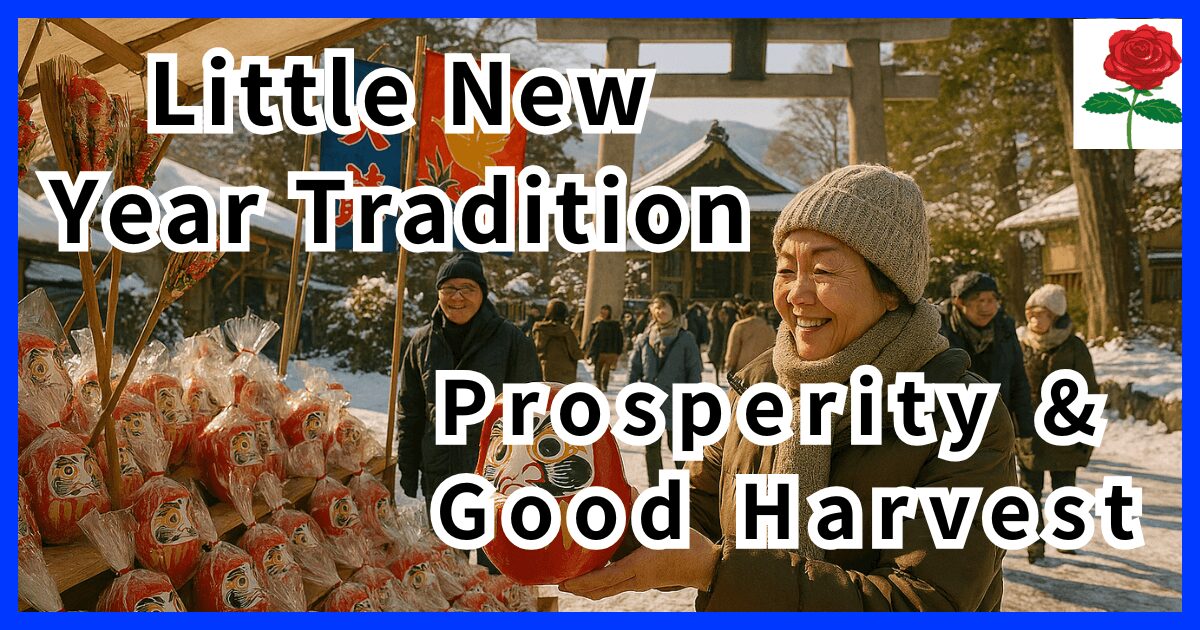
澄み切った冬の空気の中、境内にだるまや熊手が並ぶ光景。
Daruma dolls and rakes lined up in the temple grounds in the crisp winter air.
人々の願いと笑顔が、静かな町を一気に活気づけます。
The wishes and smiles of the people instantly awaken the quiet town.
小布施町の安市は、小正月に皇大神社周辺で行われる伝統行事で、五穀豊穣と商売繁盛を祈願します。
Obuse Town’s “Anichi” market is a traditional event held around Kotai Shrine during the Little New Year, to pray for bountiful harvests and prosperous business.
この祭りの真髄は、華やかな演出ではなく、人々の祈りそのものです。
The true essence of this festival lies not in the flashy performances, but in the people’s “prayer” itself.
人々は天照大御神を祀る皇大神社に手を合わせ、新年の五穀豊穣と商売繁盛を祈ります。
People join their hands at Kotai Shrine, dedicated to Amaterasu Omikami, and pray for bountiful harvests and prosperous business in the new year.
この日本らしい時間は、今も静かに息づいています。
This quintessentially Japanese moment still lives on today.
境内には縁起物や地元の特産品が並び、小布施名物の栗菓子の甘い香りが漂います。
Auspicious items and local specialties are lined up in the temple grounds, and the sweet aroma of Obuse’s famous chestnut sweets wafts through the air.
観光客だけでなく、地元の人々にとっても、年の始まりを肌で感じる一日です。
It’s a day when locals, and tourists alike, can really feel the start of the new year.
ぜひ想像してみてください。
Just imagine it.
雪化粧の街並みの中、だるまを手に笑顔を浮かべる人々の姿。
Smiling people holding daruma dolls in their hands amidst snow-covered streets.
伝統は守られ、未来へと受け継がれていきます。
Traditions are preserved and passed on to the future.
小布施の安市は、そのことを静かに教えてくれるお祭りです。
Obuse’s Yasuichi festival quietly teaches us this lesson.
自分らしいスローライフをお楽しみください。
Enjoy a slow life that suits you.
朝食に感謝。
Thanks for the breakfast.
応援と高評価、宜しくお願い致します。
I appreciate your support and likes.