[Japanese page]
[Previous article]
[Next article]
Information about this article
1. About the Nanokado Hadaka Mairi
The Nanokado Hadaka Mairi is a traditional ritual held every year on January 7 at Enzō-ji Temple in Aizuyanaizu Town, Fukushima Prefecture. It is known as one of the most distinctive winter festivals in the Aizu region, where men worship while bare-chested on a freezing winter night, creating a striking and unforgettable scene.
2. Origins and Spiritual Meaning of the Hadaka Mairi
This ritual originated as an ascetic form of worship in which participants pray for good health, family safety, and a bountiful harvest in the coming year. By enduring the severe cold during the pilgrimage, worshippers seek to purify both body and mind and gain spiritual merit, reflecting deep-rooted religious beliefs.
3. Highlights of the Festival and Local Cultural Significance
Each year, the event attracts large numbers of participants and spectators, drawn by its powerful atmosphere. For local residents, the Nanokado Hadaka Mairi is a deeply cherished annual tradition that marks the true beginning of the New Year, carefully preserved and passed down through generations.
Introduction
It is midwinter in Aizu. Snow lies deep, and the night, enveloped in a freezing silence that instantly turns breath into white mist, is shattered by the powerful drumbeats echoing through the temple valley.
In the western part of Fukushima Prefecture, nestled in abundant nature, lies Yanaizu-town in Kawanuma County. The symbol of this area, standing majestically on a cliff overlooking the Tadami River, is Fukuman Kokuzo Bosatsu Enzō-ji Temple (福満虚空蔵菩薩円蔵寺), a revered institution with approximately 1,200 years of history.
The traditional event held annually on the night of January 7th at Enzō-ji Temple is the Nanokadō Hadaka Mairi (七日堂裸詣り), or “Seven-Day Hall Naked Pilgrimage.”
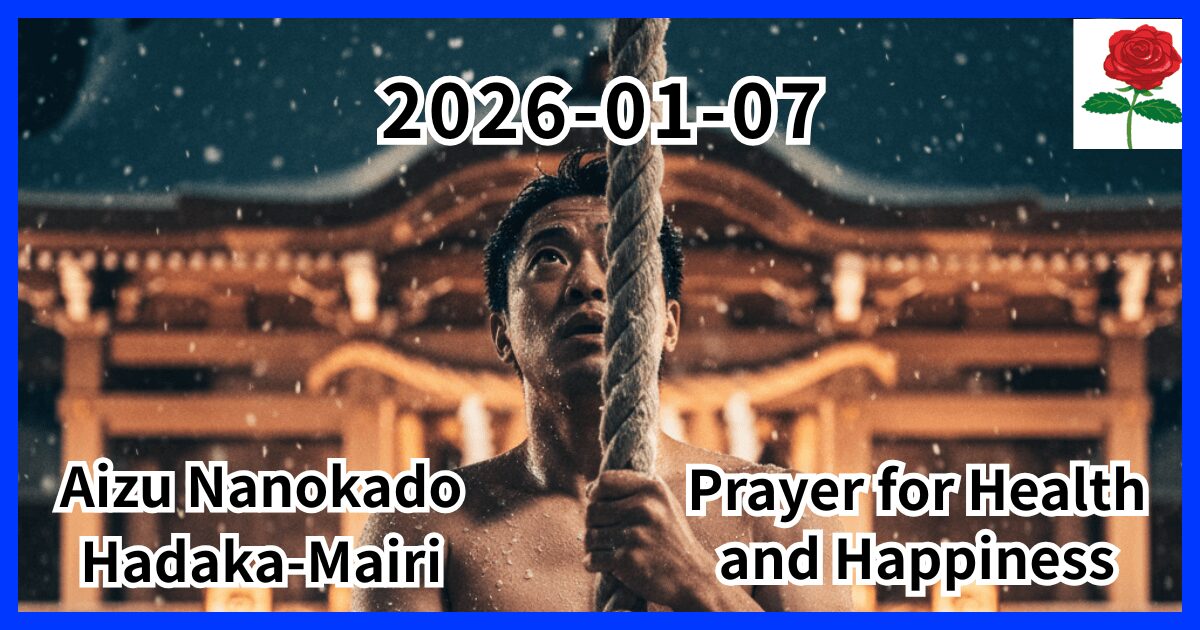
In the biting cold, with temperatures plummeting below freezing, men clad only in loincloths (fundoshi) climb up a thick hemp rope suspended from the main hall’s ceiling, without the aid of safety harnesses. This is far from mere revelry; it is a solemn ascetic practice and a kind of “Ritual of Determination.”
The mountain temple illuminated in the darkness, the tense rhythm of the drums, and the rough breaths of the men scaling the rope, challenging their own limits with every upward step. The sight leaves observers with a strong impression, inspiring deep reverence and awe.
Why is it necessary to offer prayers in such an extremely arduous way? And what are the meaning and origin behind this event, often referred to as a “Bizarre Festival” (Kisai)?
In this article, I will delve into the Nanokadō Hadaka Mairi, showing that it is not simply a brave spectacle, but a special “Prayer Ritual” deeply intertwined with the spiritual culture of snowy Aizu and the approximately 1,200-year-old faith of Enzō-ji Temple.
By reading this article, the following points will become clear:
- The basic information about the Nanokadō Hadaka Mairi and why it is called a “Bizarre Festival.”
- The history of Enzō-ji Temple and the Kokuzo Bosatsu (Akasagarbha Bodhisattva) faith that forms the background of the event.
- The deep spiritual meaning contained within the practice of climbing the rope naked in the bitter cold.
- The value of the “Resolve to Live” that this event poses to us in the modern world.
Let me guide you into the world of the quiet yet powerful prayer that has been handed down through the midwinter nights of Aizu.

What is the Nanokadō Hadaka Mairi?
The Nanokadō Hadaka Mairi is a traditional event of profound significance at the beginning of the year in the Aizu region of Fukushima Prefecture. I will now delve deeply into the basic information and the essence of this ritual—what it is and why it continues to captivate so many people.
Outline of the Event
The Nanokadō Hadaka Mairi is held every year on the night of January 7th at Fukuman Kokuzo Bosatsu Enzō-ji Temple in Yanaizu-town, Kawanuma County, Fukushima Prefecture.
The purpose of the event is to pray for protection from illness throughout the year (Mubyō-sokusai), family safety, a rich harvest, and individual happiness.
However, the reason this ritual is often referred to as a “Bizarre Festival” stems from its rigorous method of execution:
- Stripping Naked in the Extreme Cold:
January 7th, when the event takes place, is one of the coldest times of the year in the Aizu region. Nighttime temperatures frequently drop below freezing, and it is not uncommon for snow to be falling. The participating men enter the main hall virtually naked, clad only in a loincloth (fundoshi), exposing themselves to the harsh cold.
- Climbing a Hemp Rope Without Safety Gear:
The climax of the Hadaka Mairi is the ascetic practice of scaling a thick hemp rope that hangs down from the main hall’s ceiling beam. This rope reaches up to the temple’s great Waniguchi (Ōwaniguchi, a large bell). Participants challenge themselves to climb the rope using only their own strength, without any safety ropes whatsoever.
The act of climbing to a great height while naked and without safety gear is extremely dangerous, and impossible to achieve without immense courage and strong faith. This severity is the main reason the event is recognized as a “Bizarre Festival” or a “Naked Ascetic Practice.”
Name and Origin of the Event
The name “Nanokadō Hadaka Mairi” (Seven-Day Hall Naked Pilgrimage) comes from the fact that the ritual is held on the seventh day of the New Year (Shōgatsu Nanoka). Enzō-ji Temple has positioned January 7th as an especially important day known as “Nanokadō Mairi.”
While there are various theories regarding the specific origin of this event, it is deeply connected to the founding of Enzō-ji Temple and is believed to have a history spanning at least several centuries. Enzō-ji is said to have been founded in the early Heian period by Tokuitsu Sōzu, one of the ten great disciples of Kōbō Daishi (Kūkai). The Hadaka Mairi, held at this sacred site of the Kokuzo Bosatsu faith, thus possesses a strong Buddhist background aimed at attaining enlightenment and wisdom through severe ascetic practices.
References to the “Aizu-Yanaizu Nanokadō Hadaka Mairi” state that it is a “traditional event, held for approximately 1,200 years, where people pray to Fukuman Kokuzo Bosatsu for a year of health and well-being, climbing a hemp rope naked in the bitter cold of midwinter.” The figure “approximately 1,200 years” closely matches the founding period of Enzō-ji Temple, suggesting that this tradition has been carried down as one with the temple’s history.
Not Mere Festivity, but a “Prayer Ritual”
Although the Nanokadō Hadaka Mairi takes place in the presence of tourists, its essence is not that of a “festival,” but rather a “Prayer Ritual” or an “Ascetic Practice based on Faith.”
By enduring the cold and risking danger to climb the hemp rope, participants confront their own physical and spiritual weaknesses head-on. Overcoming this hardship in itself serves as a declaration of resolve to ward off the year’s bad luck and welcome the new year with a pure heart.
In summary, the Nanokadō Hadaka Mairi can be described as a solemn initiation ritual for the New Year, nurtured by Aizu’s severe climate, in which individuals overcome their weaknesses and make a vow to the deities and Buddhas. The unwavering power of faith, which Enzō-ji Temple has long preserved, lies behind this valiant event.
The History and Faith of Enzō-ji Temple
To truly grasp the essence of the Nanokadō Hadaka Mairi, it is essential to understand the history and the faith surrounding the temple that serves as its stage: Fukuman Kokuzo Bosatsu Enzō-ji Temple. The approximately 1,200-year journey of Enzō-ji is synonymous with the history of faith in the Aizu region itself, and it is the very source of the ascetic practice known as the Naked Pilgrimage.
Founding and First Abbot: The Footprints of Tokuitsu Sōzu
Enzō-ji Temple is said to have been founded in the early Heian period, around 807 AD (Daidō 2). The founder was the eminent monk, Tokuitsu Sōzu. Tokuitsu studied at Kōfuku-ji in Nara and subsequently dedicated himself to spreading Buddhism, primarily in the Aizu region and across Tohoku. He is also known for engaging in debates with celebrated figures of the time, such as Kūkai (Kōbō Daishi) and Saichō.
The following legend surrounds the circumstances of Enzō-ji’s founding by Tokuitsu:
While Tokuitsu was traveling throughout the country, he stopped in the Tadami River valley in the area of Yanaizu-town. There, he received a spiritual vision and discovered a sacred glowing log on the riverbank. Tokuitsu is said to have carved an image of the Kokuzo Bosatsu (Akasagarbha Bodhisattva) from this log and enshrined it, marking the beginning of Enzō-ji Temple. Due to the great achievements of Tokuitsu Sōzu, Enzō-ji has been revered as one of the leading sacred sites in Tohoku since ancient times.
The Principal Image: The Kokuzo Bosatsu Faith Governing Wisdom and Fortune
At the core of Enzō-ji Temple’s faith lies its principal image, the Kokuzo Bosatsu. This is one of the most important Bodhisattvas in Buddhism, widely worshipped as the deity who presides over “wisdom, good fortune, and memory.”
- Meaning of “Kokuzo”: The name “Kokuzo Bosatsu” translates to “Akasagarbha,” meaning “Storehouse of the Void (Space),” signifying that the Bodhisattva accumulates infinite wisdom and compassion, like the vastness of the universe. This Bodhisattva is believed to bestow upon people inexhaustible merits and wealth.
- The Name “Fukuman”: As the temple’s formal name is “Fukuman Kokuzo Bosatsu” (Kokuzo Bosatsu of Abundant Fortune), special emphasis is placed on the merit of granting “fortune” (Fuku) and “good luck” (Fukutoku). The prayer for “protection from illness and happiness for the year” performed during the Naked Pilgrimage is directly connected to these teachings of the Kokuzo Bosatsu.
- The Thirteen Buddhas: Kokuzo Bosatsu is also one of the “Thirteen Buddhas” who preside over rites for the deceased, and is especially known as the guardian deity for those born in the Year of the Ox (Ushi) and the Year of the Tiger (Tora).
For the participants in the Naked Pilgrimage, enduring the extreme cold and successfully climbing the hemp rope is a concrete action taken to overcome their own foolishness and worldly desires, thereby attaining the pure wisdom and good fortune bestowed by the Kokuzo Bosatsu.
Geographical Features: The ‘Kakezukuri’ Main Hall and the Tadami River
Enzō-ji’s geographical location further enhances the solemnity of the faith and the heroic nature of the Naked Pilgrimage.
The temple is constructed on a sheer cliff overlooking the deep gorge carved by the Tadami River. The Main Hall employs the “Kakezukuri” (suspended) architectural style, similar to Kyoto’s Kiyomizu-dera Temple, where pillars are assembled to support the building over the edge of the cliff.
The interior of this suspended Main Hall, where the Naked Pilgrimage takes place, is situated high above the Tadami River. The cold air of the winter night completely envelops the temple. The severity of the location and the grandeur of nature serve to reaffirm how small human endeavors are, solidifying the participants’ resolve for the ascetic practice.
Furthermore, it is said that the hemp rope hanging from the main hall is cut off after the participants finish climbing, and a portion taken home will bring good luck against evil spirits and fires. This demonstrates a facet of Aizu’s folk beliefs, incorporating the power of faith into daily life.
The Symbol of Aizu: The Legend of the Akabeko
Enzō-ji is also famous as the birthplace of the Akabeko (Red Cow), a local folk toy of the Aizu region beloved as a charm against evil.
According to legend, the main hall of Enzō-ji was destroyed by a massive earthquake in the Aizu region about 400 years ago during the Keichō era (1596–1615). During the reconstruction of the hall, a herd of red cattle (Beko is the Aizu dialect word for cow) suddenly appeared, helping to transport materials and supporting the difficult construction. When the work was completed, the cattle vanished, but one cow that stayed until the very end, working until it collapsed from exhaustion, was enshrined beside the Buddha statue—which is said to be the origin of the toy.
The Akabeko has been cherished by the people of Aizu as the “Cow that Carries Fortune” and a “Talisman to Ward Off Epidemics.” The narrative of faith, such as “salvation by a power beyond human knowledge” and “the spirit to overcome hardship,” passed down through Enzō-ji, is deeply rooted in the background of the Nanokadō Hadaka Mairi.
It is the weight of Enzō-ji’s history, the teachings of the Kokuzo Bosatsu, and the local devotion symbolized by the Akabeko legend that have served as the foundation supporting the rigorous ascetic practice of the Nanokadō Hadaka Mairi to this day.
Why “Naked” and “Without a Safety Harness”?
The question that most astonishes and puzzles people witnessing the Nanokadō Hadaka Mairi is: “Why strip naked in sub-zero temperatures in midwinter?” and “Why climb a dangerous hemp rope without a safety harness?” This seemingly harsh and reckless behavior precisely symbolizes the deep religious and spiritual meaning embedded within this ritual.
What “Nakedness” Signifies: Purity and Determination
The act of stripping naked is not merely a display of resilience to the cold. In a religious context, nakedness signifies “purity,” “innocence,” and “a state free from defilement.”
As people navigate daily life, they inadvertently accumulate various forms of spiritual “dirt”—desires, worldly passions, and distractions. Becoming naked symbolizes shedding all the defilement of the past year, returning to a pure, newborn state.
Furthermore, being naked on a severely cold night is an ascetic practice that forces participants to confront their own weakness of will and physical limits head-on.
- Confronting the Cold: Exposing oneself naked to sub-zero temperatures involves physical pain. Enduring this pain is an act of training to cut off one’s own desires and worldly passions, serving as a process to attain a pure state of mind.
- Visualization of Resolve: The sight of the men overcoming the cold and heading towards the main hall is a visible manifestation of their “strong determination” for the new year. They physically demonstrate their vow to the deities and Buddhas: “I will never yield to the hardships and difficulties that the coming year may bring.”
In essence, “nakedness” in the Nanokadō Hadaka Mairi carries an extremely profound spiritual meaning: “purging defilement, cleansing the heart, and strengthening one’s resolve to live through the new year.” This echoes the opening statement: “Exposing oneself to the cold is not a punishment. It is a ritual of determination to fulfill one’s wishes.”
The Hemp Rope and the Great Waniguchi: Overcoming Obstacles to Fulfill Wishes
The core action of the Naked Pilgrimage—”climbing the hemp rope”—is also rich with symbolic meaning.
- The Hemp Rope (Overcoming Worldly Passions): The thick hemp rope the participants climb is interpreted as a symbol of the difficulties that humans must overcome, or the worldly passions (bonnō) that cling to the heart. Climbing the slippery rope vertically without a safety line literally embodies the message that challenges must be overcome through self-reliance.
- The Resolve of No Safety Line: Refusing to use a safety harness demonstrates a powerful resolve to “cut off all paths of retreat.” This dangerous act reflects the independent spirit cherished by the people of Aizu since ancient times—the spirit of “achieving things through one’s own strength.” Failure is not an option; they must push relentlessly upward toward the fulfillment of their wishes.
- The Waniguchi Bell (Fulfillment of Wishes): Only those who successfully complete the climb can touch the bell attached to the Great Waniguchi (Ōwaniguchi), which hangs from the main hall’s ceiling beam. The act of touching the Waniguchi and ringing the bell signifies that “the wish has reached the deities and Buddhas.” At this moment, the prayers of the men who endured the bitter cold are fulfilled, and they are said to be granted the divine favor of protection from illness.
This rope climb truly embodies the rigorous yet universal truth that “wishes can only be fulfilled by confronting one’s own weakness and possessing the strong will to overcome difficulties.”
Positioning as a Buddhist Ascetic Practice
The Nanokadō Hadaka Mairi is also deeply connected to ancient traditions of Buddhist asceticism in Japan, particularly those with elements of Shugendō (mountain asceticism).
- Water and Cold Asceticism (Suigyō and Kangyō): Japanese Buddhism includes practices like “Suigyō” (water asceticism), where practitioners enter freezing rivers or the sea in winter, and “Kangyō” (cold asceticism), performed in extreme cold, both aimed at purifying the body and mind and enhancing spiritual power. The Naked Pilgrimage is a type of Kangyō, promoting spiritual growth by willingly embracing harsh natural conditions.
- Kokūzō Gumonji Hō: Enzō-ji’s principal image, Kokuzo Bosatsu, is associated with the secret ritual known as Kokūzō Gumonji Hō, which involves rigorous practice to gain miraculous memory and wisdom. The Nanokadō Hadaka Mairi can be seen as a specific “ascetic act (gyō)” aimed at obtaining the wisdom and fortune of this Bodhisattva.
Throughout Enzō-ji’s 1,200-year history of faith, the Naked Pilgrimage has been established not merely as a local festival, but as the most pure and potent form of prayer for the people living in the deep cold of Aizu to strengthen their own spirituality and protect themselves from the calamities of the coming year.
Viewing Highlights
While the Nanokadō Hadaka Mairi is a solemn ritual, it is also a significant event that heralds the start of the year for local residents of Aizu-Yanai and worshippers from afar. Here, we explain how this traditional event proceeds and describe the scene that unfolds on-site, providing a detailed breakdown of the day and key viewing points.
The Atmosphere Just Before the Pilgrimage: Evening into Night
On January 7th, the day of the event, Enzō-ji Temple is already bustling with many worshippers from the morning. However, the true sense of tension begins to build in the afternoon, after sunset, as the bitter cold and darkness engulf Yanaizu-town.
- Preparations and Purification Rites:
Participants in the Naked Pilgrimage perform purification rites to prepare for the main event. As discussed in the previous chapter, this ritual is a vital step in deepening the meaning of “cleansing” associated with stripping naked. The participants are local residents and devoted followers, and their expressions already show a strong resolve and a palpable tension.
- Atmosphere Around the Main Hall:
Around 8:00 PM, many spectators begin to gather near the Main Hall. The Kakezukuri (suspended) Main Hall is illuminated, standing out starkly in the darkness, its imposing structure accentuated. Despite the falling snow, the spectators are bundled in thick winter clothes, but the sounds of preparation and the rhythmic beat of the drums emanating from the hall raise expectations for the passionate ritual about to begin.
The Signal of the Drums: The Start of the Ritual
The climax of the Nanokadō Hadaka Mairi typically begins around 8:30 PM.
The powerful and solemn beat of the Enzō-ji Temple drums echoing in the cold sky serves as the signal for the ritual’s commencement. The sound of the drums boosts the morale of the participants and simultaneously announces the start of the ceremony to the deities and Buddhas.
[Inside the Main Hall of Enzō-ji]
The Naked Pilgrimage takes place inside the Main Hall. Even though the outside temperature is below freezing, the hall becomes filled with a unique warmth from the crowd of participants and spectators; however, the winter cold relentlessly stings the skin of the participants.
The men, clad only in loincloths, advance into the Main Hall. The moment they enter naked, the atmosphere completely changes, charged with intense tension. At this time, the participants slap each other on the shoulders and shout loudly to ward off the cold and fear, striving to focus their minds.
The Grueling Challenge of the Hemp Rope Climb
The greatest highlight and the ascetic practice itself is the hemp rope climb.
A single, thick hemp rope hangs vertically from a very high position near the Main Hall’s ceiling beam. It is believed that if one can touch the small bell located right beneath the Great Waniguchi (the large bell) at the rope’s end, the wish for protection from illness will be granted.
- Timing and the Struggle:
There is only one rope. Therefore, participants rush towards the rope, but they don’t all attempt to climb at once. They carefully gauge the timing to grab the rope, attempting to conserve their strength.
Once they take hold of the rope, other participants follow one after another. Climbing the slippery hemp rope vertically requires tremendous physical endurance and mental fortitude, as the cold numbs their senses.
- Depiction of the Unharnessed Challenge:
What makes the spectators hold their breath is the sight of the participants climbing the rope without a safety harness, relying solely on their arm and leg strength, and their strong faith. The men on the rope are pushed upwards as if they were a single unified entity. However, those whose strength or concentration fails unfortunately slip and fall midway. The murmuring of the crowd, the reverberation of the drums, and the men’s shouts fill the main hall.
- Reaching the Ōwaniguchi:
A few men finally reach the height of the main hall’s beam, high above the onlookers. The moment they touch the Waniguchi bell and a sharp “Chirin!” rings out is the supreme moment of the Naked Pilgrimage.
This sound of the bell is not just noise. It is the proof that the year’s prayers have reached the deities and Buddhas, signifying the “fulfillment of their resolve” after enduring the bitter cold practice. The main hall erupts in cheers and applause, and the spectators, moved by the brave display, share in the fresh and determined feeling of the New Year’s beginning.
The Conclusion of the Ritual and the Merit of the Hemp Rope
Once the hemp rope climb concludes, the Naked Pilgrimage comes to an end.
- End of the Pilgrimage:
After the ceremony, the naked men quickly dress and warm themselves, their expressions filled with the sense of accomplishment and clarity that comes from successfully completing the ascetic practice.
- Distribution of the Hemp Rope:
The hemp rope used in this ritual is believed to possess merits for warding off evil and preventing fire. After the climb, it is cut into small pieces and distributed to the worshippers. By taking this rope home, people bring the divine favor of Enzō-ji’s Kokuzo Bosatsu and the “power of resolve” demonstrated by the participating men into their homes. This rope is cherished as an amulet for protection against misfortune throughout the year.
The Nanokadō Hadaka Mairi is not merely an event showcasing difficult asceticism. It is a condensation of people’s earnest wishes and the power of faith dedicated to answering them. Witnessing this spectacle on a freezing night is a precious experience that allows one to feel the history and spiritual culture of Aizu firsthand.
The Resolve to Confront One’s Own Weakness
The Nanokadō Hadaka Mairi not only embodies the faith of Enzō-ji Temple but also strongly reflects the unique spiritual culture nurtured by the history and climate of the snowy Aizu region. Examining why this event holds more meaning for the people of Aizu than just an annual fixture is crucial for understanding its essence.
The Spirituality Nurtured by Aizu’s Harsh, Snowy Climate
The Aizu region is surrounded by mountains and is particularly prone to heavy snowfall in winter. In an era before electricity or modern heating systems were widespread, life in winter was extremely difficult. Survival demanded a profound respect for nature and a persistent tenacity to overcome difficulties through self-reliance.
- Coexistence and Struggle with Nature:
In snow country, nature offers blessings but constantly imposes severe trials. Faced with the might of nature, the people of Aizu cultivated the wisdom and the resilient spirit necessary to survive the harsh environment, not just by relying on deities and Buddhas, but by training their own bodies and spirits.
- Respect for Self-Control (Kokkishin):
The “nakedness” and the “rope climb without a safety harness” in the Nanokadō Hadaka Mairi are direct symbols of this Aizu spiritual culture—the Kokkishin (the spirit to overcome one’s own desires and weaknesses). Successfully enduring the midwinter cold and completing the dangerous challenge at height requires extraordinary self-control and willpower. Through this ascetic practice, the people reaffirm the soul of Aizu: the resolve to “never be defeated by any hardship.”
The Ritual’s Message of “The Resolve to Live”
Held at the beginning of the year, the Naked Pilgrimage is a ritual where participants swear their “Resolve to Live” for the coming year before the deities and Buddhas.
- Purifying Misfortune and Cleansing the Soul:
While many purification rites exist throughout Japan to cleanse the defilement and misfortune of the previous year, the Naked Pilgrimage achieves this through the most direct method: physical and spiritual asceticism. Exposing the body to the extreme cold carries a powerful message: washing away past weaknesses and errors, and starting the new year as a “pure and new self.”
- Solidarity and Community Spirit:
The Naked Pilgrimage is a collective event as well as an individual practice. The sight of men in loincloths enduring the cold, encouraging one another, and challenging the rope reveals the solidarity of the local community. By collectively sharing the hardship and praying for good health, they strengthen the unity of the entire community and gain the power to overcome the year ahead.
Posing the Question of “Time for Reflection” to the Modern World
In today’s society, which is characterized by advanced information technology and a demand for speed and efficiency, traditional ascetic practices like the Nanokadō Hadaka Mairi pose a crucial question to us.
- “The Origin of Prayer”:
While many modern prayers tend toward ease and efficiency, the Naked Pilgrimage forces us to return to the origin of “what prayer truly is.” This ritual teaches that genuine wishes are not fulfilled with half-hearted intentions, but that “it is only by willingly embracing hardship and facing the challenge with strong willpower and resolve that one can approach their fulfillment.”
- The Value of “Time for Introspection”:
In our busy daily lives, we rarely have the time to pause and reflect on our own hearts. The tense, nighttime atmosphere of the Nanokadō Hadaka Mairi and the sight of the men undertaking the practice prompt the audience to ask themselves: “What are my own true wishes?” and “How should I live this year?”—offering a quiet time for introspection.
This event is not a festival designed for fanfare or tourist spectacle. What endures within it is a quiet yet powerful, universal truth, cherished for about 1,200 years in the deep snows of Aizu: that “human beings must constantly maintain the strength to confront adversity.”
Conclusion
We have deeply examined the meaning and origin of the Nanokadō Hadaka Mairi, the traditional event held annually on January 7th at Enzō-ji Temple in Aizu-Yanai, Fukushima Prefecture. This event, often referred to as a “Bizarre Festival,” is not merely a local gathering; it is a vital cultural heritage, condensing the history, faith, and severe climate of the Aizu region.
Reaffirming the Essence of the Nanokadō Hadaka Mairi
The essence of the Nanokadō Hadaka Mairi can be summarized in three points:
- A Solemn Prayer for Protection from Illness:
Based on the 1,200-year-old faith in the Kokuzo Bosatsu of Enzō-ji Temple, it is the purest and most potent form of prayer for happiness and health throughout the year.
- The Spirit of Self-Control Encapsulated in “Nakedness” and the “Hemp Rope”:
“Nakedness,” exposed to the bitter cold in just a loincloth, is a ritual of cleansing to purge defilement and purify the heart. The act of climbing the “hemp rope,” which hangs high from the main hall’s beam without a safety harness, symbolizes the strong spirit of self-control (Kokkishin) and the resolve to overcome one’s own weakness, worldly passions, and life’s difficulties through sheer self-reliance.
- Embodiment of Aizu’s Spiritual Culture:
It is a crucial communal rite where participants and spectators gather to reaffirm the “indomitable spirit” and the “resolve to live” nurtured by the snowy, harsh climate of Aizu.
What the Quiet, Powerful Prayer Conveys
This traditional event grants us, living in the modern world, an opportunity to pause and reflect.
In our pursuit of efficiency and convenience, we may be losing the primal sense of “willingness to endure hardship” to achieve something. However, the Nanokadō Hadaka Mairi presents the universal truth that genuinely valuable wishes and goals can be grasped not through easy methods, but only through a “Ritual of Determination” that stakes one’s own body and spirit.
The sound of the drums echoing in the dark mountain temple, and the sight of the men exposed to the cold air relentlessly pushing upward, awaken within each of our hearts the “will to cherish the new year” and the “courage to confront difficulties.”
The Soul of Aizu to be Passed Down
The Nanokadō Hadaka Mairi should not be consumed merely as photos or videos of a rare festival. It is a living culture, a condensation of the soul of the people of Aizu who have survived harsh winters over 1,200 years.
On the night of January 7th, 2026, the valiant Naked Pilgrimage will once again take place at Enzō-ji Temple, and the earnest wishes of the people will ascend into the frigid sky.
If you find yourself at a turning point in life or starting a new year requiring strong resolve, why not journey to Aizu-Yanai and experience the essence of this quiet yet powerful prayer firsthand?
Career advancement
2026年1月7日。
January 7, 2026.
今日は、福島県会津柳津市で行われる「七日堂裸詣り」をお伝えします。
Today, I’ll be reporting on the Nanakado-Hadaka-Mairi, which takes place in Aizu-Yanaizu City, Fukushima Prefecture.
真冬の夜、気温が氷点下になる中、
On a midwinter night, with temperatures dropping below freezing,
褌姿の男たちが命綱も使わずに麻縄を登っていきます。
men clad in loincloths climb hemp ropes without safety ropes.
これは、ただの祭りではありません。
This is no ordinary festival.
想像してみてください。
Imagine:
闇に包まれた山寺、鳴り響く太鼓の音、
A mountain temple shrouded in darkness, the sound of thundering drums,
そして一歩一歩、祈りを捧げながら縄を登る男たちの息遣い。
and the breathing of men praying with each step as they ascend the rope.
「七日堂裸詣り」は、会津柳津市円蔵寺で毎年1月7日の夜に行われる、伝統行事です。
The Nanakado-Hadaka-Mairi is a traditional event held every year on the evening of January 7th at Enzo-ji Temple in Aizu-Yanaizu City.
参加者は本堂の梁に張られた麻縄を登り、
Participants climb the hemp ropes stretched across the beams of the main hall and
大鰐口の鈴に触れることで、一年の無病息災を祈ります。
pray for good health and safety for the year ahead by touching the bells at the large bell-like bell-like opening.
この修行は、約1200年の歴史を持つ円蔵寺の信仰と深く結びつき、「自らの弱さと向き合い、祈りをもって一年を始める」という会津の精神文化を今に伝えています。
This training is deeply connected to the faith of Enzo-ji Temple, which has a history of approximately 1,200 years, and continues to convey the spiritual culture of Aizu, which calls for “facing one’s own weaknesses and starting the year with prayer.”
寒さに身を晒すことは、罰ではありません。
Exposing yourself to the cold is not a punishment.
願いを叶えるための決意の儀式なのです。
It is a ritual of determination to make own wish come true.
自分らしいスローライフをお楽しみください。
Enjoy your own slow life.
朝食ありがとうございました。
Thank you for breakfast.
応援と評価をお願い致します。
Please support and rate.