[Japanese page]
[Previous article]
[Next article]
Information about this article
1. About Chion-in Temple’s Joya-no-Kane (New Year’s Eve Bell Ringing)
Chion-in Temple’s Joya-no-Kane is a traditional Buddhist ceremony held on New Year’s Eve in Kyoto, using one of the largest temple bells in Japan. At the end of the year, the bell is rung 108 times to cleanse worldly desires and welcome the New Year, making it a deeply symbolic Buddhist ritual.
2. The Meaning of the 108 Bell Rings and the Role of 17 Monks
The number 108 represents the earthly desires (bonnō) believed to affect all human beings, and striking the bell is meant to purify both body and mind. A distinctive feature of this ceremony is the coordinated performance by 17 monks, who ring the massive bell together using unique movements and ritual chants.
3. Highlights and Cultural Significance
The most impressive highlights are the powerful, resonant sound of the bell and the monks’ solemn, precisely synchronized movements. Chion-in’s Joya-no-Kane is carefully preserved as a symbolic tradition representing Japan’s year-end culture and Buddhist ceremonial heritage.
Introduction
On New Year’s Eve, there is nothing that symbolizes the Japanese year-end more vividly than the slow, resonant sound of a temple bell echoing through the cold night air.
As the bustle of the city fades and the lights in homes grow calm and subdued, a deep gong can be heard from somewhere in the distance.
Its reverberation feels less like a time signal or a religious ritual, and more like a gentle cue that the year is drawing to a close and that it is time to prepare ourselves for the one about to begin.
The “Joya no kane”, or New Year’s Eve bell, is an annual Buddhist tradition in Japan in which temple bells are struck from late on New Year’s Eve until the first moments of New Year’s Day.
Many temples strike the bell 108 times, a number widely known to symbolize the various earthly desires and attachments—bonnō—that cloud the human heart.
Listening to the bell encourages people to reflect on the past year, let go of lingering worries or attachments, and welcome the new year with a purified and refreshed state of mind.
This sensibility lies at the heart of the tradition.
The custom is not merely a seasonal event but a cultural practice shaped over centuries.
It is believed to have originated in Zen temples of China’s Song dynasty before being introduced to Japan, where it spread among Zen monasteries from the Kamakura period onward.
By the Muromachi period, it had become an essential part of New Year’s Eve, and during the Edo period it took firm root in the daily lives of ordinary people.
Understanding this historical background reveals that the “Joya no kane” is far more than a simple “year-end sound”—it is a refined expression of spiritual culture shaped over a long span of time.
The bell also has the power to bring quiet comfort to those who hear it.
In the stillness of a temple at night, the deep resonance of the bell gently stirs the emotions and memories within us, far removed from the noise of everyday life.
Each time the sound vibrates through the air, moments from the past year rise to the surface—gratitude, regrets, and hopes for the coming year naturally well up in the heart.
In this article, we will explore the history, meaning, and customs of the “Joya no kane”, as well as the grand bell-ringing tradition at Chion-in Temple in Kyoto.
Chion-in, the head temple of the Jōdo (Pure Land) school of Buddhism, is renowned nationwide for its massive temple bell and the powerful, coordinated effort required to ring it.
Behind this tradition lies the teaching of Hōnen, the founder of the Jōdo school, whose spiritual legacy continues to shape the temple’s practices today.
The “Joya no kane” is not simply a sound marking the transition from one year to the next.
It is a spiritual ritual that helps us recognize the turning of the year, settle our hearts, and step forward into the future with clarity.
By listening to the bell, we are invited to face ourselves and quietly prepare for the first steps of a new year.

Key Points: History and Origins.
The “Joya no kane”, or New Year’s Eve bell, is widely recognized as one of the most iconic year-end traditions in Japanese Buddhism.
The custom of striking a temple bell at midnight on New Year’s Eve to prepare for the coming year is a spiritual practice that has been cultivated over many centuries.
Today, it is performed at temples throughout Japan, but its origins are not uniquely Japanese; they are believed to trace back to the Song dynasty in China.
In Zen temples of the Song period, it was customary to ring a bell at the turn of the year to ward off evil spirits.
It was said that the bell was rung particularly to dispel negative forces thought to enter from the northeast, a direction traditionally considered inauspicious.
This practice was introduced to Japan during the Kamakura period, when Zen Buddhism was spreading and the daily ringing of bells—morning and evening—became established in temple life.
The Kamakura period was also a time of active cultural exchange with the Song dynasty.
Zen monks traveled to Japan and founded temples such as Kenchō-ji and Engaku-ji, bringing with them many aspects of Song culture and thought.
The practice of ringing bells was one of these influences, and at first it served primarily as a way to mark the time of day.
Over time, however, the sound of the bell came to carry meanings beyond a simple time signal.
By the Muromachi period, striking the bell on New Year’s Eve had taken on special significance, forming the basis of what is now known as the “Joya no Kane”.
During this era, the idea of purifying oneself of worldly desires at the end of the year and welcoming the new year with a clear and peaceful mind became widespread.
The bell thus became firmly established as an important ritual marking the transition from one year to the next.
In the Edo period, the “Joya no kane” became deeply rooted in the daily lives of ordinary people.
Temples served as central institutions within local communities, and the ringing of the bell at year’s end offered people a meaningful opportunity to reflect on the past year and settle their hearts.
It is said that in the city of Edo, the sound of bells ringing from many directions filled the night, becoming a beloved symbol of the New Year’s Eve landscape.
The tradition spread nationwide in the early Shōwa era, largely thanks to radio broadcasts.
When NHK began airing live coverage of the “Joya no kane” on its New Year’s Eve program Yuku Toshi Kuru Toshi, the sound reached households across the country.
Even those unable to visit a temple came to regard the bell as a symbol of the year’s end.
The broadcast continues today, helping to share and preserve the cultural significance of the tradition.
Different Buddhist schools hold varying views on the “Joya no kane”, which adds another layer of interest.
Because the custom originated in Zen Buddhism, Zen temples have long observed it.
However, in Jōdo Shinshū (True Pure Land Buddhism), the idea of “dispelling worldly desires” does not align with its doctrinal teachings, and some temples do not perform the ritual.
For example, Higashi Hongan-ji and Nishi Hongan-ji do not ring the bell on New Year’s Eve, instead using the bell only for memorial services or prayers for peace.
These differences show the cultural diversity within Japanese Buddhism and how the meaning of the ritual varies among traditions.
Ultimately, the “Joya no kane” is far more than a simple year-end custom.
It is a symbol of spiritual culture shaped over a long history.
A practice that originated in China took root in Japan’s climate, religious sensibilities, and social life, evolving into the form we know today.
Understanding this background allows us to appreciate the deeper meaning carried by the sound of the bell.
The Meaning Behind the 108 Strikes
When people think of the “Joya no kane”, the New Year’s Eve bell, the number “108” is often the first thing that comes to mind.
On the night of December 31, temple bells across Japan are struck 108 times.
This number carries deep Buddhist symbolism and is far more than a simple tradition.
In fact, the number 108 itself has long been understood as a representation of the human mind and the many forms of suffering we experience throughout life.
The most widely known explanation is that 108 corresponds to the number of bonnō, or earthly desires and attachments, that trouble the human heart.
In Buddhism, bonnō refers to the cravings, obsessions, and delusions that disturb the mind and lead to suffering.
Although these desires are said to be countless, Buddhist tradition has long used the symbolic number 108 to represent them.
There are several theories about how this number was derived.
One of the most common explanations combines three Buddhist concepts: the “six senses,” the “three temporal states,” and the dual states of “pure” and “impure.”
The six senses—sight, hearing, smell, taste, touch, and thought—are the gateways through which we perceive the world.
Each of these six senses is believed to operate across three time frames: past, present, and future.
Furthermore, each sense can exist in either a pure state or an impure one.
When calculated, this becomes: 6 senses × 3 time states × 2 conditions = 36.
Then, by multiplying this 36 by the three types of emotional responses—pleasure, pain, and neutrality—we arrive at: 36 × 3 = 108.
In this way, the number 108 symbolizes a comprehensive understanding of the human mind, grounded in Buddhist philosophy rather than mere numerology.
Another explanation links 108 to the concept of the “four sufferings” and “eight sufferings” described in Buddhism.
The four unavoidable sufferings are birth, aging, illness, and death.
The eight sufferings expand on these by adding emotional pains such as separation from loved ones or encounters with those one dislikes.
By treating these as numbers—4 × 9 = 36 and 8 × 9 = 72—and adding them together, we again arrive at 108.
Although this interpretation has a more mnemonic quality, it similarly frames 108 as a symbol of life’s hardships.
There is also a theory that connects 108 to the cycle of the year. When the 12 months, the 24 solar terms, and the 72 micro-seasons of the traditional calendar are added together, the total is 108.
This reflects a worldview in which human life was closely intertwined with the rhythms of nature, and it resonates with the Japanese sensibility of reflecting on the passing of the year through the changing seasons.
Not all temples adhere strictly to the number 108.
Some adjust the number of strikes based on local customs or temple traditions.
Temples with large crowds may allow visitors to strike the bell beyond the traditional count, while others—particularly those whose doctrinal teachings differ—may not perform the “Joya no kane” at all.
For example, certain temples in the Jōdo Shinshū tradition do not ring the bell on New Year’s Eve because the idea of “eliminating worldly desires” does not align with their teachings.
These variations show that the “Joya no kane” is not a rigid ritual but a cultural practice shaped by each temple’s history, beliefs, and relationship with its community.
The 108 strikes of the bell serve as a symbolic soundscape that encourages people to face themselves at the end of the year.
Many feel that with each resonant strike, the worries and attachments accumulated over the year loosen their grip little by little.
While it may be impossible to completely rid ourselves of all desires, listening to the bell helps calm the mind and prepare the heart for the year ahead.
The Etiquette and Experiential Appeal of the “Joya no kane”
The “Joya no kane”, or New Year’s Eve bell, is far more than the simple act of striking a bell.
Behind this tradition lies a set of customs and attitudes that have been cultivated over centuries, and by experiencing even a small part of them, visitors can gain a deeper spiritual appreciation of the ritual.
Stepping into a temple grounds on New Year’s Eve, one immediately senses a quiet tension unlike that of ordinary days.
The expressions of those waiting for the bell to ring naturally take on a solemn, reflective tone.
One of the basic forms of etiquette when striking the bell is to offer a slight bow before the bell tower.
This gesture expresses respect for the bell as a sacred object and signifies that striking it is not merely a ritual action, but an opportunity to calm and prepare the mind.
When it is one’s turn, the striker holds the wooden beam firmly with both hands and gently pushes it toward the bell to produce the sound.
There is no need to swing it forcefully; in fact, a composed and steady movement is said to create a deeper and clearer tone.
Depending on the temple, visitors may be allowed to strike the bell themselves, while in other temples only monks perform the ritual.
Large temples sometimes distribute numbered tickets or accept advance registrations to manage the crowds.
Meanwhile, temples that place strong emphasis on tradition may reserve the ringing exclusively for monks, with lay visitors participating by listening quietly and preparing their hearts.
These differences arise from each temple’s history, doctrinal background, and relationship with its local community—there is no single “correct” approach.
Experiencing the sound of the bell within the temple grounds late at night is something truly special, unlike anything encountered in daily life.
The deep resonance of the bell, echoing through the cold winter air, seems to penetrate the body and gently stir the heart.
With each strike, memories of the past year naturally surface—moments of gratitude, reflections on mistakes, and hopes for the coming year.
Many people describe the “Joya no kane” as a “reset for the heart,” and it is easy to understand why.
In recent years, the environment surrounding the “Joya no kane” has also begun to change.
In urban areas, the late-night ringing has sometimes been criticized as noise, prompting some temples to move the ringing to an earlier time or reduce the number of strikes.
These adjustments have sparked debate, but they are generally understood as efforts to coexist harmoniously with local residents.
At the same time, many people still look forward to hearing the bell, and temples continue to explore ways to preserve tradition while adapting to modern society—an important effort in terms of cultural continuity.
Ultimately, the appeal of the “Joya no kane” lies not only in its etiquette or formal structure, but in the experience of being present in that moment.
Listening to the bell while reflecting on the past year, calming the mind, and preparing for the new one—this quiet time is a rare and precious opportunity in the midst of a busy life.
The “Joya no kane” offers us a moment to pause, breathe, and reconnect with ourselves.
A New Year’s Eve Tradition Symbolic of Kyoto
Kyoto is home to countless temples, each with its own unique way of celebrating the New Year.
Among them, the “Joya no kane” at Chion-in—the head temple of the Jōdo (Pure Land) school of Buddhism—stands out as one of the most famous in all of Japan.
Known as the temple closely associated with Hōnen, the founder of the Jōdo school, Chion-in is a distinguished landmark with expansive grounds and magnificent temple architecture.
Its long history, grand scale, and especially its powerful bell-ringing ceremony have made Chion-in’s “Joya no kane” a beloved symbol of New Year’s Eve in Kyoto.
The origins of Chion-in trace back to the humble hermitage where Hōnen spent his final years.
Hōnen spread the recitation of Namu Amida Butsu—the nembutsu—as a path of salvation accessible to all, and his teachings were later systematized into what became the Jōdo school.
After his passing, disciples who revered his legacy developed the temple, and during the Edo period, the Tokugawa shogunate supported the construction of its large-scale temple complex.
Much of Chion-in’s present appearance reflects this Edo-period development, including its massive Sanmon gate and the grand Miei-dō hall.
The Sanmon, in particular, is one of the largest surviving wooden temple gates in Japan and is designated a National Treasure.
Its imposing presence symbolizes Chion-in’s status as the head temple of the Jōdo school and leaves a lasting impression on all who visit.
The Miei-dō, which enshrines an image of Hōnen, serves as the spiritual center of the temple and plays a vital role in the faith of Jōdo Buddhists.
Chion-in’s “Joya no kane” is especially famous for the sheer size of its bell and the distinctive method used to ring it.
The temple’s massive bell is considered one of the largest in Japan, weighing approximately 70 tons.
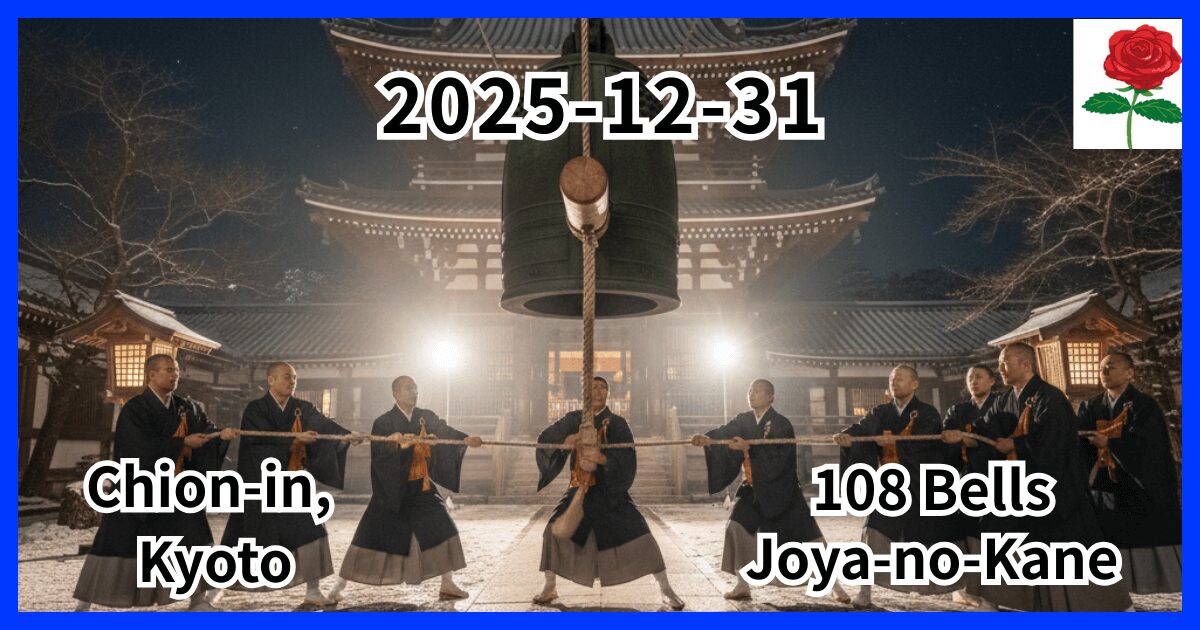
To ring such a colossal bell, a unique technique involving 17 monks working together is employed.
Several monks pull on ropes attached to a huge wooden beam, coordinating their movements before swinging it forward in unison.
Just before the beam strikes the bell, a sharp chant of “Ei!” echoes through the air, and the bell releases a deep, resonant tone.
This dramatic motion and the profound sound it produces are central to the appeal of Chion-in’s New Year’s Eve bell.
Because of its ritual significance, this bell-ringing ceremony is not open to the general public.
Instead, crowds gather around the bell tower to watch the monks’ synchronized movements and listen to the majestic sound of the enormous bell.
The tone spreads slowly through Kyoto’s crisp winter air, blending with the stillness of the city and creating a sensation as if time itself has momentarily stopped.
Chion-in’s “Joya no kane” is not merely a New Year’s event—it is also a ritual that embodies the spirit of the Jōdo school.
Hōnen’s teaching of the “heart of the nembutsu,” which offers salvation to all, is said to be reflected in the compassionate resonance of the bell.
Its deep, lingering sound has long been regarded as a guide that helps people cast off worldly attachments and welcome the new year with a purified heart.
The bell of Chion-in is also broadcast nationwide through television and radio.
It is frequently featured on NHK’s annual New Year’s Eve program Yuku Toshi Kuru Toshi, allowing its sound to reach homes across Japan.
Even for those unable to visit the temple in person, Chion-in’s bell has become a cherished symbol of the year’s end, offering a valuable opportunity for Kyoto’s cultural traditions to be shared throughout the country.
Chion-in’s “Joya no kane” is both a winter tradition of Kyoto and a symbol of Japan’s spiritual culture.
The overwhelming presence of the giant bell, the coordinated efforts of the monks, and the profound resonance that fills the night—all of these elements enrich the special moment of crossing from one year into the next, making it a deeply meaningful experience.
What the Sound of Chion-in’s Bell Symbolizes
The “Joya no kane” at Chion-in is remembered not only for the sheer size of its bell or the dramatic ritual used to ring it, but also for the profound symbolism carried in its sound.
Echoing through Kyoto’s crisp winter air, the tone is perceived as far more than a signal marking the turn of the year.
It embodies the spirit of the Jōdo (Pure Land) school, the teachings of Hōnen, and the deeply rooted sense of “prayer” that lives within the Japanese heart.
Chion-in’s great bell, weighing roughly 70 tons, produces a sound that is deep, lingering, and slow to expand, as if it gently shakes the air itself.
At the moment the bell rings, those gathered in the temple grounds instinctively hold their breath, quietly watching as the sound melts into the night sky.
The resonance is not merely heard with the ears—it is felt throughout the body, giving the impression that it reaches directly into the depths of one’s heart.
This sound carries special meaning because it is closely tied to the teachings of the Jōdo school.
Centered on the recitation of Namu Amida Butsu, Hōnen’s teaching emphasizes that all beings can be saved through the compassion of Amida Buddha.
As the head temple of this tradition, Chion-in remains a place where Hōnen’s spirit continues to live on.
The bell’s resonance not only reflects the general purpose of the “Joya no kane”—to dispel worldly desires and purify the mind—but also evokes the “heart of the nembutsu,” offering deep comfort to those who listen.
The sound of Chion-in’s bell also harmonizes beautifully with the atmosphere of Kyoto itself.
Winter in Kyoto is known for its cold, clear air, which allows sound to travel far and cleanly.
In the stillness of the late night, the slow spread of the bell’s resonance across the city feels as though the ancient capital as a whole is receiving and holding the sound.
The abundance of wooden buildings and the surrounding mountains soften the reverberations, creating a unique and lingering echo.
Chion-in’s bell is not simply “large” or “powerful”—it has a warmth that seems to gently embrace the hearts of those who hear it.
With each strike, memories of the past year naturally rise to the surface—moments of gratitude, reflections on mistakes, and quiet hopes for the year ahead.
The sound offers a chance to recover the inner stillness that is so easily lost amid the noise of daily life.
Moreover, the bell of Chion-in has become a national symbol of New Year’s Eve through television and radio broadcasts.
When it is featured on NHK’s annual program Yuku Toshi Kuru Toshi, its deep resonance reaches homes across Japan, bringing a solemn sense of the year’s end even to those who cannot visit the temple in person.
This widespread sharing through media shows that Chion-in’s bell is not merely a local tradition but a cultural touchstone for the entire country.
The sound of Chion-in’s bell serves as a symbolic bridge connecting past and present, religion and everyday life, the individual and society.
By listening to its resonance, we are invited to face ourselves, calm our hearts, and prepare for the new year.
The bell’s voice seems to quietly affirm that Hōnen’s teachings continue to live on today, and it stands as a powerful symbol of the spiritual depth embodied by Chion-in.
Conclusion
The “Joya no kane”, the bell that rings late on New Year’s Eve, is far more than a simple signal marking the turn of the year.
It offers a quiet moment of closure, gently settling the heart.
This tradition, cultivated over centuries, has taken root in Japanese life and sensibilities in ways that go beyond its religious origins.
When we listen to the bell, memories of the past year naturally rise to the surface—moments of gratitude, reflections on our actions, and quiet hopes for the year ahead.
Chion-in’s “Joya no kane” in particular has left a deep impression on many people through its grandeur and spiritual depth.
The sight of monks working together to ring the massive bell is more than a ritual; it symbolizes how the teachings of the Jōdo school and the spirit of Hōnen continue to live on today.
The bell’s deep resonance spreads slowly through Kyoto’s clear winter air, gently enveloping those who listen.
Its sound has long guided people in letting go of worldly attachments and welcoming the new year with a purified heart.
In modern society, lifestyles have diversified, and people spend New Year’s Eve in many different ways.
Yet no matter how times change, the “Joya no kane” continues to hold its power to calm the mind.
Many people now listen to the bell through television, radio, or the internet, and even without visiting a temple, its sound quietly reaches the heart.
Amid the rush of daily life, the “Joya no kane” offers a precious moment to pause and face ourselves.
The moment of welcoming a new year is special for everyone.
To close the year with the sound of the bell, to settle the heart, and to take a fresh step forward—this quiet ritual will remain meaningful to many people for years to come.
The bells of Chion-in and other temples act like bridges connecting past and future, offering comfort and lighting a small flame of hope within us.
In the stillness that follows the fading of the bell, we quietly accept the beginning of a new year.
The sense of clarity and warmth felt in that moment may be the greatest gift the “Joya no kane” has to offer.
Wishing for a new year that is as calm, deep, and rich as the bell’s resonance, we step forward once again into the days ahead.
Career advancement
2025年12月31日。
December 31st, 2025.
今日は京都・知恩院で行われる「除夜の鐘」についてお伝えしたいと思います。
Today, I’d like to tell you about the New Year’s Eve Bell Ceremony held at Chion-in Temple in Kyoto.
――「ゴーン」と鳴り響く音。
The resounding “gong.”
この一音に、どれほどの想いが込められているか、ご存知でしょうか?
Do you know how much emotion is put into this one sound?
大晦日の夜の、京都・知恩院。
It’s New Year’s Eve at Chion-in Temple in Kyoto.
日本最大級とされる梵鐘の前に、17人の僧侶が親綱と子綱を握ります。
In front of the temple bell, said to be one of the largest in Japan, 17 monks hold the main and secondary ropes.
掛け声は、「えーい、ひとーつ」「そーれ」。
The call is, “Eee, hitotsu,” and “Sore.”
ぜひ想像してみてください。
Please try to imagine it.
冷え込む夜気の中、僧侶たちが息を合わせ、全身で鐘を撞く姿。
In the chilly night air, the monks work together in unison to strike the bell with their entire bodies.
撞かれる回数は108回。
It is struck 108 times.
これは、仏教で人が持つとされる108の煩悩を表しています。
This represents the 108 earthly desires that Buddhism says humans possess.
一打ごとに、怒りや迷い、執着を手放し、心を清めていく――。
With each strike, we let go of anger, doubt, and attachment, and purify our hearts.
それが除夜の鐘の本当の意味です。
That is the true meaning of the New Year’s Eve Bell Ceremony.
知恩院の鐘は、規模が大きいため、一回撞くだけでも高度な技術と協力が必要になります。
Chion-in Temple’s bell is so large that even ringing it once requires advanced skill and cooperation.
だからこそ、この行事は「個」ではなく、「和」を象徴する儀式でもあるのです。
For this reason, this event is also a ritual that symbolizes harmony, rather than individuality.
一年を振り返り、新しい年を迎えるための、静かで力強い祈り。
It is a quiet yet powerful prayer to look back on the past year and welcome the new year.
それが京都・知恩院の除夜の鐘です。
That is the New Year’s Eve bell ringing at Chion-in Temple in Kyoto.
ちなみに、今が旬の冬野菜は「ほうれん草」です。
By the way, the winter vegetable in season right now is spinach.
栄養たっぷりで、寒い朝の味噌汁にぴったりです。
It’s packed with nutrients and perfect for miso soup on a cold morning.
朝食に感謝。
Thank you for breakfast.
応援と評価、宜しくお願い致します。
Please support and rate us!