[Japanese page]
[Previous article]
[Next article]
Information about this article
1. What Is “Shimai Kobo”?
Shimai Kobo refers to the final Kobo Market of the year, held on December 21 at Toji Temple in Kyoto, where the Kobo Market traditionally takes place on the 21st of every month. The market is held in honor of Kobo Daishi (Kūkai), whose monthly memorial day falls on the 21st. As the year-end event, Shimai Kobo attracts significantly more stalls and visitors than regular monthly markets.
2. Year-End Preparations and How Visitors Enjoy the Market
At Shimai Kobo, the temple grounds are filled with stalls selling a wide variety of items, including New Year decorations, shimenawa sacred ropes, zodiac ornaments, seasonal household goods, antiques, and vintage clothing. The market is bustling with visitors preparing to welcome the New Year, making it both a shopping destination and a festive cultural experience.
3. Cultural and Historical Significance
The Kobo Market at Toji Temple is a traditional fair connected to the memorial day of Kobo Daishi, one of the most important figures in Japanese Buddhism. As the last market of the year, Shimai Kobo holds special significance as a symbolic closing of the year, and its lively atmosphere makes it a beloved year-end tradition in Kyoto. The sight of countless stalls set against the backdrop of Toji’s iconic five-story pagoda is widely recognized as a quintessential Kyoto winter scene.
Introduction
As the year draws to a close, Kyoto takes on a special atmosphere.
Among the many year-end traditions, one event stands out for the crowds it attracts: Shimai Kōbō, held at Tō-ji Temple.
On this day, the temple grounds fill with rows of stalls and lively energy.
More than just a market, it is a uniquely Japanese event where people both wrap up the old year and prepare for the new one.

Kyoto at Year’s End
Walking through the city, your breath turns white in the cold air, and winter’s chill slowly seeps into your fingertips.
Temple grounds are filled with the crisp clarity unique to winter.
Trees have shed their leaves, and the sky beyond their bare branches carries a quiet tension, a serene stillness.
With the brilliance of autumn foliage gone and the peak tourist season fading, Kyoto’s expression subtly changes.
The bustle of fall gives way to the gentle signs of people preparing for the New Year.
Even amid the year-end rush, there is a warmth in the everyday rhythms of life—that is Kyoto’s face in December.
Among Kyoto’s many year-end traditions, Shimai Kōbō, held at Tō-ji Temple, draws especially large crowds.
Of the monthly Kōbō Market held on the 21st, the December market is called Shimai Kōbō, the “last Kōbō” of the year, and has long been cherished as a way to close out the year.
Tō-ji (officially Kyōō Gokoku-ji) was founded in 796 during the Heian period by Emperor Kanmu.
Located at the southern edge of ancient Kyoto, just east of the Rashōmon Gate, it was established as a state-sponsored temple to protect the capital.
In the original city layout, Tō-ji and its counterpart Sai-ji stood symmetrically on either side of Rashōmon—but today, only Tō-ji remains.
It is the sole surviving structure that preserves the original urban design of Heian-kyō.
In 823, Emperor Saga granted Tō-ji to Kūkai (Kōbō Daishi), who had just returned from China.
This transformed the temple into the central training ground of Shingon Esoteric Buddhism, and its name was changed to Kyōō Gokoku-ji.
Kūkai began constructing the lecture hall and the five-story pagoda, shaping the temple complex into the form that largely remains today.
Tō-ji is home to numerous cultural treasures, including the National Treasure five-story pagoda, the Golden Hall, the Mieidō (Daishi Hall), and the wooden statue of Dainichi Nyorai.
The pagoda, standing about 55 meters tall, is the tallest wooden pagoda in Japan and a symbol of Kyoto.
In 1994, Tō-ji was registered as a UNESCO World Heritage Site as part of the “Historic Monuments of Ancient Kyoto.”
Shimai Kōbō is the final Kōbō Market of the year, held on the 21st—Kūkai’s monthly memorial day.
The market’s origins date back to the Kamakura period, when Princess Sen’yōmon-in held memorial services for Kūkai, attracting worshippers and eventually vendors.
As the name “Shimai” suggests, this market carries a special meaning: a moment to close the year with gratitude and prepare for the next.
People visit Tō-ji to give thanks for the year’s blessings and to place their hopes in the coming one.
Shimai Kōbō is a place where “the end of the year” and “the beginning of the next” coexist—where reflection and anticipation overlap.
The Market Scene: A Year-End Tradition Alive with Energy
Stepping into the temple grounds on the day of Shimai Kōbō, you are immediately greeted by countless stalls lined up in neat rows.
New Year decorations, kagami mochi, shimenawa ropes, lucky rakes, daruma dolls, zodiac ornaments—everything needed for the New Year fills the market.
Crowds gather at every stall, lively voices echo through the cold air, and the warmth of people’s excitement mixes with winter’s chill.
Many visitors purchase new lucky charms or decorations, hoping for a good year ahead.
Letting go of old charms and welcoming new ones is more than a simple replacement—it is a small ritual of resetting the heart.
Kōbō Market is also famous for its antiques and secondhand goods.
Old ceramics, tools, and furniture carry the traces of their previous owners’ lives.
Finding a single special item feels like having a quiet conversation with the past.
After walking through the vast grounds, warm food becomes irresistible.
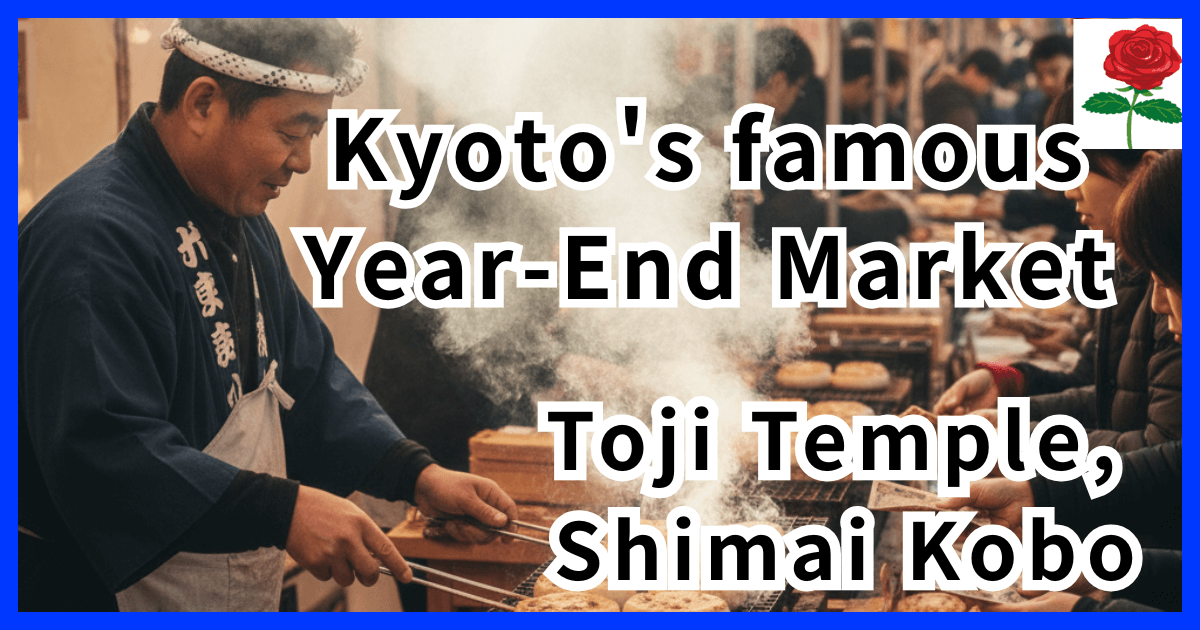
The smell of grilled mochi, the steam rising from sweet amazake, and hot soups that warm you from the inside—each bite enjoyed with cold hands wrapped around a bowl is a uniquely Kyoto winter pleasure.
The Spirit of Shimai Kōbō: A Blend of “Closure” and “Prayer”
Shimai Kōbō is not just a large year-end market.
It embodies the Japanese cultural value of marking transitions—kugiri, the act of creating a boundary or pause.
Japanese life has long been shaped by natural rhythms: the seasons, the phases of the moon, the turning of the year.
Year’s end is the most significant of these transitions.
Tō-ji, as the heart of Shingon Buddhism, is a place where Kūkai’s teachings still resonate.
The market held within its grounds has always been both a religious event and a part of everyday life.
Prayer and daily living blend naturally here—that is the essence of Kōbō Market.
The word “Shimai” carries not only the meaning of “last,” but also “to bring closure” and “to settle the heart.”
Visitors walk through the grounds thinking:
- “I made it through another year.”
- “May next year be even better.”
Their steps become a form of prayer, reflection, and quiet hope.
The Temple Complex: A Thousand Years of Space Embracing the Event
The charm of Shimai Kōbō is not only in the lively stalls but also in the profound presence of Tō-ji’s architecture.
The five-story pagoda, Japan’s tallest wooden pagoda, rises sharply into the clear winter sky.
Destroyed four times by lightning or fire, the current structure was rebuilt in 1644 by Tokugawa Iemitsu.
Its resilience mirrors Kyoto’s own history—falling, rising, enduring.
On the day of Shimai Kōbō, the pagoda’s quiet strength offers visitors a deep sense of reassurance.
The Golden Hall, rebuilt in the Momoyama period, houses Yakushi Nyorai, the Buddha of healing.
Praying before Yakushi at year’s end symbolizes gratitude for health and a wish for peace in the coming year.
The Lecture Hall contains the “Three-Dimensional Mandala,” a group of 21 statues arranged according to Kūkai’s vision of the Buddhist cosmos.
Passing by the hall during Shimai Kōbō, you feel a stillness that contrasts with the bustling market—a sense that Kūkai’s presence lingers even now.
Kyoto’s Year-End Culture: Everyday Life Interwoven with Prayer
Kyoto’s December is filled with long-standing traditions:
- Shopping at Nishiki Market
- The Okeramairi ritual at Yasaka Shrine
- Year-end ceremonies at temples
- Preparing New Year decorations
- Cooking for the New Year
Shimai Kōbō attracts not only tourists but also many locals.
This shows that the event is not a performance for visitors—it is part of Kyoto’s living culture.
“Every year, we buy our New Year decorations here.”
“We always visit to close out the year.”
“We drink amazake as a family—it’s our tradition.”
These small customs quietly support the rhythm of life in Kyoto.
Even shopping becomes a form of prayer:
the way someone selects a decoration, returns an old charm, or picks up a lucky item—each gesture carries a wish for the coming year.
A Place to Pause: Shimai Kōbō in Modern Life
In today’s fast-paced world, we often forget how to pause.
Notifications, deadlines, endless tasks—finding a moment of rest is difficult, even at year’s end.
Shimai Kōbō offers a rare chance to slow down.
Walking through the grounds, browsing stalls, placing your hands together in prayer—each action gently eases the pace of your mind.
As you move with the flow of people, thoughts naturally arise:
- “A lot happened this year.”
- “Next year, I want to live a little more calmly.”
It feels like reclaiming a part of yourself that had been left behind in the rush of daily life.
Shimai Kōbō is not a place to judge your year as good or bad.
It is a place where you can carry everything—successes, failures, regrets—and still be accepted.
Tō-ji’s thousand-year history has embraced countless human emotions, and that quiet acceptance remains.
A small lucky charm you bought,
the pagoda seen through the steam of amazake,
the warmth you felt when you pressed your hands together—
these become tiny lights guiding you into the new year.
The Comfort of Tō-ji: A Place That Endures
One reason Shimai Kōbō remains special is the sense of security offered by Tō-ji itself.
The pagoda, rebuilt again and again, seems to say, “No matter what kind of year you had, another year will come.”
The mandala in the Lecture Hall expresses the harmony and cycles of the universe.
Standing before it on the day of Shimai Kōbō, you feel time flowing differently—a reminder of Kūkai’s belief that all human life is part of a larger cosmic rhythm.
Conclusion
Shimai Kōbō is far more than a year-end market.
It is a moment to reflect on the past year and gently shift your heart toward the next.
Walking the grounds, browsing the stalls, and offering a prayer help you reclaim the “time for yourself” that is so easily lost in daily life.
If you visit Kyoto in December, take a walk through Tō-ji during Shimai Kōbō.
In the cold winter air, you will feel the warmth of people’s hopes and the quiet promise of a new year.
Career advancement
2025年12月21日。
December 21, 2025.
今日は、京都・東寺で行なわれる「終い弘法」についてお伝えします。
Today, we’ll be reporting on the “Shimai-Kobo” festival, which will be held at Toji Temple in Kyoto.
一年で最も賑う縁日が、実は年末に行われることをご存知でしたか?
Did you know that the busiest festival of the year actually takes place at the end of the year?
ぜひ想像してみてください。
Imagine that.
澄み切った冬の空気の中、境内には屋台がいっぱい立ち並びます。
In the crisp winter air, the temple grounds are lined with food stalls.
お餅の香ばしい香、お正月飾りを選ぶ人々の笑顔。
The fragrant aroma of rice cakes, the smiles of people choosing New Year’s decorations.
「終まい弘法」は、弘法大師・空海の月命日に行なわれる「弘法市」の締くくりです。
“Shimai-Kobo” marks the end of the “Kobo Market,” held on the monthly anniversary of the death of Kobo Daishi, also known as Kukai.
12月の京都の風物詩として、多くの人がお守りやお餅、骨董品を求めて東寺を訪れます。
A Kyoto tradition in December, many people visit Toji Temple in search of amulets, rice cakes, and antiques.
この日は単なる市ではありません。
This day is more than just a market.
一年の感謝を胸に、新年を迎えるための「節目の時間」なのです。
It is a “milestone time” to welcome the New Year with gratitude for the past year in our hearts.
ちなみに、今が旬の野菜は、大根、白菜、ほうれん草です。
By the way, the vegetables that are in season now are daikon radish, Chinese cabbage, and spinach.
朝食に感謝。
Thank you for breakfast.
応援と評価、宜しくお願い致します。
Thank you for your support and ratings.