[Japanese page]
[Previous article]
[Next article]
Information about this article
1. What Is the Asakusa Hagoita Market?
The Hagoita Market is a traditional year-end market held every year from December 17 to 19 at Sensoji Temple in Asakusa, Tokyo. It is also known as the “Toshi-no-Ichi” (Year-End Market) and the “Osame no Kannon” (Final Kannon Visit of the Year).
The market primarily features hagoita paddles used for New Year’s games, and it has been celebrated as a long-standing year-end tradition since the Edo period.
2. Meaning of “Toshi-no-Ichi” and “Osame no Kannon”
Toshi-no-Ichi refers to a year-end market where people prepare to welcome the New Year, while Osame no Kannon marks the final visit of the year to Kannon, the Buddhist deity of compassion.
The event has long been cherished as a meaningful occasion to express gratitude for the past year and to pray for happiness and family safety in the year ahead.
3. Key Features and Atmosphere of the Hagoita Market
During the market, the temple grounds are lined with numerous stalls selling auspicious hagoita paddles, including elaborately decorated oshi-e hagoita featuring raised fabric artwork.
Amid the lively year-end atmosphere, visitors can enjoy temple worship, shopping, and the charm of traditional Edo culture all at once, making the Hagoita Market a unique seasonal experience in Tokyo.
Introduction
December 18, 2025.
Today, I would like to share the atmosphere of the year-end tradition known as the Hagoita Fair, officially called the “Toshi-no-Ichi / Osame no Kannon Hagoita Market,” held at Senso-ji Temple in Tokyo.
The cold winter air hangs over Asakusa. In the early morning temple grounds, white breath drifts into the air, and the sound of footsteps quietly echoes across the stone pavement. Even though the sun has barely risen, people naturally find themselves drawn toward Senso-ji. They are not here simply for sightseeing. Coming to this place on this particular day holds a special meaning for many Japanese people.
Before long, the view opens up to rows upon rows of colorful hagoita paddles, tightly packed together. Decorated in vivid reds, golds, and whites, their brilliant designs catch the light and shimmer, resembling flowers blooming in the winter streets of Asakusa. Each paddle has its own unique expression—no two are exactly alike.
Once the event begins, the atmosphere in the temple grounds changes instantly. Lively calls from the vendors fill the air, smiles pass from face to face, and the sound of camera shutters can be heard everywhere. The usual year-end rush blends with a warm sense of nostalgia, and Senso-ji is quickly enveloped in the vibrant energy of the season’s end.
Yet this hagoita market is far more than a simple festival. It is a distinctly Japanese year-end tradition that gives form to gratitude for safely completing the year and to prayers for the year ahead. Senso-ji, long regarded as a center of Kannon (Avalokiteshvara) devotion, has welcomed people for centuries as a place to visit at the close of the year, known as Osame no Kannon, where they come to reflect and prepare their hearts.
This custom, which dates back to the Edo period, has been passed down to the present day, even as its outward form has evolved. Looking at the hagoita, choosing one, and holding it in your hands—each of these actions helps make the turning point of the year tangible, gently guiding people’s minds toward the transition into the New Year.
So why do people make their way to Senso-ji on this day, even in the cold?
The answer lies in a deeper sense of what the year’s end truly means—something that can only be felt at the hagoita market.

Key Point
The Toshi-no-Ichi / Osame no Kannon Hagoita Market at Senso-ji Temple represents a quintessential Japanese year-end tradition—one that gives tangible form to gratitude for the past year while entrusting hopes and wishes to the year ahead.
When people hear “hagoita market,” many imagine a lively year-end fair lined with brightly colored decorative paddles. However, its true essence goes far beyond a festive event or a place for shopping. The act of choosing a hagoita, holding it in one’s hands, and taking it home is best understood as a ritual for properly bringing the year to a close.
Originally, hagoita were tools used in hanetsuki, a traditional New Year’s game. Over time, they came to be regarded as auspicious objects believed to ward off misfortune. Seeking out a hagoita at the end of the year therefore carries a dual meaning: it expresses gratitude for the year that has passed while also offering prayers for protection and well-being in the year to come.
There is also deep significance in the fact that this event takes place at Senso-ji. For centuries, the temple has served as a spiritual refuge at the heart of Kannon devotion. Osame no Kannon refers to the final visit of the year to pay respects to Kannon, a meaningful occasion to report a year lived in safety and to pray for continued blessings in the coming year. The hagoita market naturally took root within this flow of faith and tradition.
Simply visiting Senso-ji on this day becomes an act of mental and emotional preparation for the New Year. In the midst of a busy year-end, people intentionally pause, take time to reflect on the year behind them, and gather their thoughts. That moment of reflection provides a clear sense of closure and helps shape the mindset needed to step into a new year.
In other words, the hagoita market at Senso-ji is both
a place where the year comes to an end and a place where one’s heart is prepared for a new beginning.
It is precisely this dual role that has continued to draw people to the market from the Edo period to the present day.
Reason
So why has the Hagoita Fair at Senso-ji Temple remained such an important year-end tradition, continuing to attract so many people even today?
There are three main reasons.
The first reason
The first reason lies in the meaning of hagoita as symbols of protection against misfortune and evil spirits.
Originally, hagoita were used for hanetsuki, a traditional New Year’s game similar to badminton. However, this was not merely a form of entertainment. It was widely enjoyed as a custom expressing prayers for children’s healthy growth.
The shuttlecock used in hanetsuki has a small black seed at its tip called mukuroji. The name itself carries an auspicious meaning: “free from illness” or “without suffering.” Because of this wordplay, mukuroji was long regarded as a lucky charm. Each strike of the shuttlecock was believed to drive away bad luck and evil spirits, and this belief naturally became part of everyday life.
Over time, the hagoita itself came to be seen as a symbol of warding off misfortune, eventually becoming an essential good-luck item for the New Year. From the Edo period onward, its role shifted further—from a practical tool for play to a decorative object meant to invite good fortune into the home.
Buying a hagoita at the end of the year is therefore more than a simple purchase. It represents an act of cleansing away the misfortune of the past year and preparing to welcome the new year with a fresh and positive spirit. This clear, visible form of protection is one of the key reasons why the Hagoita Fair became firmly established as a year-end tradition.
The second reason
The second reason is the significance of the event being held at the very end of the year.
The Hagoita Fair at Senso-ji is known as the Toshi-no-Ichi (Year-End Market) and the Osame no Kannon (the final visit to Kannon of the year). As these names suggest, the event marks the closing chapter of the year.
For centuries, Japanese people have placed great importance on seasonal transitions and turning points in time. Visiting temples and shrines at the end of the year has long served as a way to express gratitude for having made it safely through the year and to pray for health and peace in the year to come.
Senso-ji, one of Tokyo’s most historic and revered Kannon temples, has played a central role in this custom. People come to offer thanks, reflect on the events of the year, and quietly prepare their hearts for the next one. This practice is what is known as Osame no Kannon.
The Hagoita Fair naturally became intertwined with this flow of events. Choosing a hagoita after worship is not simply shopping—it is a symbolic act that clearly marks the transition from one year to the next.
The end of the year is often busy and overwhelming, but by taking part in this tradition, people are given a moment to pause and reflect on their own year. This opportunity for reflection is another reason the Hagoita Fair has endured.
The third reason
The third reason is its role as a place that connects people.
The Hagoita Fair is not merely a marketplace. It is a space where memories, customs, and human relationships accumulate over time.
Some families visit every year. Others buy new hagoita to match their children’s growth. Many regulars return to the same stalls, seeking the work of the same artisans year after year. These actions are personal memories, but they are also expressions of living cultural tradition.
Asakusa has long been a center of popular culture since the Edo period. Temples and shrines served as gathering points where people met, talked, and shared seasonal events. This atmosphere is deeply reflected in the Hagoita Fair.
The act of gathering in the same place every year heightens one’s awareness of time. The scenery may look the same as last year, yet the person standing there has changed, even slightly. This sensation strengthens the feeling of a year’s turning point and gives rhythm and continuity to everyday life.
In this way, the Hagoita Fair simultaneously fulfills three roles:
a symbol of protection against misfortune,
a marker that brings closure to the year,
and a cultural space that connects people.
It is precisely this overlap of meanings that has allowed the tradition to be passed down for generations and remain alive to this day.
Example
Now, let us take a closer look at what the Toshi-no-Ichi / Osame no Kannon Hagoita Fair at Senso-ji Temple actually looks like in practice.
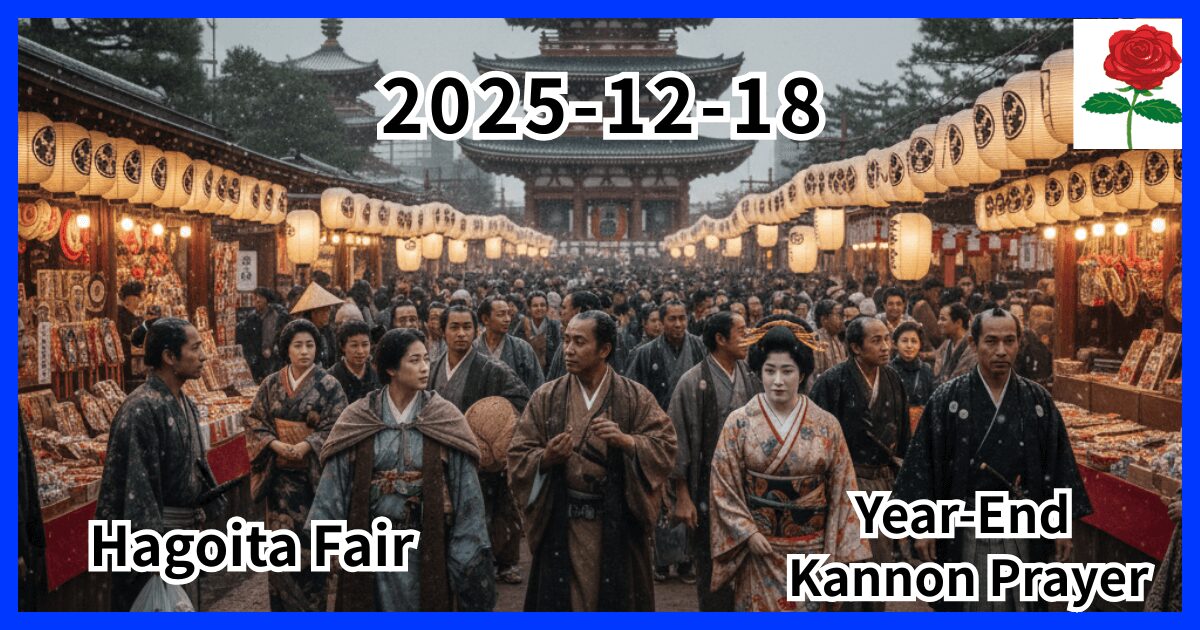
During the Hagoita Fair, countless stalls line the temple grounds and the approach roads leading to Senso-ji. Many vendors begin preparing early in the morning, and as the day goes on, the flow of visitors increases rapidly. Walking through the grounds, your eyes are immediately drawn to rows upon rows of hagoita displayed on both sides. The sheer number and vividness of the decorations can feel overwhelming, especially for first-time visitors.
The hagoita on display come in an astonishing variety of designs. Some feature bold, three-dimensional depictions of kabuki actors with powerful expressions. Others portray women in elegant furisode kimono, while many incorporate traditional auspicious motifs believed to bring good fortune. No two are exactly alike. In recent years, designs reflecting current events or trends of that particular year have also appeared, turning the fair into a place where visitors can sense the spirit of the times.
Many of these hagoita are made using a traditional technique known as oshie hagoita. Layers of fabric and cotton are carefully built up to create a three-dimensional effect, and the finished pieces are crafted with remarkable attention to detail. At this point, they go far beyond being simple playthings and can be considered works of folk art. Each hagoita embodies years of an artisan’s experience and skill, and when viewed up close, their delicacy often causes passersby to stop in their tracks.
Another major attraction of the fair is the lively interaction at the stalls. When a hagoita is sold, the vendor leads a spirited hand-clapping ritual accompanied by enthusiastic calls. People nearby naturally join in with applause, and the atmosphere becomes momentarily unified. This scene is one of the most iconic features of the Senso-ji Hagoita Fair and strongly evokes the excitement unique to the end of the year.
“Have a good New Year.”
This phrase is more than a simple seasonal greeting. It carries the seller’s appreciation for the year just passed and heartfelt wishes for the buyer’s happiness in the coming one. The moment of receiving a hagoita brings with it both the sense of having acquired a good-luck charm and a quiet anticipation for the New Year ahead.
Looking around the venue, one can see a wide range of expressions on people’s faces. Parents carefully selecting a hagoita for their child. Young friends enjoying the atmosphere and taking photos together. Longtime regulars who return on the same day every year to buy from the same stall.
There are many tourists as well, yet the fair feels more than just a sightseeing event. It carries a calmness rooted in everyday life and tradition. This is likely due to the weight of history and faith associated with Senso-ji, which can be felt even amid the lively crowds.
All of these scenes overlap and blend together, allowing the Hagoita Fair at Senso-ji to be etched into people’s hearts as a special memory unique to that year. The sounds, the air, the presence of others—elements that cannot be fully captured in photos or videos. Experiencing all of this in person may well be the true value of this time-honored event.
Conclusion
The Toshi-no-Ichi / Osame no Kannon Hagoita Fair at Senso-ji Temple is a distinctly Japanese year-end tradition, one in which people express gratitude for having safely completed the year while at the same time offering their wishes for the year to come.
Hagoita were originally familiar as tools used in a traditional New Year’s game, but over time they came to embody deeper meanings as talismans believed to ward off misfortune and invite good fortune. Choosing a hagoita at the end of the year is therefore not merely a shopping experience. It is an act of reflection—looking back on one’s own year and giving form to hopes for the year ahead.
There is also profound significance in the fact that this event takes place at Senso-ji. With its long history as a center of Kannon worship, the temple has remained a place where people entrust their wishes. By visiting Senso-ji for Osame no Kannon, the final Kannon pilgrimage of the year, people gather their feelings of gratitude and prayer, quietly preparing their hearts to welcome the New Year.
Amid the lively atmosphere of the Hagoita Fair, one can still sense the breath of common people’s culture that has continued since the Edo period. The oshie hagoita brought to life by skilled artisans, the spirited calls and rhythmic hand clapping, and the simple phrase “Have a good New Year”—each of these elements serves to connect people with one another and to share the meaning of the year’s end.
Precisely because modern year-end life is often so busy, placing oneself within such a tradition carries special value. By stepping away, even briefly, from smartphones and schedules, and turning one’s attention to the air of the temple grounds and the expressions on people’s faces, it becomes possible to quietly reflect on the year just passed.
If you find yourself in Asakusa at the end of the year, take a moment to experience the atmosphere of the Hagoita Fair. The colorful hagoita, the smiling faces, and the lively voices filling the temple grounds may gently ask you a simple question: Are you ready to welcome the New Year?
The Hagoita Fair at Senso-ji continues to pass on this “time of year’s end”—linking past, present, and future—unchanged, even today.
Career advancement
2025年12月18日。
December 18, 2025.
今日は、浅草寺で開催される「歳の市・納めの観音羽子板市」の様子をお伝えします。
Today, we’ll be reporting on the “New Year’s Market/Osame Kannon Hagoita Market” held at Sensoji Temple.
想像してみてください。
Imagine it.
浅草の冬、境内には、色とりどりの羽子板が敷き詰められています。
In winter in Asakusa, the temple grounds are covered with colorful hagoita.
イベント開始からわずか数秒後、年末の熱気に包まれます。
Just a few seconds after the event begins, the air is filled with the excitement of the end of the year.
この羽子板市は、無事に一年を終えられたことへの感謝と、これから一年の無病息災、家内安全を祈願する年末の行事です。
The hagoita market is an end-of-year event where people give thanks for the safe passage of the year and pray for good health and safety for their families in the year ahead.
江戸時代から続く、浅草の冬の風物詩です。
It’s a winter tradition in Asakusa that has continued since the Edo period.
露店に並ぶ羽子板は、歌舞伎役者や縁起の良い装飾が施され、まるで動く芸術作品のようです。
The hagoita lined up at the stalls are decorated with kabuki actors and auspicious ornaments, making them seem like moving works of art.
一つ一つに「厄除け」の願いが込められています。
Each one is imbued with a wish to ward off evil.
ぜひ想像してみてください。
Just imagine it.
人々の笑顔、元気な掛け声、そして年末の浅草の雰囲気。
The smiling faces of the people, the energetic shouts, and the atmosphere of Asakusa at the end of the year.
この日に浅草寺を訪れることは、新年への心構えでもあります。
Visiting Sensoji Temple on this day is also a way to prepare yourself for the new year.
旬の野菜は春菊。
The seasonal vegetable is garland chrysanthemum.
朝食ありがとう。
Thank you for breakfast.
応援と評価、宜しくお願い致します。
Thank you for your support and ratings.