[Japanese page]
[Previous article]
[Next article]
Information about this article
1. What Is the Kasuga Wakamiya On-Matsuri?
The Kasuga Wakamiya On-Matsuri is a prestigious annual festival held every December at the Wakamiya Shrine of Kasuga Taisha in Nara. Dating back to the Heian period, it is regarded as one of the oldest traditional festivals in Japan.
The festival began as a ritual to pray to the Wakamiya deity for bountiful harvests and national prosperity, and it remains a unique tradition where religious devotion and performing arts are deeply intertwined.
2. The Festival’s Main Highlight: The Historical Procession
The greatest highlight of the On-Matsuri is the grand historical procession, in which participants wear authentic reproductions of costumes from the Heian, Kamakura, and Muromachi periods.
Samurai, court nobles, Shinto priests, and performers march through the streets, creating a powerful living panorama that feels like a Japanese historical scroll brought to life.
3. Cultural Significance and Other Highlights
Beyond the procession, the festival features sacred rituals and traditional performances, including bugaku court dance and Noh theater, preserving forms of Japanese performing arts that have been passed down since ancient times.
The Kasuga Wakamiya On-Matsuri is widely recognized, both in Japan and abroad, as a festival that allows visitors to experience Nara’s history, spiritual traditions, and performing arts culture in a comprehensive and immersive way.
Introduction
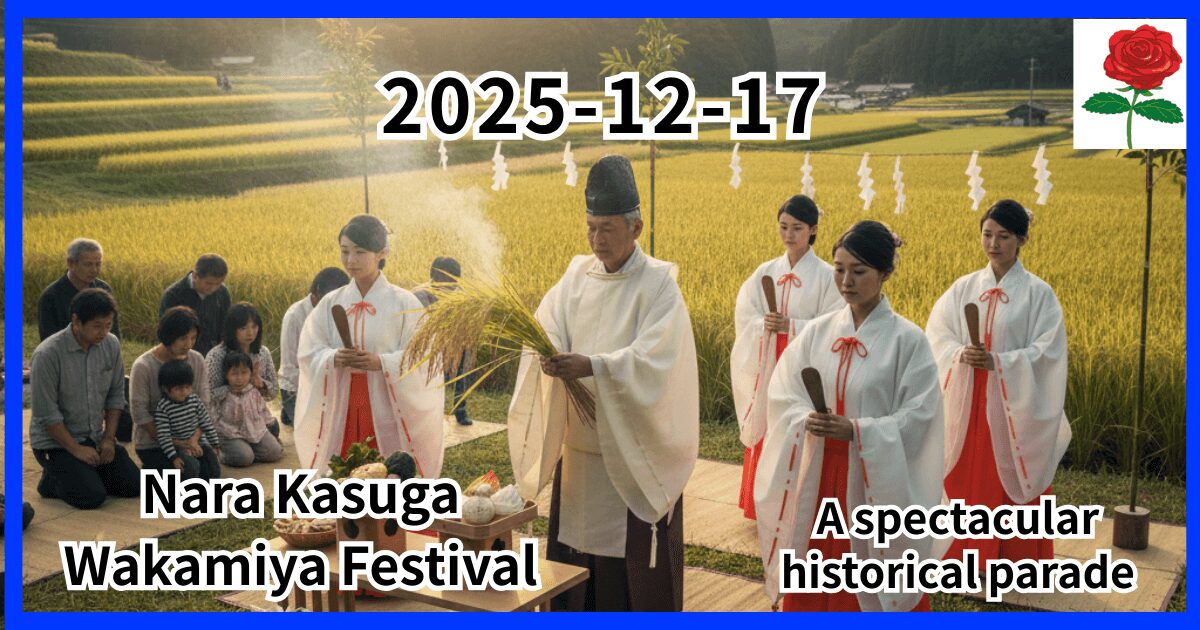
December 17, 2025. Today, we invite you to explore the Kasuga Wakamiya On-Matsuri, a Shinto ritual that has continued for over a thousand years in Nara, Japan.
Imagine, for a moment, how you would feel if you saw people from the Heian period silently walking before your eyes.
The sound of gagaku (ancient court music) drifts from afar, and people in vibrant, historical costumes slowly proceed in a long procession—the Kasuga Wakamiya On-Matsuri makes this scenario of “stepping into history” a tangible reality right before you.
This festival is a sacred rite dedicated to the Wakamiya Shrine, an auxiliary shrine of the great Kasuga Grand Shrine in Nara. It began with the simple yet profound prayer for an abundant harvest, the peace of the nation, and the health of the people.
The ultimate highlight is the Jidai Gyoretsu (Procession of Eras), involving approximately 500 participants. People dressed in costumes symbolizing distinct periods of Japanese history—Heian, Kamakura, Muromachi, and Edo—solemnly parade through the streets.
It is both spectacular and, paradoxically, quiet. Unlike boisterous festivals, the On-Matsuri places “prayer” at the center, embodying a unique Japanese aesthetic rooted in reverence and restraint.
The Kasuga Wakamiya On-Matsuri can truly be described as a “thousand-year-old state ritual that allows one to experience the Japanese spirit of prayer and values through a historical procession.” It is not merely a tourist event or historical reenactment; it is an intense distillation of the very foundations of Japanese culture, encompassing:
- The harmony between nature and humanity
- An attitude of gratitude toward the divine and a modest way of life
- A profound consciousness of sustaining history, never allowing it to be broken
For this reason, the Kasuga Wakamiya On-Matsuri is not just a festival to see, but a festival to feel and contemplate.
We hope that through this sacred tradition, you will be able to sense the “weight of a thousand years of prayer” that we are in danger of losing in the modern age.

What is the Kasuga Wakamiya On-Matsuri?
The Kasuga Wakamiya On-Matsuri is an annual festival held around December 17th, dedicated to the Wakamiya Shrine, which is an auxiliary shrine (Sessha) of the Kasuga Grand Shrine. Kasuga Grand Shrine, founded during the Nara period, is one of Japan’s most prominent ancient shrines. Wakamiya Shrine is located about 300 meters south of the main shrine and enshrines the divine child (Mikogami) of the Kasuga deity, known as Wakamiya-sama (Amewoshikumone-no-mikoto).
The origin of this festival dates back to the Heian period, specifically to Chōshō 4 (1135). During that era, the capital city of Nara was plagued by successive epidemics and natural disasters, leading to widespread social unrest. To alleviate the people’s suffering, Fujiwara no Tadamichi, who was then the Chief Advisor to the Emperor (Kanpaku), founded the festival. His goal was to offer prayers to Wakamiya-sama, the child deity of the Kasuga Kami (deity), for a bountiful harvest, national stability, and the peace and health of the populace.
The Fujiwara clan deeply revered Kasuga Grand Shrine as their tutelary shrine (Ujigami). By consecrating the Wakamiya deity, Lord Tadamichi sought to ensure the protection of the entire city of Nara and, by extension, the entire nation. A key characteristic of the On-Matsuri, therefore, is that it was a sacred rite planned and initiated on a national scale by the era’s highest political authority.
The “On” in “On-Matsuri” uses the Chinese character Go or O (御), signifying “great festival” or “sacred festival.” It is not merely a local event; as a ceremony executed with the prestige of the Kasuga deity and the Fujiwara clan, its importance has been maintained for nearly a thousand years.
Tracing the History: A Rite of Prayer That Never Ceased
The most remarkable feature of the Kasuga Wakamiya On-Matsuri is the fact that it has continued for over a thousand years without a single interruption.
Since its founding in 1135, Japanese history has endured repeated periods of civil war, shifts in political power, and radical social transformations. In particular, during the 150 years spanning the Muromachi and Sengoku (Warring States) periods, Japan was plunged into chaos, causing countless traditions, cultural practices, and temple and shrine events to cease. Yet, the Kasuga Wakamiya On-Matsuri persisted. This continuity was due to its nature as a sacred rite held within the sacred precinct (Shin’iki), beyond the “First Torii Gate,” and the strong will of the residents and influential figures of Nanto (Nara).
This continuation is not just historical preservation. It vividly illustrates how deeply the Japanese people valued the concept of “living in harmony with nature and unseen beings (the Kami).” In the face of any hardship, the people sought to maintain spiritual stability and social harmony by perpetually giving thanks to Wakamiya-sama and praying for the coming year’s abundant harvest and peace.
Even powerful warlords like Oda Nobunaga and Toyotomi Hideyoshi recognized the significance of this rite and provided protection and support. In the Edo period, elements like the “Daimyō Gyōretsu (feudal lord procession)” were added by the Tokugawa Shogunate, further enhancing its scale and authority. The festival’s survival through the turbulent currents of history serves as proof that the prayer to Wakamiya-sama was indispensable to both political powers and the local community.
The Full Scope of the On-Matsuri: Schedule and Climax
While the “Owatari Shiki (Procession)” and “Otabisho Festival” on December 17th are the most famous parts, the Kasuga Wakamiya On-Matsuri actually spans four days, from December 15th to the 18th, during which solemn rites and performances are held. The preparations and rituals to welcome the deities begin even before the climax on the 17th.
Among these days, December 17th is undoubtedly the day when the festival’s splendor, solemnity, and historical weight are most concentrated. In particular, the “Senkō-no-Gi” (Ritual of Transfer) held in the early morning is the most sacred rite, where Wakamiya-sama secretly moves to the Otabisho (temporary sanctuary). General spectatorship is strictly restricted for this ritual. It is only after this divine transfer that the people form a procession—the “Owatari Shiki”—to proceed to the Otabisho to offer their service to Wakamiya-sama.
The On-Matsuri, with its intricate structure spanning several days, continues to embody the ideal form of a Japanese Shinto rite: welcoming the deity, entertaining the deity, and finally, sending the deity off with gratitude.
The Core of the On-Matsuri
The True Meaning of the “Procession of Eras”: Service, Not Reenactment
The Owatari Shiki (Procession) on December 17th, known as the greatest spectacle of the Kasuga Wakamiya On-Matsuri, is a grand parade where approximately 500 people, dressed in costumes from the medieval to early modern periods, walk through the city of Nara. However, this procession is fundamentally different from a mere historical fashion show or an entertainment-focused “reenactment event.”
The purpose of this procession is simple: “to serve the Wakamiya deity and proceed before the divine presence.”
The procession is composed of diverse groups symbolizing the history of Japan, spanning from the Heian to the Edo periods. These include the imposing mounted archers of the Kamakura samurai, known as Yabusame, the Daimyōshū (feudal lords) group modeled after the Edo period’s great processions, and the Chigo (child) Procession, where children play the starring roles. These groups represent “Service Corps,” where people from each era offer thanks and prayers to the Wakamiya Kami in their respective capacities.
In essence, the Owatari Shiki is the act of dedicating the entirety of Japanese history to the divine presence, transcending time itself.
What is particularly crucial is that everything, down to the color and shape of the costumes, the order of the procession, and the way each person walks, is rigorously stipulated. This is not “to show what the past looked like,” but “to demonstrate that the past and the present are connected by the same prayer.” It is the ultimate embodiment of the “consciousness of sustaining history and connecting it to the future.” Participants in the procession are not merely acting out roles; they bear the serious responsibility of being “inheritors,” connecting the prayer to Wakamiya-sama across a thousand years.
The Sacred, Secret Rite: The Senkō-no-Gi
Before the Owatari Shiki begins, around midnight on December 17th, the most sacred and solemn rite, the Senkō-no-Gi (Ritual of Transfer), is performed. This is the ceremony in which Wakamiya-sama secretly transfers from the main shrine of the Wakamiya Shrine, where the deity usually resides, to the Otabisho (temporary sanctuary), where the deity will stay throughout the festival.
This ritual is completely closed to the public. All surrounding lights are extinguished, and in the darkness, only the sounds of gagaku (court music) can be heard as the rite is performed modestly by Shinto priests alone. Extreme caution is taken to ensure that the form of Wakamiya-sama or the process of the transfer is never witnessed by human eyes.
The subsequent Owatari Shiki gains its meaning precisely because of this Senkō-no-Gi. Since the deity has already arrived at the Otabisho and is awaiting the people’s service, the populace proceeds to the deity’s location to offer thanks, prayers, and sacred performances.
This rite, performed in darkness and absolute silence, is completely devoid of spectacle, symbolizing the Japanese people’s awe and profoundly cautious attitude toward Shinto rituals. It encapsulates a uniquely Japanese “form of faith“: believing in the presence of the divine, yet avoiding direct sight of the deity and reserving reverence within the heart.
A Thousand Years of Silence: Japan’s Unique Aesthetic of Serenity
Many visitors to the Kasuga Wakamiya On-Matsuri are first struck and then moved by its “silence.”
To eyes accustomed to boisterous Japanese festivals, the atmosphere of the On-Matsuri is highly distinctive: loud shouting and flashy displays are eliminated, and all that can be heard is the ethereal melody of gagaku, the rustling of the participants’ robes, and the gentle sound of footsteps. This silence is the very essence that makes the On-Matsuri a “divine rite” rather than a mere event, embodying the aesthetic at the foundation of Japanese culture.
- Harmony Over Self-Assertion: Participants in the procession quietly and diligently fulfill their own roles, never disrupting the overall flow. This reflects the Japanese social philosophy of respecting wa (harmony) and prioritizing equilibrium over individual expression.
- Reverence Over Excitement: Both participants and spectators approach the festival with deep respect and awe toward the divine. The quiet demeanor of the audience is, itself, a crucial element composing the ceremony.
- A Space Akin to Wabi-Sabi: Beneath the splendor of the costumes flows a serenity characteristic of the ancient capital of Nara, one that rejects boisterousness. This spirituality aligns with Wabi-Sabi (the aesthetic of transient and imperfect beauty) that Japanese culture values, intentionally creating a tranquil space for communion with nature and the deities.
It is only through this stillness that we can truly “feel” the weight of a thousand years of prayer. The sincere devotion of the people, expressed through gratitude to the Kami and wishes for national peace, speaks deeply to us through this veil of silence.
Dedication of Sacred Arts: A Banquet to Entertain the Deity
In the afternoon of the 17th, ancient and elegant “Shinto Arts (Shinjigēno)” are dedicated at the Otabisho, where Wakamiya-sama is now enshrined. This is a sacred banquet, or “entertainment,” offered to the deity by the people who proceeded there during the Owatari Shiki.
The dedicated arts are diverse, including Gagaku (court music), Bugaku (court dance), Dengaku (field ritual music and dance), Nōgaku (Noh theater, originating from Sarugaku), and Seinō (ancient dance). While many of these arts historically evolved into secular forms, they retain their distinct form as divine rites within the On-Matsuri, representing the wellspring of Japanese performance history.
Gagaku and Bugaku are particularly notable for their scales and rhythms, which are completely different from modern music, gently unraveling the listener’s sense of time. This music is not meant to “entertain” humans but is dedicated to welcoming and honoring the divine. Its melodies and movements have preserved their form for a millennium, and it is common for listeners to feel a spontaneous sense of sacred solemnity as they listen.
These sacred arts incorporate movements that symbolize prayers for a bountiful harvest and intentions to ward off disaster. They collectively embody the fervent prayers of the people of Nanto (Nara)—gratitude to Wakamiya-sama and a wish for a year of peace and abundant fruition.
Highlights and Specific Attractions
The Climax: The Owatari Shiki (Procession of Eras) as a Living Historical Scroll
In the afternoon of December 17th, following the secret Senkō-no-Gi in the morning, the Owatari Shiki (Procession of Eras) takes place. This is the act of service where people proceed to the Otabisho (temporary sanctuary) after Wakamiya-sama has been transferred there. The procession starts from the O-Yado (Great Lodge) along the main path of Kasuga Grand Shrine in the morning, passes by locations like the JR Nara Station area, and finally heads towards the Otabisho near the Wakamiya Shrine.
This procession, featuring approximately 500 participants, is truly a “living historical scroll.” People representing diverse social statuses and periods of Japanese history carry out their respective roles, moving forward as a single, unbroken stream.
It is particularly awe-inspiring to watch performance groups like the Sarugaku (predecessor to Noh) and Dengaku (field music and dance) dedicate their dances and music as they move. This strongly indicates that the path of the procession itself is a “stage of dedication” to the deity.
Another wonderful aspect of this procession is that the form has been preserved and handed down for hundreds of years by the residents of Nanto (Nara). Everything, from the colors and patterns of the costumes to the smallest tools used, is rigorously reproduced and inherited based on descriptions in ancient documents. This provides a sense of “authentic weight” that goes far beyond mere replication.
The Otabisho Festival: The Zenith of Sacred Arts
After the procession arrives at the Otabisho, the Otabisho Sai (Otabisho Festival) is held on the special stage (a grassy area) where Wakamiya-sama has taken up residence. The primary characteristic of this festival is the “dedication of sacred performing arts.”
This location is historically significant as the place where Noh theater was first performed outdoors in Japan—the so-called Shiba Nō (Grass Noh)—making it a crucial site in the history of Japanese performing arts.
During the Otabisho Festival, in addition to the aforementioned Gagaku, Bugaku, Dengaku, and Seinō, Noh and Kyōgen plays are dedicated. These arts function as fertility rites (Yoshuku) praying for an abundant harvest and as a sacred banquet meant to please the deity.
Spectators sit on the grass and quietly appreciate the thousand-year-old arts in a solemn atmosphere. Unlike performances seen in modern theaters, the dances and sounds dedicated directly to the deity are filled with a unique tension and sanctity. In particular, the simple yet powerful Dengaku dances and the gracefully profound melodies of Gagaku deeply move the hearts of onlookers.
The dedication of these arts continues late into the night. The stage illuminated by bonfire light, dramatically emerging from the darkness, creates a fantastical space where time seems to stand still, making this event truly the climax of the sacred arts.
The Entire City of Nara Becomes the “Stage”
The allure of the Kasuga Wakamiya On-Matsuri does not end within the grounds of Kasuga Grand Shrine or the Otabisho. The festival transforms the entire city of Nara into a colossal stage.
The route of the Owatari Shiki, which passes through Nara Park and past the Wakamiya Shrine before heading to the Otabisho, integrates perfectly with the historical landscape of the ancient capital. The stone pavement, the earthen walls, and the distant forest of Mount Kasuga—all these elements serve as the backdrop, intensifying the procession’s solemn atmosphere.
As stated by the Nara City Tourist Association, “The townscape, the stone pavements, the forest, the air of Nara—everything becomes part of the festival.”
This offers one of the few opportunities to experience “Nara, the Capital of Prayer,” rather than just “Nara, the tourist destination.”
The sight of this ancient, strict procession moving through the center of a modern city, requiring traffic regulation to proceed, demonstrates the pride in tradition and the strong will for continuation held by the people of Nanto. Through this festival, we are reminded that Nara is not merely a tourist spot but a land that has consistently been “a place with the divine” throughout a thousand years of history.
The Wakamiya On-Matsuri, which colors the entire city of Nara, offers observers a precious experience that allows them to grasp history from a broader perspective and feel the deep spirituality of Japanese culture.
Conclusion
The Kasuga Wakamiya On-Matsuri is far more than just an opportunity to view a magnificent historical procession or witness ancient, elegant performing arts. This thousand-year-old sacred rite vividly conveys the fundamental cultural roots and values that the Japanese people have treasured to those of us living in the modern age.
The following three crucial values are condensed within this festival:
- Harmony between Nature and Humanity: The original prayers of the festival—for a rich harvest, national stability, and the health of the people—are based on a humble attitude toward the blessings and threats of nature. Through this festival, people have inherited the wisdom of giving thanks to the unseen force of nature and living modestly within it.
- The Consciousness of Sustaining History and Connecting to the Future: The fact that this festival has never ceased, even through turbulent periods of war and political change, is a powerful expression of the Japanese people’s strong sense of “reverence for the past and responsibility for the future.” The commitment to preserve ancient forms in every detail of the costumes and performances shows that the “present” is regarded as a vital bridge connecting the past and the future.
- Social Harmony and Community Spirit: Participants in the procession, regardless of their status or the historical era they represent, cooperate toward the shared purpose of “serving” Wakamiya-sama. The festival’s operation is primarily driven by the residents of Nanto (Nara), supported by a powerful sense of community dedicated to protecting the tradition across the entire region. This symbolizes the ancient Japanese societal view that “no person lives alone.”
The Kasuga Wakamiya On-Matsuri can be regarded as a living cultural asset that has shaped these unique Japanese aesthetics and ethics within the flow of history.
A Message for Modern Life
In today’s information society, where everything is demanded to be fast and efficient, the message that the Kasuga Wakamiya On-Matsuri conveys to us is profound.
The ritual’s solemn silence and the rhythm of prayer repeated over a thousand years grant us “a time to pause.” It quietly reminds us of the gratitude toward nature and the culture inherited from our ancestors—feelings often forgotten in the busyness of daily life.
In particular, the darkness and stillness of the Senkō-no-Gi in the early morning of December 17th, and the solemn pace of the historical procession during the day, are the antithesis of flashy performances and modern entertainment. It is a space that encourages introspection and reverence, prompting us to re-examine the true nature of the human heart.
The On-Matsuri encourages us not just to observe a historical event, but to engage with its “form of prayer,” thereby gently placing ourselves within the thousand-year current and becoming one of the inheritors of history.
For Prospective Visitors: The Manner of Respecting Silence
To truly experience the Kasuga Wakamiya On-Matsuri, it is critically important to understand and respect the “solemnity of the sacred rite.”
This festival is not intended for revelry or noise. Especially on the 17th, when the deity transfers to the Otabisho and the festival reaches its peak, quiet reverence is required from spectators. When viewing the ceremony, please keep the following points in mind and adopt a position of silent observation:
- Maintain Absolute Silence: Refrain from loud conversation or private cheering toward the procession. Since this is a sacred ritual, let us preserve the silence where only the sounds of gagaku and footsteps resonate.
- Careful Photography: Photography is strictly prohibited during the Senkō-no-Gi in the early morning. When photographing the procession or performances during the day, please avoid using flash and exercise the utmost care not to interfere with the sacred rite.
- Serving as a Spectator: The audience is also a vital element in shaping the atmosphere of this divine rite. Observing the ceremony with a humble attitude is the greatest respect you can show to the tradition upheld by the people of Nanto.
Take this opportunity, where the entire city of Nara becomes a solemn stage, to deeply feel the weight of the prayer passed down over a thousand years with your own senses.
Career advancement
2025年12月17日。
December 17, 2025.
今日は、奈良で千年以上続く神事「春日若宮おん祭」についてお伝えしたいと思います。
Today, I’d like to tell you about the Kasuga Wakamiya On-Matsuri, a Shinto ritual that has been held in Nara for over a thousand years.
突然ですが、平安時代の人々が目の前を歩いていたら、あなたはどんな気持ちになるでしょうか?
This may seem sudden, but how would you feel if people from the Heian period were walking before your eyes?
このお祭りでは、そのような光景が現実のものとなります。
At this festival, that same scene becomes a reality.
春日若宮おん祭は、五穀豊穣と人々の健康を祈願する、奈良を代表する伝統行事です。
The Kasuga Wakamiya On-Matsuri is a traditional event that represents Nara, and is held to pray for bountiful harvests and the health of the people.
最大の見どころは、約500人が参加する「時代行列」です。
The highlight of the festival is the “Historical Procession,” attended by approximately 500 people.
平安時代から江戸時代まで、各時代の衣装を身にまとった人々が、雅楽の音色にのせて静かに練り歩きます。
People dressed in costumes from each period, from the Heian period to the Edo period, quietly parade to the sounds of Gagaku Music.
まるで日本の歴史の教科書の中に迷い込んだかのようです。
It’s as if you’ve wandered into a Japanese history textbook.
この行列は、華やかなだけではありません。
This procession is not just colorful;
「自然と人が調和して生きる」という日本人の祈りと価値観が込められています。
It is imbued with the Japanese prayer and values of “people living in harmony with nature.”
千年の時を超えて受け継がれてきた祈りを、ぜひ想像してみてください。
Try to imagine this prayer that has been passed down for over a thousand years.
今が旬の野菜は春菊です。
The vegetable that is in season now is garland chrysanthemum.
朝食に感謝、ありがとう。
Thank you for breakfast.
応援と評価、宜しくお願い致します。
Thank you for your support and rating.