[Japanese page]
[Previous article]
[Next article]
Information about this article
1. What Is the Gion “Kotohajime”?
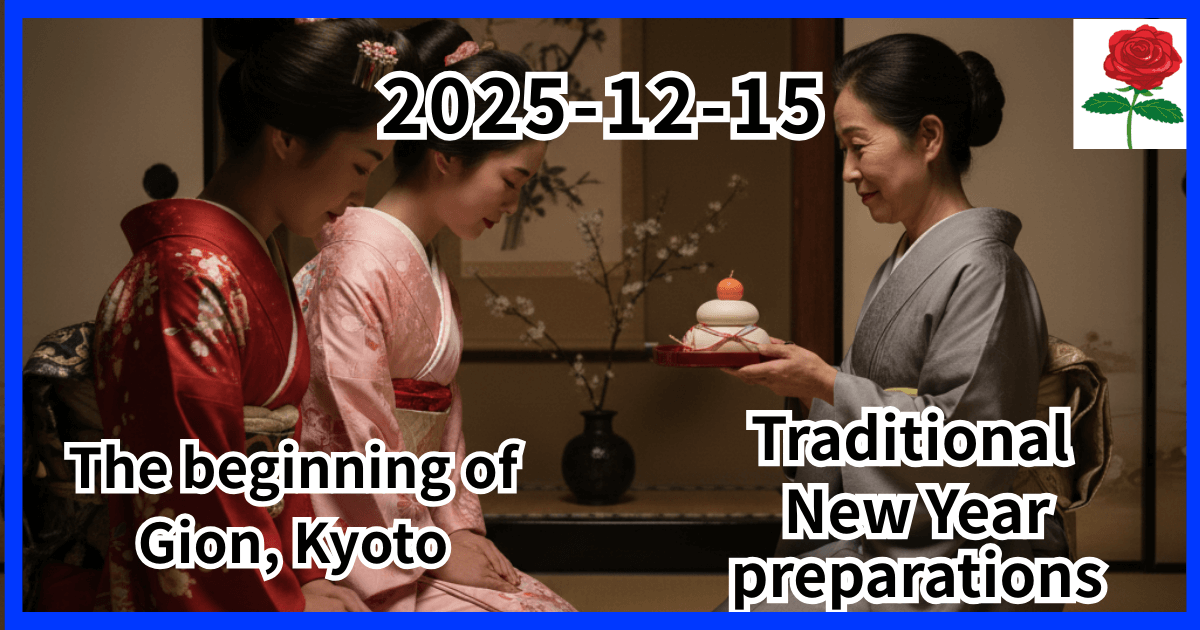
The Gion Kotohajime is a traditional annual event held on December 13 in Kyoto’s geisha districts, marking the official beginning of preparations for the New Year.
For geiko (geisha), maiko (apprentice geisha), and those connected to the hanamachi, it serves as an important ceremonial turning point of the year, symbolizing both a conclusion of the past year’s work and the start of welcoming the new one.
2. Customs and Meaning of Kotohajime
On Kotohajime, geiko and maiko make formal New Year’s courtesy visits to their okiya (geisha houses), ochaya (teahouses), and other affiliated establishments.
Through these visits, they express gratitude for the year just passed and offer prayers for a safe and successful New Year, reflecting a distinctly Japanese cultural emphasis on politeness, gratitude, and the importance of human relationships.
3. Cultural Significance Within Kyoto’s Hanamachi
The Gion Kotohajime preserves the unique customs, aesthetic values, and traditional sense of time that define Kyoto’s hanamachi culture.
Beyond its surface elegance for visitors, it is a rare and meaningful annual observance that offers insight into the everyday life and spiritual mindset of the geisha districts, making it an essential cultural tradition of Kyoto.
Introduction
The streets of Gion, Kyoto, undergo a profound transformation, shedding their vibrant, tourist-heavy image and becoming enveloped in a tense silence. This period is marked by the distinct purity and serenity of a special year-end ritual known as “Shogatsu Kotohajime“ (The Start of New Year’s Preparations).
Far removed from loud decorations or festive commotion, a quiet, introspective period reigns over the Gion district for several days. Geiko (geisha) and Maiko (apprentice geisha) embark on a crucial phase in their lives, dedicating themselves to refining their spirit and their art in preparation for the New Year.
“New Year’s preparations already?” some may wonder.
However, in traditional Japanese culture, the New Year was never just a flip of the calendar page. It represented a fundamental “reset of the mind,” necessitating a formal ritual to ensure everything would be “started correctly.” Shogatsu Kotohajime is the very first step in this spiritual preparation. The ritual held in the Gion Hanamachi (geisha district), in particular, is preserved as an extremely quiet and solemn event, contrasting sharply with the area’s generally glamorous reputation.
A deep-rooted concept in traditional Japanese culture is that things do not begin spontaneously; they commence only through a “Ceremony of Beginning.” This “Aesthetics of Beginning” has been further refined and beautifully elevated within the Hanamachi, where the mastery of art is paramount.
In this article, we will thoroughly explain the deep meaning behind “Gion Hanamachi’s Kotohajime,” and why it continues to be cherished today, incorporating its historical background. We invite you to explore the profound depths of Kyoto’s culture—a side rarely visible to tourists—and the unwavering commitment of the Geiko and Maiko.

Shogatsu Kotohajime in the Gion Hanamachi
The “Shogatsu Kotohajime” (Start of New Year’s Preparations) ritual held in Kyoto’s Gion Hanamachi is far more than just a round of year-end greetings. This is a uniquely Japanese annual event—a deeply spiritual rite in which Geiko and Maiko fundamentally renew their mindset and artistic posture, while expressing gratitude and firm resolve to everyone who has supported them throughout the year.
The reason this ceremony is considered so vital to the performing arts of Gion—to the extent that one could say it marks “the true beginning of the Hanamachi’s year”—is because it clearly signifies the following three spiritual milestones:
Humbly Reflecting on a Year of Artistry
Kotohajime is a day for Geiko and Maiko to deeply examine their performance achievements and their dedication to practice (Keiko) over the past year. Behind the glamour of the stage, they recognize that they were only able to devote themselves to their art thanks to the support of many people, including their masters (Shishō) and the proprietors (Okami-san) of the teahouses (Ochaya).
They reaffirm a profound resolve, engraving the harsh reality that “Art is not mastered in a day” into their hearts, acknowledging their own imperfections. Rather than being a mere formality, it is an opportunity to scrutinize their sincere attitude toward their craft through introspection and self-critique.
Expressing Gratitude and Respect to Supporters
The culture of the Hanamachi is built upon strong bonds of trust among people: the interconnectedness of “Ochaya (teahouses) and Okiya (geisha houses), masters and disciples.” Kotohajime is the day they formalize this gratitude.
Geiko and Maiko visit the homes of their masters and the Ochaya in near-formal attire, offering greetings filled with appreciation for the year’s guidance and support. Every word and every gesture (Shosa) exchanged during this time is rooted in the traditional Japanese aesthetic of “paying utmost respect (Rei o Tsukusu).” Through this rite, the human relationships that sustain the Hanamachi are reaffirmed, and the community’s solidarity is strengthened.
Resolving to “Start the New Year Correctly”
In Japanese culture, the notion that “starting things correctly” influences subsequent success has long been upheld. Shogatsu Kotohajime serves as the “preparation” for the New Year’s arrival, signifying a “spiritual deep cleaning” that precedes any physical tasks like house cleaning or decoration.
In the Hanamachi, “starting correctly” means solidifying a renewed commitment to the path of art. It is not about passively waiting for the year to change, but rather a day to actively hit the spiritual “launch button” to mentally switch gears and begin the new year at a higher standard. This is the essence of Gion Hanamachi’s Shogatsu Kotohajime.
Historical Background
The deep spirituality inherent in the Kotohajime ritual performed in the Gion Hanamachi is profoundly rooted in the unique Japanese “sense of time” and the traditional approach to annual events, which has been maintained since ancient times.
Shogatsu Kotohajime: “The Preparation for the Preparation to Welcome the Toshigami“
The origins of Shogatsu Kotohajime date back to the mid-Edo period, although the underlying philosophy is even older. It was traditionally established as the day to begin preparations for welcoming the Toshigami-sama (New Year’s deity) during the New Year. The Toshigami-sama is believed to be the deity who brings a good harvest and happiness for the year, and it was believed that welcoming this deity with great reverence would ensure peace and stability for the year ahead.
Generally, Shogatsu Kotohajime is observed on December 13th of the modern calendar. Historically, this day marked the official start of major preparations, such as “Matsumukae” (gathering pine branches and wood from the mountains needed for kadomatsu decorations and for boiling ozōni soup) and “Susu-harai” (the grand cleaning ceremony to sweep away a year’s worth of soot and dust).
Why December 13th Was Chosen: The Auspicious Kishukunichi Day
Why was December 13th selected as the day to begin? The answer lies in the ancient calendar system.
According to Wikipedia, in the Senmyō Calendar (Senmyō-reki), which was used until the mid-Edo period, the 13th day of the 12th month always fell on the “Ki” (鬼 / Ogre) day of the Nijū-nana Shuku (twenty-seven lunar mansions). This “Ogre Day” was considered especially propitious for all undertakings, except for weddings.
New Year’s preparations are sacred acts for welcoming the Toshigami-sama, the most revered deity. Thus, December 13th, being an optimal auspicious day for starting almost anything (apart from the private celebration of a wedding), was selected as the favorable date. Although subsequent calendar reforms caused the date to lose synchronization with the lunar mansions, the custom that “Kotohajime is on the 13th” has been preserved to the present day.
Connection to Koto Yōka
Traditional Japanese annual events also include “Koto Osame” (The Closing of New Year’s Affairs) and “Koto Yōka” (The Eighth Day of Affairs). Depending on the region and the era, some traditions designated December 8th as the Koto Hajime (Start of Affairs) and February 8th as the Koto Osame (or Koto Yōka):
- December 8th (Koto Hajime): The day to begin handling New Year’s affairs.
- February 8th (Koto Osame): The day to conclude handling New Year’s affairs.
While the dates for Kotohajime have varied regionally and historically, the core principle remains the same: the Japanese people have always intentionally delineated the beginning and end of major activities through “rituals,” rather than simply relying on calendar dates.
It is this profound spiritual culture of valuing the “Day of Beginning” that has been sublimated in the Gion Hanamachi, manifesting as the ceremonial renewal of their artistic practice—the very foundation of their lives—and is passed down into the modern age.
Significance Exclusive to Gion
While Shogatsu Kotohajime is a traditional event observed across Japan, the version performed in the Gion Hanamachi holds a highly specialized and solemn significance, distinguishing it from the general household duties of susu-harai (cleaning) or New Year’s shopping.
For the Geiko and Maiko of the Hanamachi, their art (Gei) is the foundation of their livelihood and their entire self-expression. Therefore, Kotohajime functions not as a simple seasonal greeting, but as a deep, internal ceremony for thoroughly reviewing their commitment to the “Path of Art.”
The Resolve of the Hanamachi: Art and Life Unified
For general households, New Year’s preparations primarily focus on tidying up the physical environment. However, the pursuit of art demands not only technical skill, but also a specific mindset, a sense of gratitude, and above all, “a continuous drive for improvement.”
Gion‘s culture is founded upon the rigorous philosophy that “Art is not mastered in a day.” The act of Geiko and Maiko dressing in formal wear and visiting their masters and teahouses on the day of Kotohajime is nothing less than reaffirming their personal dedication to this demanding philosophy.
The Kotohajime in the Hanamachi specifically aims to adjust the following three “states of mind”:
Correcting the Posture Towards Art
At the close of the year, they critically examine their attitude toward their own artistry. Did they approach their practice with sincerity? Was there arrogance? Did they always remember their beginner’s spirit?
When exchanging greetings before their masters, even though words may be few, their self-assessment and passion for the coming year emerge in every gesture and movement. This self-assessment serves as the most crucial compass for navigating the endless pursuit of the artistic path.
Cultivating “Virtue” by Expressing Gratitude to Masters and Teahouses
A Geiko or Maiko can only take the stage through the instruction of their master, the protection of the teahouse proprietress, and the support of the Okiya (Geisha House). They are literally beings who stand on the “support” of many people.
Kotohajime is the most important annual opportunity to express heartfelt thanks for that enormous debt of gratitude. In Hanamachi society, not only artistic brilliance but also “human virtue”—meaning etiquette and humility—is highly valued. The commitment to paying respect and never forgetting gratitude is not merely good manners; it is recognized as an essential element of the artistic path itself.
Acknowledging Imperfection and Clarifying Goals for the New Year
During their visits for Kotohajime, Geiko and Maiko receive words of encouragement from masters and proprietresses, such as “Please continue to strive next year.” These words resonate deeply, serving as a trigger to clearly define their goals for the upcoming year.
In contrast to their dazzling public performances, this event is introspective because they know there is no endpoint to the path of art. Acknowledging one’s own imperfection and forming the quiet resolution to “strive for a higher level”—this is the most core meaning encapsulated within Gion Hanamachi’s Shogatsu Kotohajime.
The Duration and Flow of the Ritual
While the Shogatsu Kotohajime in the Gion Hanamachi possesses a solemn atmosphere, its execution is quite fluid and carried out in a hushed manner. Let us examine the specific period of the ritual, the appearance of the Geiko and Maiko, and the places they visit.
The Period of Observance and Formal Attire
In line with tradition, the core date for Kotohajime is December 13th, but in Gion, the concentrated round of greetings generally takes place from that day until about the 15th.
During this period, Geiko and Maiko walk the streets wearing attire that is close to formal wear, distinct from their usual dazzling costumes. For particularly important greetings, they wear a Montsuki (kimono bearing family crests), especially the Kuromontsuki (black formal kimono) worn for high-status winter occasions, presenting a clean and dignified appearance. This formal dress visually underscores the significance of the ritual—the act of “conveying gratitude and resolve.”
The Places Visited: A Journey Through Hanamachi Relationships
The primary locations visited by the Geiko and Maiko during Kotohajime are the places housing the key people who support their artistic careers:
- The Master’s Residence (Shishō’s Taku):
The most crucial visits are to the homes of the masters who teach them arts such as dance (Mai), song (Uta), and instrumental music (Hayashi). Here, they express thanks for the year’s guidance and request instruction for the coming year. This greeting is a ceremony to reaffirm the “vertical connection” of the master-disciple relationship in the artistic path.
- Teahouses (Ochaya – Clients):
Greetings to the Ochaya—which regularly provide settings for performances and give Geiko and Maiko the stage to practice their art—are indispensable. This expresses gratitude for the “horizontal connection” that supports the economic foundation of the Hanamachi.
- Geisha Houses (Okiya – Affiliation):
Maiko who live communally, and the Geiko affiliated with the Okiya, visit to express gratitude for the support provided in their daily lives.
- Associated Shrines and Temples (Jinja Bukaku):
They may also visit local shrines and temples to pray for the safety of the Hanamachi and the progress of their artistic pursuits, offering prayers for the New Year.
At each location, the Geiko and Maiko pay close attention to their deportment and the depth of their bow, conveying their New Year’s greetings, gratitude, and commitment for the coming year.
The Customary Phrase: “Omedetō-san dosu“
The symbolic phrase exchanged during this round of greetings is “Omedetō-san dosu.”
This is the joyful phrase “Omedetō gozaimasu” (“Congratulations” or “Happy New Year”) suffixed with the Kyoto dialect dosu. It carries a deep meaning infused with gratitude and resolve, implying sentiments such as: “We are beginning our preparations for a good year,” or “Thank you for your support this past year; we are starting our New Year preparations (Kotohajime).”
When the master or proprietress responds to “Omedetō-san dosu” with “Okibari-yasu” (“Please persevere” or “Good luck”), the relationship between master and disciple, or between mutual parties, is reaffirmed, and the connection for the following year is promised.
This sight of the quiet and solemn round of greetings is a precious ritual that conveys the true, uncommercialized beauty of Gion today.
The Aesthetics of Deportment (Shosa)
In the Gion Hanamachi’s Shogatsu Kotohajime, the verbal exchange—such as the “Omedetō-san dosu” mentioned previously—is deliberately minimal. However, during this ritual, deportment (Shosa) speaks volumes, conveying the Geiko and Maiko’s sincerity and resolve far more eloquently and profoundly than words ever could.
This culture of prioritizing Shosa reflects the “High-Context Culture” deeply rooted not only in the Hanamachi but throughout Japanese society.
Shosa Conveys the Essence of Artistry
For Geiko and Maiko, their bearing and posture are part of their art, and every aspect of their daily life is considered an extension of their training. The Shosa particularly emphasized during the Kotohajime greetings includes the following elements:
- Posture (Tachii-furumai): A dignified, straight-backed posture speaks volumes about their sincere mindset toward their art and the diligence of their practice over the past year.
- Depth of Bow (Rei): The angle and duration of the bow express the degree of respect and gratitude shown to the recipient. A deep bow, especially to the master or the Ochaya proprietress, is a vital, non-verbal means of conveying immeasurable reverence.
- Walking Style (Yūgasa): Their movements as they walk the stone pavements of wintery Gion—never hurried, always quiet and graceful—reflect their personal character and dignity.
These actions are taught not merely as formal manners, but as the “beauty emanating from the heart,” which moves those who witness it. To express one’s spirit through attitude and movement without relying on excessive speech—this is the very essence of the artistry pursued in the Hanamachi.
Kotohajime as a Japanese High-Context Culture
In cultural anthropology, world cultures are classified based on their reliance on “context” when transmitting information:
- Low-Context Culture: Information transfer relies on explicit language and clear explanations are highly valued (e.g., Western nations).
- High-Context Culture: Communication heavily depends on shared history, culture, personal relationships, and non-verbal cues (context). Emphasis is placed on relationships where people can understand each other without saying much (e.g., Japan, Korea).
The Kotohajime ritual in the Gion Hanamachi is the pinnacle of this high-context culture.
The masters and proprietresses listen not just to the short phrase “Omedetō-san dosu” but interpret the Geiko and Maiko’s growth and resolve for the coming year from non-verbal information: their posture, the sparkle in their eyes, the depth of their bow, and how they hold the gifts in their hands.
Furthermore, the master’s response, “Okibari-yasu” (Please persevere), holds a profound sense of expectation and affection that goes beyond the single word itself.
In this way, the Kotohajime ceremony beautifully embodies the traditional Japanese aesthetic and relationship style, where hearts connect and understand each other without relying on excessive verbal communication.
The Inheritance of Tradition
Among the rituals of Shogatsu Kotohajime in the Gion Hanamachi, the most moving and important interaction takes place at the residence of the arts master. Here, beyond a simple expression of gratitude, a pledge for the future is exchanged, ensuring that the spirit and techniques of the art are passed down to the next generation.
Symbolic Gifts: Kagami-Mochi and the Dance Fan (Mai-Ōgi)
When Geiko and Maiko visit the masters and Ochaya, they bring various items, primarily lucky charms related to New Year’s preparations.
At the master’s residence, a symbolic item for “starting” practice in the new year is presented to the disciple. The most significant of these is the Dance Fan (Mai-Ōgi).
- Kagami-Mochi (Offering):
It is customary during the Kotohajime greetings to present small Kagami-Mochi (stacked rice cakes) as an offering for the Toshigami-sama. This Kagami-Mochi is offered at the practice hall’s kamidana (household shrine) and symbolizes the preparation to invite good fortune for the coming year.
- Dance Fan (Otoshidama):
The master acknowledges the disciple’s gratitude and encourages them to continue striving in the new year by presenting the Dance Fan as “Otoshidama” (New Year’s Gift). This fan is not merely a tool. It often symbolizes the master’s chosen “artistic theme” or “mindset” for that year. By accepting this new fan, the disciple renews their resolve to continue along the path of art.
The Dance Fan is considered the soul’s instrument for the Geiko and Maiko. The new fan presented by the master carries the master’s deep expectation and affection—the message being, “Use this fan next year, continue to follow my teachings, and dedicate yourself wholeheartedly.” It is the baton of art being entrusted.
From “Social Custom” to “Artistic Discipline”
The master and disciple engage in the following traditional exchange of words:
- Disciple (Geiko/Maiko):
“Omedetō-san dosu. Rainen mo yoroshū otano mōshimasu.” (Congratulations. I humbly request your guidance for the coming year as well.)
- Master:
“Okibari-yasu. Rainen mo otano mōshimasu.” (Please persevere. I also look forward to your efforts next year.)
Within this brief exchange, the master encourages the disciple, and the disciple conveys gratitude for the master’s guidance.
Through this ceremony, not only artistic techniques but also intangible cultural assets—such as the strict discipline of the Hanamachi, the nature of human relationships, and the spiritual attitude toward the artistic path—are continuously passed down.
It can truly be said that Shogatsu Kotohajime is the moment when the lifeblood of tradition is renewed within the closed society of the Gion Hanamachi.
The Harmony of Modernity and Tradition
Despite its beauty and historical depth, the Shogatsu Kotohajime in the Gion Hanamachi is rarely witnessed by tourists, except by chance. The definitive reason for this is that the ritual is not held as a public tourism event.
The fact that Kotohajime continues to be observed quietly and in a virtually private manner holds significant meaning for the preservation of this tradition in the modern age.
A “Private Rite,” Not a Tourist Event
Kotohajime in the Hanamachi is strictly a “private rite” for Geiko and Maiko to confront their artistic path, express daily gratitude, and state their resolve for the coming year.
- Non-Disclosure: The dates and routes for Kotohajime are never publicly announced. This is because it is a highly spiritual event completed entirely within the internal relationships of the Hanamachi, not intended for viewing or photography.
- Emphasis on Concentration and Silence: Any external noise or commotion during the ritual would disrupt the concentration of the Geiko and Maiko and undermine the solemn atmosphere of the ceremony. Silence is essential for them to focus on their dignified deportment (Shosa) and to sincerely face their masters.
Therefore, even if tourists visit Gion during this period, they are only likely to catch a fleeting glimpse of Geiko and Maiko in their black formal Montsuki walking quietly along the stone pavement; it is rare to witness the core elements of the rite itself.
The “Culture of Non-Display” Protects the Dignity of Tradition
In contemporary society, everything tends to be publicized, consumed, and commoditized as information. However, Gion‘s culture—especially a solemn rite like Kotohajime—preserves its dignity and value precisely by “not being displayed” and “not being easily consumed.”
This stance of preserving the tradition away from the public eye yields two important benefits:
- Maintenance of the Sacred Nature of the Artistic Path: The arts, by nature, are only attained through rigorous training and discipline. By maintaining Kotohajime as a private rite, Geiko and Maiko reaffirm that the path they follow is a sacred and serious one, not swayed by temporary trends or fleeting interest.
- Preservation of the Hanamachi Community: Kotohajime serves to strengthen the internal relationships that sustain the Hanamachi: masters, Ochaya, and Okiya. By exchanging gratitude and resolve purely among themselves, without concern for external observers, strong bonds of trust and community solidarity are maintained.
The quiet scene of Kotohajime witnessed in wintery Gion gives the momentary illusion that “Kyoto’s time has slipped back to the past.” It is a quiet testament to the resolve of the Hanamachi people, who value tradition and introspection while resisting the swift current of modern life.
Conclusion
The Gion Hanamachi’s “Shogatsu Kotohajime“ is a priceless annual event that conveys the spirit of resolve and gratitude hidden beneath the surface of the glamorous Hanamachi culture.
The reason this ritual continues to be esteemed as an extremely solemn rite, rather than a mere year-end tradition, is that it condenses the “Aesthetics of Beginning” that the Japanese people have cherished since antiquity.
As explained in this article, Kotohajime encompasses the following three vital meanings:
- Emphasis on Introspection and Humility: Reflecting on the past year’s artistic endeavors, acknowledging one’s shortcomings, eliminating arrogance, and correcting one’s mindset toward the artistic path.
- Reaffirming Relationships: Expressing courtesy and deep gratitude toward the supportive community—masters and Ochaya—not primarily through words, but through dignified deportment (Shosa).
- The Resolve to “Start Correctly”: Not treating the New Year as a simple passage of time, but intentionally resetting one’s consciousness to complete the spiritual preparation necessary to begin the new year in the best possible state.
The Value of Kotohajime in Modern Society
For those of us living in contemporary society, we are constantly bombarded by information, and the boundaries between “endings” and “beginnings” tend to become ambiguous.
It is precisely in such an era that the attitude taught by Gion‘s Kotohajime—the act of pausing, engaging in introspection, offering thanks, and quietly resolving one’s future—holds immense value.
Taking the initiative to define when one will perform their own “spiritual Kotohajime,” rather than just waiting for the calendar date to change, will undoubtedly enrich our lives.
At the close of the year, stopping to pay respect to one’s work, role, and the people who have offered support—it is within this quiet act that the unwavering resolve to pursue the next goal is born.
If you have the opportunity to visit Kyoto in mid-December, please turn your attention, if only briefly, to the quiet, dignified time of Gion that lies behind the bustle. There, the “Aesthetics of Beginning” that the Japanese people have valued for centuries is still alive and well, speaking to us about the importance of “ordering one’s mind.”
Career advancement
2025年12月15日。
December 15, 2025.
今日は、京都・祇園花街で行われる静かで美しい伝統行事「事始め」についてご紹介します。
Today, I’d like to introduce you to Kotohajime, a quiet and beautiful traditional event held in Kyoto’s Gion Hanamachi district.
実は、新年がもう始まっているかのような、静かで美しい伝統行事なのです。
It’s a quiet and beautiful traditional event that makes you feel as if the new year has already begun.
13日から15日にかけて、祇園花街の芸妓さんや舞妓さんが、それぞれのお座敷やお茶屋を参拝するために巡回します。
From the 13th to the 15th, geisha and maiko from the Gion Hanamachi district travel around to each of their Teahouses and Tatami-rooms to pay their respects.
この「事始め」は、新年に向けて心と芸を整える大切な節目です。
Kotohajime is an important milestone for preparing their minds and arts for the new year.
「今年も頑張ろう」という決意を伝える、日本ならではの文化です。
It’s a uniquely Japanese culture that conveys the determination to “do our best this year.”
派手な祭りではありませんが、冬の祇園に厳かな雰囲気を添え、花街の一年が静かに始まるのです。
While not a flashy festival, it adds a solemn atmosphere to winter Gion and marks the quiet start of the year in the Hanamachi district.
観光旅行ではなかなか見ることが出来ない、京都の奥深さが感じられる瞬間です。
It’s a moment when you can experience the depth of Kyoto, something you rarely get to see on a sightseeing trip.
ちなみに、今が旬の野菜は大根です。
By the way, the vegetable that’s in season right now is daikon radish.
体を温めるので朝食にぴったりです。
It warms the body, making it perfect for breakfast.
朝食ありがとう。
Thank you for breakfast.
応援と評価、宜しくお願い致します。
Thank you for your support and ratings.