[Japanese page]
[Previous article]
[Next article]
Self Lesson
Repeating the sentences out loud is the quickest way to train your Japanese brain!

2025年12月14日。
December 14, 2025.
今日は、ただのお祭りでは終わらない、伝統行事についてお伝えします。
Today, we’ll be telling you about a traditional event that’s more than just a festival.
まずは想像してみてください。
First, imagine.
江戸時代から続く縁結びの願いが、一本の飴に込められたら?
What if the wish for matchmaking, a tradition that dates back to the Edo period, was embodied in a single piece of candy?
想像できますか?
Can you imagine?
その形は、花嫁の島田髪にあります。
It’s shaped like a bride’s Shimada hairstyle.
光を受けてキラキラと輝く飴は、まるで幸せな未来を約束するお守りのようです。
The candy sparkles in the light, like a talisman promising a happy future.
これが、宮城県大和町にある吉岡八幡神社で行われる「島田飴まつり」です。
This is the Shimada Ame Festival, held at Yoshioka Hachiman Shrine in Taiwa-cho, Miyagi Prefecture.
この日に配布・販売される島田飴は約1,500個と希少なため、持つだけで運気が変わると信じる人が後を絶ちません。
Only around 1,500 Shimada Ame will be distributed and sold on this day, and many people believe that simply holding one will change their luck.
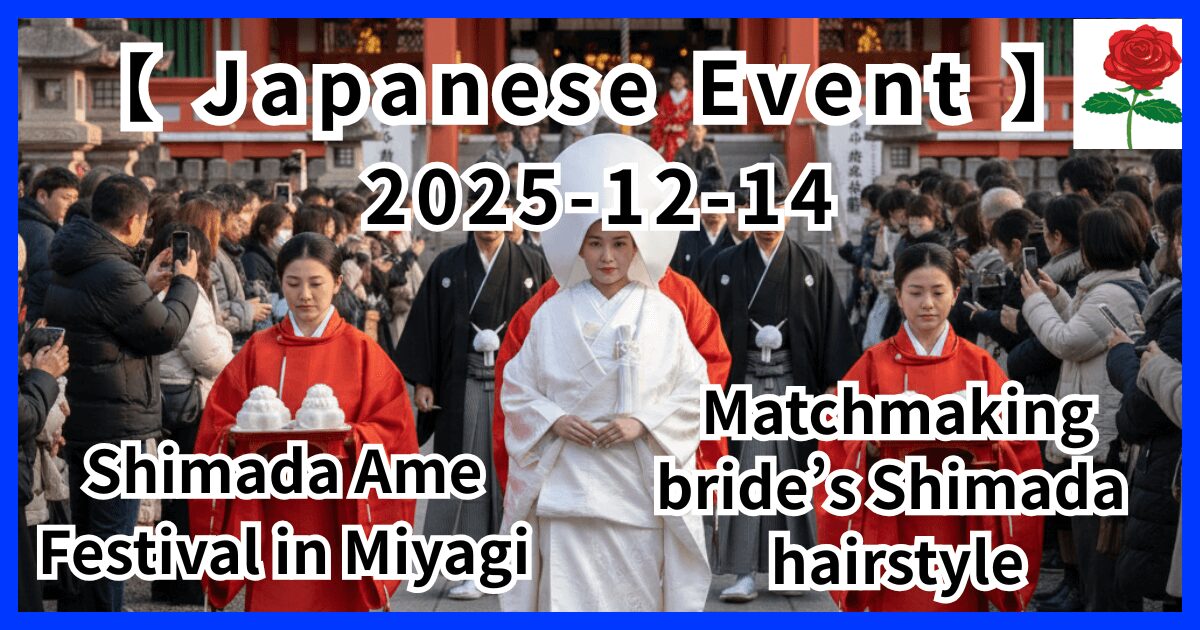
そして、ハイライトは、神社に島田飴を奉納する「花嫁行列」です。
The highlight of the event is the bridal procession, where the Shimada Ame is offered to the shrine.
白無垢、島田髷、緋色の装束をまとった人々が静かに練り歩く様子を見ていると、まるでタイムスリップして「物語の世界に迷い込んだ」ような気分になります。
Watching people dressed in white wedding kimonos, Shimada hairstyles, and scarlet attire quietly parade through the streets, makes you feel as if you’ve traveled back in time and “strayed into a world of stories.”
会場では、もう一つの縁起物「切り飴」も登場します。
Another lucky charm, “kiriame” (cut candy), will also be available at the venue.
「喜びが消えない」という願いが込められたこの飴は、毎年多くの人が求めて訪れます。
This candy, which is imbued with the wish that “joy will never fade,” is sought after every year by many people.
今日、私が伝えたいメッセージは一つあります。
Today, I have one message to convey:
「運命は待つものではなく、自ら創り出すもの」。
“Destiny is not something we wait for, but something we create ourselves.”
島田飴まつりは、そんなあなたを優しく後押ししてくれる行事です。
The Shimada Ame Festival is an event that will gently support you in this regard.
朝食に白菜の味噌汁か、優しい大根の煮物はいかがでしょうか?
How about some Chinese cabbage miso soup or a gentle stewed radish for breakfast?
朝食に感謝。
Thank you for breakfast.
応援と高評価、よろしくお願い致します。
Thank you for your support and likes.
Shimada-Ame Festival (Shimada Candy Festival) Information
Location and Date (Annual Event)
- Venue: Yoshioka Hachiman Shrine (Yoshioka Hachiman Jinja)
- 33 Machiura, Yoshioka, Taiwa Town, Kurokawa District, Miyagi Prefecture, Japan
- Date:Annually on December 14th
- This is a cherished traditional festival, known for centuries as a place where people pray for matchmaking and success in relationships.
Origin of Shimada-Ame and Wishes for Finding a Partner
The Shimada-Ame (Shimada Candy) has a deep historical origin connected to its unique shape.
- Shape’s Origin: Legend says that during the Edo period, the chief priest of the Yoshioka Hachiman Shrine fell ill. His wife gave him a candy shaped like the traditional “Shimada-mage” (Shimada hairstyle) as a substitute for medicine. The priest recovered completely after eating it.
- Matchmaking Origin:
- Since the Shimada hairstyle was the signature look for unmarried women, the candy became a symbol for wishing for good relationships and marriage.
- A custom spread where mothers of daughters nearing marriage would buy this candy after the festival and have their daughters eat it to pray for a good match.
- It is prized as a lucky charm symbolizing a happy marriage, not only sought by women hoping for a good relationship but also because its shape resembles the formal “Takashimada” wig worn by brides.
Charm and Significance of the Bridal Procession (Hanayome Dochu)
The “Hanayome Dochu” (Bridal Procession) is the festival’s highlight—a sacred ceremony where the candy is dedicated to the Yoshioka Hachiman Shrine.
- Procession Details: The parade consists of a bride dressed in traditional white kimono (Shiromuku) and cotton hood (Wataboshi) or head covering (Tsunokakushi), accompanied by attendants wearing traditional attire like the Shimada wig and crimson (Hiiro) Hakama. They walk solemnly through the town.
- Meaning of the Event: This procession reenacts and preserves the story of the priest’s wife’s sincerity and the long-held wish for good matches. It is believed that observing the procession itself brings good fortune in relationships to spectators.
- Visual Appeal: The sight is evocative of historical dramas and traditional Japanese weddings, creating a solemn and beautiful scene—making you feel as though you have “stepped back in time,” as mentioned in the original text.
“Kiri-Ame” – The Other Lucky Candy
- Alternative Name/Type: In addition to Shimada-Ame, another type of candy called “Kiri-Ame” (Cut Candy) or “Fuku-Ame” (Fortune Candy) is sold.
- Wish: As the name suggests, this candy carries the wish that “joy will never cease” and “good fortune will be continuous.”
- Availability: While the Shimada-Ame is highly limited (about 1,500 pieces), Kiri-Ame is easier to obtain and is popular as a souvenir.
Information on Finding Good Fortune and Relationships
While the Shimada-Ame Festival at Yoshioka Hachiman Shrine is famous, Japan has many other popular spots and customs believed to bring good luck in finding a match or a successful relationship.
Major Shrines and Temples for Relationships
- Izumo Taisha Grand Shrine (Izumo Ōyashiro)
- Location: Izumo City, Shimane Prefecture
- Significance: The main deity, Ōkuninushi-no-Ōkami, is said to govern the “unseen world” and is particularly known for presiding over matchmaking. It is traditionally believed that during Kamiari-zuki (the month when gods gather, around November on the modern calendar), all the gods of Japan gather here to hold a conference on human relationships.
- Jishu Shrine (Jishu Jinja)
- Location: Kyoto City (on the grounds of Kiyomizu-dera Temple)
- Significance: An ancient shrine said to have been founded in the Age of the Gods. Its main deities include Ōkuninushi-no-Mikoto. The “Love-Fortune-Telling Stones” on the grounds are famous; it’s said that if you can walk from one stone to the other with your eyes closed, your wish for love will come true.
- Tokyo Daijingu Shrine
- Location: Chiyoda Ward, Tokyo
- Significance: Known as “O-Ise-sama of Tokyo,” it enshrines Amaterasu Ōmikami, the same goddess as Ise Grand Shrine. It is also famous for being the first shrine in Japan to conduct Shinto-style wedding ceremonies, making it extremely popular among women seeking a relationship deity.
Charms and Customs for Wishing for Relationships
| Item/Custom | Associated Wish | Specific Examples |
| Omamori (Amulet) | To receive divine protection and attract good relationships. | “Enmusubi Omamori” from various shrines, heart-shaped Ema (votive plaques). |
| Red String | A symbol of the bond connecting a person to their destined soulmate. | Amulets or accessories using a red string or cord. |
| Ema (Votive Plaque) | To communicate specific wishes directly to the gods. | Writing your name and wish on special relationship-themed Ema. |
| Power Stones | To elevate one’s luck using the energy of the stone. | Rose Quartz (love luck), Inca Rose (soulmate), Amethyst (true love), etc. |
| Shimada-Ame | (From above) A lucky charm shaped like a bride’s hairstyle, wishing for a good match and marriage. | Sold at Yoshioka Hachiman Shrine in Taiwa Town, Miyagi Prefecture. |
The Philosophy Behind “Enmusubi”
The Japanese concept of Enmusubi (Relationship/Bonding Fortune) is broad; it doesn’t just refer to finding a romantic partner or spouse, but also includes all “good relationships” (Ryōen) in life, such as those with colleagues, friends, and even good health.
- Ryōen (Good Fortune): Includes not just romance and marriage, but all good human connections and opportunities that enrich one’s life.
- Action and Mindset: As mentioned in the Shimada-Ame text, the philosophy emphasizes that “fate is not something you wait for, but something you create yourself.” Taking proactive steps, such as praying at a shrine (declaring your wish) or eating the Shimada-Ame (taking action), is believed to be essential for attracting good relationships.