
[Japanese page]
[Previous article]
[Next article]
Self Lesson
Repeating the sentences out loud is the quickest way to train your Japanese brain!

2025年12月9日。
December 9, 2025.
今日は、「こんな日があるなんて知らなかった!」と思わずにはいられないお話をしたいと思います。
Today, I’d like to tell you a story that will make you say, “I never knew such a day existed!”
まずは想像してみてください。
First, imagine this.
「干し魚をアルカリ溶液に浸し、その後数日間水に浸して水分を補給する」。
“Dried fish is soaked in an alkaline solution, then soaked in water for several days to rehydr ate.”
そんな、とてつもなく時間のかかる料理があります。
There’s a dish that takes an incredibly long time to make.
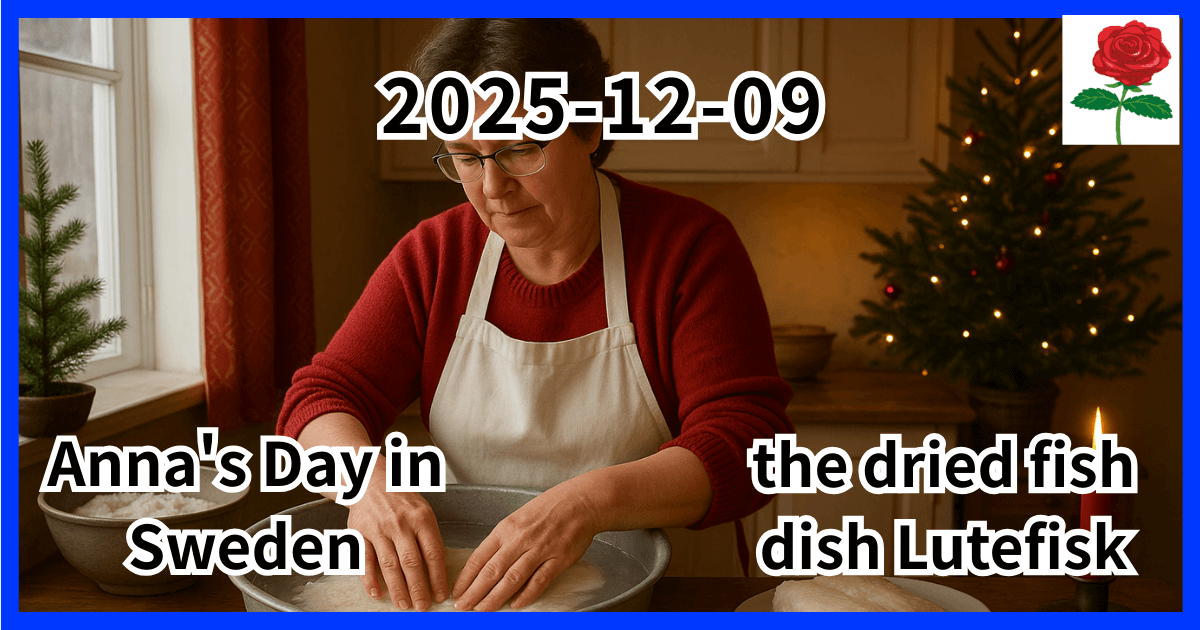
ルーテフィスクは、スウェーデンとフィンランドのクリスマスの定番です。
Lutefisk is a Christmas staple in Sweden and Finland.
伝統的に準備が始まるのは、12月9日、「アンナの日」です。
Traditionally, preparation begins on December 9th, Anna’s Day.
昔は、干した白身魚を灰と石灰を混ぜたアルカリ溶液に浸し、毎日水を交換しながらゆっくりと水分を補給していました。
In the old days, dried white fish was soaked in an alkaline solution made from a mixture of ash and lime, and the water was changed daily to slowly rehydrate it.
これが、クリスマス・イブの夕食に間に合うように仕上げるための「タイムリミット」だったわけです。
This was the “time limit” to finish it in time for Christmas Eve dinner.
「え?そんなに大変なの?」と思われるかもしれませんが、北欧では、これが冬の伝統なのです。
You might be thinking, “Huh? It’s really that hard,” but in Scandinavia, this is a winter tradition.
家庭によって味は様々ですが、北欧では「待ち遠しい伝統の味」として親しまれています。
The taste varies from household to household, but in Scandinavia it is beloved as a “long-awaited traditional taste.”
各国には、それぞれの食文化にまつわる物語があります。
Every country has its own stories connected to its food culture.
アンナの日は「季節を迎えるための知恵が詰まった日」とも言えます。
Anna’s Day can be said to be “a day filled with wisdom for welcoming the season.”
さて、日本では冬野菜が甘くなる季節。
In Japan, it’s the season when winter vegetables become sweet.
今朝はカブの味噌汁はいかがですか?
How about some turnip miso soup this morning?
身体がじんわり温まりますよ。
It’s sure to warm you up.
Nordic Christmas Traditions: Annadagen, Lutefisk, and Festive Feasts
Here is the information about Nordic Christmas traditions, translated into natural and easy-to-read English.
What is Annadagen (Saint Anna’s Day)?
- Date: Annually on December 9th.
- Origin: It comes from the Christian calendar, dedicated to Saint Anna, believed to be the grandmother of Jesus Christ. However, in the Nordic calendar, especially in Sweden and Finland, it became established as an important marker signaling a change of season starting in the Middle Ages.
- Traditional Role:
- Start of Christmas Prep: It marks the beginning of the serious Christmas season preparations.
- Starting Lutefisk: If you begin preparing Lutefisk—a Christmas staple—on this day, it was traditionally said to be ready just in time for Christmas Eve dinner (December 24th).
- Brewing Check: Traditionally, it was also the day to check if the Christmas beer and other brews were fermenting successfully.
- Weather Forecast: In rural areas, the weather on Annadagen was sometimes believed to predict the weather for the rest of the winter.
Details on Lutefisk
- Name Origin:
- The Swedish name “Lutefisk” comes from “lut” (lye or alkali solution) and “fisk” (fish), meaning “lye-treated fish.”
- Preparation Method: This process is incredibly time-consuming and unique:
- Drying Stage: First, white fish like cod are completely air-dried (stockfish).
- Lye Treatment (The “Ash and Lime” Step): The dried fish is soaked in an alkali solution for several days. Historically, this solution was made from the ashes of birch or slaked lime mixed with water. This treatment causes the fish to swell and gives it a distinctive, jelly-like texture.
- Rinsing: To remove the alkali, the fish is then soaked in fresh water for several days, with the water changed daily. This step is crucial for making the fish safe to eat.
- Cooking: Finally, it is cooked (boiled or baked) before serving.
- Food Culture:
- Season: It is a traditional dish primarily eaten during the Christmas season in Sweden, Finland (where it’s called lipeäkala), and Norway (where it’s called lutefisk).
- Taste and Texture: It is known for its mild flavor and a very delicate, soft, gelatinous texture.
- Serving: It is typically served with accompaniments like Béchamel sauce (white sauce), mustard, fried bacon, potatoes, and sometimes a purée of peas.
Why Start Preparing Lutefisk on Annadagen?
The main reason the preparation of Lutefisk (sometimes phonetically written as “Luiyfisk” in the source) traditionally starts on Annadagen is the extensive time required for processing.
- The Time Crunch: The process of soaking the fish in the alkali solution and then thoroughly rinsing it in fresh water for multiple days is essential to make it safe and palatable. The entire process takes a significant amount of time. By starting the preparation on December 9th, families ensured the dish would be ready just in time for their Christmas Eve dinner.
This tradition is truly a cultural legacy filled with seasonal wisdom, originating from a time before refrigeration when preserving food (fish) was vital for providing crucial nutrition throughout the long, cold winter.
As an interesting side note: Just as turnip miso soup is delicious in Japan during winter because the cold increases the vegetable’s natural sweetness, both Nordic and Japanese winter culinary traditions are rich with the wisdom of enjoying the season.
Fish Used for Lutefisk
Lutefisk’s origins lie in using fish that were preserved by drying (stockfish).
Main Species Used
The following white fish are primarily used:
| Species | Swedish/Norwegian Name | Characteristic |
| Cod | Torsk | The most common and traditional choice. It has a thick flesh that holds up well, developing a firm, gelatinous texture after lye treatment. |
| Halibut | Hälleflundra | A more premium option. It is flavorful and tends to hold its shape better than cod. |
| Hake | Lysekam / Kulleröa | Used in some specific regions. |
Drying Methods
These fish were historically preserved by drying them outdoors in the cold climate as either stockfish or klippfisk:
- Stockfish: Air-dried fish, primarily made in places like Norway’s Lofoten Islands, without salting.
- Klippfisk (Clipfish): Fish that has been salted before being dried (like salted cod).
The Lutefisk preparation method represents a unique culinary evolution, rehydrating this hard, dried fish using lye and then fresh water.
Popular Nordic Christmas Dishes
Beyond Lutefisk, countries like Sweden, Norway, Finland, and Denmark have diverse traditional dishes to celebrate Christmas (Jul or Yule).
Sweden (Julbord)
Swedes prepare a grand buffet called the “Julbord” (Christmas table):
- Julskinka (Christmas Ham): A cured ham, baked with a coating of breadcrumbs and mustard. It’s one of the main attractions.
- Janssons Frestelse (Jansson’s Temptation): A creamy potato, onion, and anchovy gratin baked in the oven.
- Köttbullar (Meatballs): The famous Swedish meatballs are a staple.
- Sill (Marinated Herring): Served in various flavors and marinades.
- Risgrynsgröt (Rice Porridge): Rice porridge cooked with milk. A single almond is often hidden inside, and the person who finds it is promised good fortune.
Norway (Julemiddag)
Norwegian traditions vary by region, often focusing on either meat or fish:
- Ribbe (Pork Ribs): Crispy-skinned pork spare ribs are popular (Eastern Norway).
- Pinnekjøtt (Dried Lamb Ribs): Salted and dried lamb ribs that are steamed (Western Norway).
- Lutefisk: Remains an important Christmas dish in Norway as well.
Denmark (Julefrokost)
- Flæskesteg (Roast Pork): A roast pork dish with crackling (crispy skin).
- Risalamande: A cold rice pudding with almonds and vanilla, topped with cherry sauce. Finding the hidden whole almond (Mandelgaven) is also a tradition here.
These feasts showcase how Nordic Christmas cuisine blends the wisdom of preservation (Lutefisk, ham, marinades) with warm, hearty dishes (gratins, roasts) to withstand the cold winter.
Nordic Christmas Drinks
Nordic Christmas is celebrated with warm, spiced drinks and traditional alcoholic beverages to keep people warm.
Glögg
- Overview: A type of mulled wine enjoyed across Sweden, Finland, and Norway, similar to a hot holiday punch.
- Ingredients: Red wine (or non-alcoholic berry juice), sugar, and a blend of spices like cinnamon, cloves, cardamom, and ginger, all heated together.
- How it’s Served: It is commonly served with raisins and blanched almonds added right before drinking. It’s the iconic drink for staying warm during Christmas.
- Alcohol Content: Sometimes fortified with vodka or brandy.
Christmas Beer (Julöl / Julebryg)
- Overview: Special brews made specifically for the Christmas season.
- Characteristics: They are traditionally darker (amber to dark), full-bodied, and often have a higher alcohol content and richer, spicier, or sweeter flavors, designed to be slowly savored in the cold.
Julmust (Christmas Must)
- Overview: An extremely popular non-alcoholic soft drink in Sweden, combining “Jul” (Christmas) and “Must” (must/juice).
- Characteristics: It has a unique flavor derived from hop and malt extracts, and is dark-colored and carbonated, similar to cola. Its sales during the Christmas season in Sweden are so high that they overshadow all other soft drinks.
Nordic Christmas Sweets
Most sweets are designed to keep well, centering on baked goods (gingerbread, cookies) and milk/rice desserts.
Pepparkakor
- Overview: The beloved gingerbread cookies of Sweden.
- Characteristics: They are thin, crispy, and highly spiced with ginger, cloves, and cinnamon. They are typically cut into shapes like stars, hearts, and the Yule Goat (Julbock).
- Custom: They are often hung on the Christmas tree as decorations.
Lussekatter (St. Lucia Buns)
- Overview: Saffron-flavored sweet buns strongly associated with Sweden’s St. Lucia’s Day (December 13th).
- Characteristics: Colored yellow by saffron, they are uniquely shaped into S-curves or coiled forms (the Lussekatter or “Lucia cats”). Raisins are used for decoration.
- St. Lucia’s Day: December 13th is near the winter solstice, a major celebration of light, and these buns symbolize light (the yellow of the saffron).
Crispy Nuts & Candy
- Knäck (Toffee): A hard caramel or taffy made by boiling down sugar, butter, and cream.
- Mandelmassa (Almond Paste): Used in chocolate candies or as a filling for baked goods.
- Gingerbread Houses: Making houses out of gingerbread dough and decorating them with icing is another Christmas staple.
These drinks and sweets enhance the long period following Annadagen when Nordic homes are filled with the warmth and joy of Christmas preparations.
Would you like to know more about the specific history of the ingredients used in these dishes?