[Japanese page]
[Previous article]
[Next article]
- Information about this article
- Introduction
- The History and Spirit of Ancient Whaling
- From Jizoji Temple Prayer to the Asuka Shrine Voyage
- “Ancient Whaling Rituals” Hidden in White Paint and Kumadori
- The Energetic Return of the “Haraso-bune” and the Chant
- The Climax: Recreating the Ancient Whaling Hunt
- The Netting Maneuver (Oikomi – The Drive)
- The Harpoon Strike (Sodome – The Finishing Blow)
- A Performance Not Just to “Show” but to “Transmit”
- The Conclusion of the Festival and the Baton to the Next Generation
- The Significance of Coming of Age Day
- A Message of Gratitude for Life and Coexistence
- Conclusion
Information about this article
1. About the Owase Haraso Festival
The Owase Haraso Festival is a Shinto ritual held on Coming-of-Age Day in Owase City, Mie Prefecture, originating from ancient traditional whaling practices. The festival preserves the region’s deep connection with the sea and features powerful and dynamic ceremonies through which participants pray for abundant catches and safe maritime voyages.
2. Origins and Historical Background of the Festival
The festival traces its roots to the traditional whaling culture that once flourished in Owase. Performed as a sacred rite to express gratitude to whales and offer prayers for their spirits, it strongly reflects the history of local communities living in harmony with the blessings of the natural world.
3. Highlights of the Ritual and Local Cultural Significance
Key highlights of the festival include distinctive movements and chants that reenact whaling scenes, along with the energetic and spirited performances of young participants. The ritual is carefully preserved as a way to pass down local traditions to future generations, offering visitors a rare opportunity to experience Owase’s unique maritime faith and coastal culture.
Introduction
Owase City is a port town nestled in the southern part of Mie Prefecture, embraced by rich nature and facing the rugged Kumano Sea. This region has historically thrived on fishing, cultivating a unique sea and mountain culture, especially in the Higashi-Kishu area. It is here, in Kajika Town on the southernmost tip of Owase, that a rare and unique traditional event—the Haraso Festival—takes place every year on the morning of Coming of Age Day (Seijin no Hi).
The Haraso Festival is far more than a simple regional celebration or an oddity. At its core, the festival embodies the enduring memory of ancient, traditional whaling that flourished in this area since the mid-Edo period, along with a deep sense of reverence for the bounty of the sea and the life of the whale. This long-standing tradition is a precious opportunity for locals to reaffirm their roots and their community pride.
Today, the word “whaling” is often accompanied by international debate and controversy. However, what the Haraso Festival recreates is not the act of hunting itself, but rather a solemn ritual of gratitude for receiving a life, and the spiritual culture of ancestors who lived alongside the sea. The festival’s historical context reveals the humble attitude of the people back then, who respected the whale as a vital resource that supported their livelihood, utilizing every part of the animal—the meat, oil, and bones—without waste.
In this article, we will delve into the profound significance of the Haraso Festival of Kajika Town, Owase City. To help first-time visitors understand its appeal and cultural importance, we will focus on the following key points:
- The historical background of the Haraso Festival and the meaning embedded in the chant “Haraso.”
- The specific rituals and flow of the traditional whaling recreation performed on the day of the festival.
- The deep connection to Coming of Age Day and its role as a rite of passage for young men.
- The universal themes of the festival regarding the relationship between humanity and nature in the modern world.
As the sound of drums and powerful chants echoes across the port in the crisp winter air, it feels as if one has traveled back in time several centuries. This festival is a living folk culture of rural Japan that is slowly fading, symbolizing the vigorous, yet nature-harmonizing way of life unique to Owase.

The History and Spirit of Ancient Whaling
To truly understand the Haraso Festival, we must first learn about the history of ancient whaling in the Owase area, its roots, and the profound meaning of the word “Haraso,” which is the core of the festival. This is because whaling in this region was not merely an industrial activity; it was the historical foundation that shaped the very lifestyle and spiritual culture of the people.
The Rise of Whaling and the “Kujira-gumi” in Higashi-Kishu
Whaling flourished in the Higashi-Kishu region, particularly along the coast of the Kumano Sea, including Kajika Town in Owase City, starting in the Edo period (1603–1868). Since modern whaling techniques did not yet exist, the practice of “Kotoshiki Hogei” (Ancient Whaling) was employed, which demanded unique local skills and highly organized teams.
Unlike the modern, deep-sea expeditions, ancient whaling involved several small boats working together to track, encircle, and corner whales migrating near the coast, using harpoons and nets for capture. This highly specialized method was managed by large fishing organizations known as “Kujira-gumi” (Whaling Guilds). While Taiji is perhaps the most famous whaling town on the Kii Peninsula, Owase and its neighboring fishing villages (ura) also established their own specific whaling systems, playing a vital role in supporting the local economy.
For common people during the Edo period, the whale was a treasure trove of resources: a crucial source of protein, and a supply of oil used for lamps and fertilizer. Even the bones were utilized for crafts and building materials. It was truly a resource “from which nothing was discarded.” Therefore, successfully catching just one whale meant prosperity for the entire village, making the success of the hunt a matter of critical importance to the community’s survival.
The Origin of “Haraso” and the Cry of the Soul
The word “Haraso,” the source of the festival’s name and its most symbolic element, is believed to derive from the powerful chant that whalers shouted during the hunt.
The fishermen would board large Japanese-style boats called “Hatcho-ro” (eight-oar boats), needing to navigate the rough waters of the Kumano Sea with perfectly synchronized rowing. The chant “Haraso” was shouted to align the rowers’ breathing and boost morale during the taxing act of rowing the ro (oars) and in the tense moments of chasing the whale.
This chant is thought to have carried multiple layers of meaning:
- Coordination and Rhythm: A signal to synchronize the rhythm of the rowers’ movements (the handling of the oars) to ensure the boat progressed safely and efficiently through the rough waves.
- Spirit and Morale: A spiritual force intended to dispel fear and muster courage when confronting the enormous whale or challenging a stormy sea.
- Prayer for Safety: An incantation or prayer-like element for the safe return of the crew and a successful catch.
In essence, “Haraso” was not just a work command; it was the “cry of the soul” shouted by fishermen as they faced the sea and the immense power of life. It symbolizes their entire spiritual culture. The act of recreating this chant during the festival is nothing less than passing down the immense labor of their ancestors and the solidarity of their community to the future.
The Haraso Festival continues to strongly thrive on the waters of Kajika Town, Owase City, as a “living folk cultural asset” that preserves the history of ancient whaling and the spirit of “Haraso” in a contemporary form.
From Jizoji Temple Prayer to the Asuka Shrine Voyage
On the day of the Haraso Festival, preparations begin before dawn in the cold air, which reflects the harsh winter conditions of the Kumano Sea. A significant feature of this event is that the entire process is not just a performance recreating whaling; it is accompanied by a series of solemn religious and ceremonial elements, including reverence for the gods and Buddha, prayers for safety, and memorial rites for the whales.
The Opening of the Festival
The festival begins at Jizoji Temple, located in Kajika Town, the event’s primary location along with the Kajika Fishing Port.
Here, the “Ura-kitō” (Village Prayer) is solemnly performed to pray for the safety of the port, a plentiful catch, and the well-being of all festival participants. In the era when whaling flourished, fishing was a constant risk to life. Beyond the danger of confronting a massive whale, the unpredictable weather of the rough Kumano Sea meant that venturing out to fish was an act close to death.
The prayer at Jizoji Temple was a crucial ritual to calm the anxiety and fear of the fishermen and seek protection from the divine. It also included memorial services for the fishermen who lost their lives during the hunt, and for the whales whose lives were taken as a bounty. This quiet time of prayer establishes the spiritual foundation for the spirited maritime festival that is about to begin.
Upon concluding the prayer, the local men (the otokoshu) participating in the festival focus their minds and embark on the event with a strong sense of communal mission.
Preparation and Departure of the “Haraso-bune”
After the prayers, the men proceed to the Kajika Fishing Port.
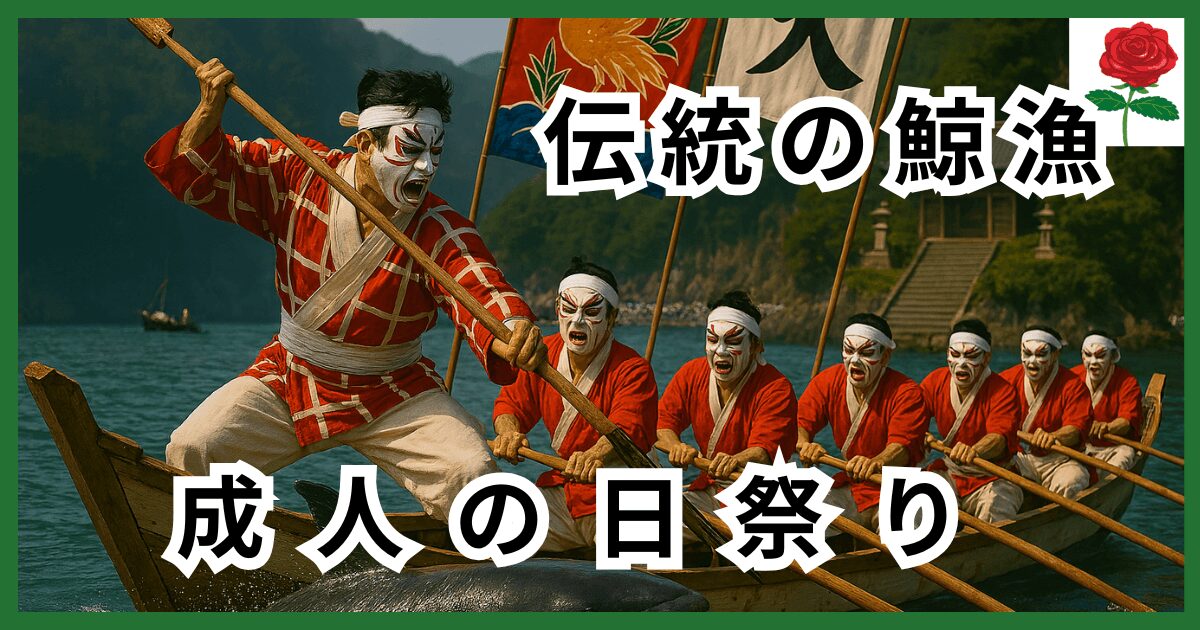
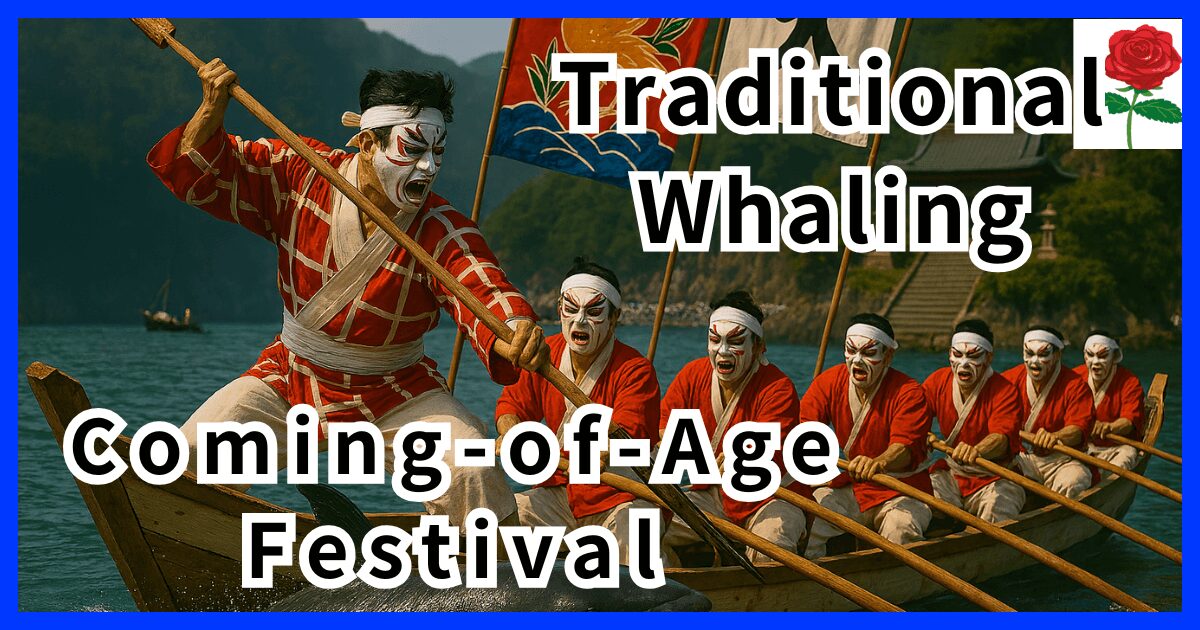
This is where the main protagonists of the festival, the “Haraso-bune” (Haraso Boats), appear. The Haraso-bune are traditional Japanese-style boats (waisen) modeled after those actually used in ancient whaling, specifically the Hatcho-ro (eight-oar boat). A majestic Tairyō-bata (big catch flag) is hoisted on the boat, making its appearance a vibrant symbol of the festival’s energy from afar.
- Hatcho-ro: The name “Hatcho” (eight oars) signifies that the boat is equipped with eight ro (oars). This illustrates the scale of the whaling vessels of the time and the critical importance of teamwork among the numerous rowers.
The local men (young and old) and other interested participants board the Haraso-bune. Although they still look like ordinary people at this point—the ceremonial face paint comes later—a deep seriousness is visible in their eyes as participants in the sacred event.
Instead of rowing out under their own power immediately, the boat is towed by a modern fishing vessel to its next destination: the Asuka Shrine located in the neighboring Sone district. This sea voyage is more than just transportation; it holds the sacred meaning of “Togyo” (a ritual procession), symbolizing the route taken by the gods for the ceremonies that follow.
Maritime Ritual
When the towed Haraso-bune arrives in front of Asuka Shrine in the Sone district—a sacred stretch of the Kumano Sea coast—a vital ceremony takes place.
The men disembark from the boat and ascend the embankment to perform the “Kujira-hō” (Whale Method), a type of Shinto ritual or devotional performance. The Kujira-hō is said to be a kind of dance or ceremonial movement accompanied by ritualistic gestures, intended to report the success of the whaling to the gods and appease the spirits of the whales. This initial offering is considered a preliminary stage, showing reverence to the sea and the gods and seeking their permission before enacting the main ancient whaling performance (the later “Kotoshiki Kujira-hō”).
Asuka Shrine is believed to enshrine gods of navigation safety and fishing, demonstrating how deeply local beliefs and whaling culture were intertwined.
The Pre-Ritual Transformation
After performing the Kujira-hō at Asuka Shrine, the men prepare for the festival’s highlight. This preparation involves the “Kewai” (makeup), which is the most striking visual feature of the Haraso Festival.
The men change into traditional costumes of red, white, or black. Most strikingly, they paint their entire faces stark white and use lipstick or other colors to draw bold, theatrical patterns, similar to the Kumadori makeup found in Kabuki theater.
The purpose of this makeup is not merely for show or performance:
- Sacredization: The white base is presumed to signify entering a sacred state as participants in a religious rite, separating themselves from the secular world, and showing their resolve to confront the sea and the whale—beings from a different realm.
- Transformation: The Kumadori represents a transformation from the daily persona of a fisherman to someone playing a role in the non-ordinary setting of the hunt, containing elements of theatricality. This fierce and striking appearance embodies the intensity and spirit of the fishermen battling the whale in the rough seas of the past.
By applying this makeup, they are completely transformed into “Haraso Festival participants,” ready to row their boats toward the recreation of the ancient whaling method, the grand climax of the entire festival.
“Ancient Whaling Rituals” Hidden in White Paint and Kumadori
The Haraso-bune, carrying the men transformed by their makeup and filled with extraordinary intensity after completing the sacred rites at Asuka Shrine, finally returns to the Kajika Fishing Port. This marks the beginning of the festival’s most spirited highlight: the recreation of the “Kotoshiki Kujira-hō” (Ancient Whaling Method). This performance embodies the entire, life-or-death process that the fishermen of Kajika once endured when confronting the whale.
The Energetic Return of the “Haraso-bune” and the Chant
The Haraso-bune, now manned by the heavily made-up participants, heads back to Kajika Fishing Port. During this return journey and within the bay area, the powerful chant “Haraso, Haraso!”—the origin of the festival’s name—reverberates repeatedly over the winter sea.
This chant is particularly crucial when the ancient rowing technique, utilizing the ro (oars), is demonstrated. The rowers move in perfect unison, their synchronized efforts propelling the boat forward powerfully, all timed to the chant. This is more than just a recreation of the rowing style; it is a spiritual performance expressing the collective rhythm, solidarity, and determination needed to overcome the rough seas. For spectators, the scene where the drum beats blend with the brave “Haraso” chant is the moment that evokes the highest sense of excitement and tension in the festival.
This ancient rowing method demonstrates to the present day the high level of teamwork and physical capability possessed by the fishermen of the time, making it truly a transmission of “living technique.”
The Climax: Recreating the Ancient Whaling Hunt
As the rowing and chanting of the Haraso-bune reach their peak, the boat transitions into the hunt phase, culminating in the “Kotoshiki Kujira-hō” climax. This recreated performance includes the following critical steps:
The Netting Maneuver (Oikomi – The Drive)
In ancient whaling, nets were often used to drive whales into shallow waters or bays, restricting their movement. The festival recreation includes the tense motions of throwing nets or encircling the whale to prevent its escape.
The participants’ agile movements and the tight coordination required in this scene illustrate just how meticulously planned the Kujira-gumi organization was as a collective.
The Harpoon Strike (Sodome – The Finishing Blow)
The most dramatic and impactful moment is the act of striking the whale with the mori (harpoon). The person standing at the bow of the boat throws the harpoon at the virtual whale with all their strength. This “finishing blow” is a performance, yet it symbolizes the sincere resolve to take a life when confronting such a massive creature, as well as the high level of skill possessed by the whalers.
The men’s white faces, the Kabuki-style Kumadori, and their imposing costumes heighten the drama of this movement, drawing the audience into the intensity of the moment. This sequence of actions is repeated multiple times, drawing loud cheers from the spectators each time.
A Performance Not Just to “Show” but to “Transmit”
The recreation of the “Kotoshiki Kujira-hō” is not merely a show for tourists. It is a critical act through which the young men of Kajika “learn with their bodies” the skills, wisdom, and spirit of their ancestors.
- Inheritance of Technique: Skills like boat handling, oar strokes, and the timing of the harpoon throw—the very techniques of the old whalers—are passed down from generation to generation.
- Reliving History: Through this performance, the youth re-experience the harsh environment in which their ancestors lived alongside the sea and the immense labor involved.
- Community Bonds: By supporting the festival collectively and fostering the younger generation, the community’s unity is strengthened.
Participating in this festival is a vital rite for establishing the young men’s identity as the “Men of Kajika,” those who live by the sea. The ceremonial makeup they wear can also be interpreted as a “temporary guise” to invoke the spirits of their ancestors, lending them strength for the momentous task and deepening the sacred meaning of the festival.
The Conclusion of the Festival and the Baton to the Next Generation
After the spirited recreation of the “Kotoshiki Kujira-hō” concludes, the Haraso-bune returns to the Kajika Fishing Port. With the completion of this sequence of rituals, they conclude their expression of gratitude for the demanding labor of whaling and for the blessings of life it provided.
Finally, the festival often concludes with local residents gathering for events such as Mochi-maki (rice cake scattering). This is a crucial communal closing ceremony to share the joy of a safe journey and a successful “hunt,” rally community spirit, and build anticipation for the following year’s festival.
The Significance of Coming of Age Day
What makes the Haraso Festival particularly unique among Japan’s traditional events is its strong connection to the national holiday, “Seijin no Hi” (Coming of Age Day). This link is not just a matter of scheduling convenience; it clearly demonstrates the festival’s fundamental role as a “rite of passage for youth.” The Haraso Festival distinctly preserves the traditional meaning of becoming a “full-fledged adult” within the communal framework, setting it apart from modern Coming of Age ceremonies.
Adulthood Means Becoming a Full-Fledged Fisherman
In the fishing village society of the past, especially in Kajika Town, where livelihoods depended on the life-threatening industry of whaling, the meaning of “adulthood” carried a weight far different from today’s society. It was not merely reaching a legal age; it meant having the capability and the responsibility to support the community’s life and safety as a “full-fledged fisherman (Uminchu)” capable of risking his life at sea.
The ancient whaling process demanded advanced boat-handling skills, robust physical strength, and instantaneous coordination among crew members. These skills were not learned through mere study; they could only be acquired through years of experience and physical training. For the young men, participating as an oarsman on a whaling boat was the ultimate validation of being recognized as a full-fledged man.
The Haraso Festival is held on Coming of Age Day because of its long-standing history as the day when young men inherited the responsibility of being the regional torchbearers, particularly as men of the sea.
Three Elements of the Festival’s Rite of Passage
The participation of young men in the Haraso Festival involves several elements of a rite of passage:
The Granting of a Role and Integration into the Community
While modern Coming of Age ceremonies tend to celebrate the individual’s milestone, the Haraso Festival signifies the granting of a vital role as a member of the collective. The young men take on the extremely important duty of rowing the Haraso-bune, bearing the Tairyō-bata (Big Catch Flag), and shouting the “Haraso!” chant, fulfilling the very tasks performed by their predecessors.
Through this act, they gain a strong awareness that “I am a person who supports this community.” The success of the festival depends on their efforts, and this experience of success fosters their sense of adult responsibility.
Sharing Physical and Spiritual Ordeals
Confronting the cold of the winter Kumano Sea, the physical hardship of rowing heavy oars on rough waters, and the participation in the solemn ritual of recreating ancient whaling all constitute a physical and spiritual ordeal for the youth. Overcoming this trial alongside their community members forges a powerful sense of solidarity and a bond that transcends generations.
The act of applying makeup and adopting a non-ordinary appearance is also part of the spiritual ordeal—stepping away from the everyday self to fully embody the sacred role required by the festival.
Embodiment of Ancestral Wisdom and History
The techniques and rituals of ancient whaling recreated during the festival are the history of Kajika itself. Through the performance, the young men physically learn how their ancestors confronted the sea, how they secured resources with ingenuity and wisdom, and the feelings of those who gave their lives.
This is more than just learning history; it is the act of internalizing the regional cultural identity, thereby establishing the “pride” and “roots” necessary to live in this community.
Community Recognition and Approval as New Torchbearers
The young men who participate in the Haraso Festival and successfully carry out their momentous roles are approved as “full-fledged men” by the entire community.
Their brave appearance is not merely a spectacle; for the elders and families living in the community, it brings a sense of relief and joy that the future of the region is being passed on. The post-festival gatherings, such as the Mochi-maki (rice cake scattering), are opportunities for this cross-generational sharing of joy and a celebratory moment expressing hope for the young men.
In an age where modern Coming of Age ceremonies are diversifying and often leaning toward individualism, the Haraso Festival powerfully and concretely demonstrates the profound meaning of “becoming an adult within the community.” Through this experience, the youth grow into new bearers of the local culture and livelihood, taking pride in being a “Man of Kajika.”
A Message of Gratitude for Life and Coexistence
The Haraso Festival is not simply a recreation of past fishing practices; it conveys an important message on universal themes relevant to contemporary society, such as the “relationship between humanity and nature” and how we “approach the sanctity of life.” We will deeply examine the profound significance of why this festival, which upholds a whaling culture, remains cherished and draws attention today.
The Humble Stance of “Receiving” a Life
The deepest cultural significance of the Haraso Festival lies in its reframing of the act of taking a life as a “sacred ritual.”
While ancient whalers found joy in catching a whale, they simultaneously felt a powerful sense of awe and an obligation to provide memorial services for the life they ended. The very fact that they utilized every single part of the captured whale without waste demonstrates their “gratitude for the bounty” and “respect for the dignity of life.” The prayers at Jizoji Temple for the whale’s spirit and the Kujira-hō offering at Asuka Shrine are evidence that they saw themselves not just as resource exploiters, but as people confronting life as part of nature’s inherent order.
In modern society, much of our food reaches consumers without the faces of the producers or the reality of the process being visible, often leading to a diminished sense of the effort and gratitude behind life. Through the valiant movements of the boats and the sincere expressions of the men, the Haraso Festival powerfully asserts the undeniable truth to contemporary people: “Our existence relies upon the lives of others.”
A Perspective of “Coexistence” Beyond Environmental Issues
Whaling is a subject of debate today concerning international environmental protection and resource management. However, the “whaling culture” conveyed by the Haraso Festival embodies the “wisdom” of a local community seeking to coexist with the sea sustainably, rather than promoting resource depletion.
Ancient whaling did not rely on mechanical power like modern whaling and was a method of utilizing whales as a local resource without drastically disrupting the marine ecosystem. The tight teamwork, deep knowledge of the sea, and prayers for success recreated in the festival reflect the philosophy of “coexistence” held by the ancestors, who revered the sea and sought to live in harmony with nature.
The Haraso Festival does not seek to argue the pros and cons of whaling itself; rather, it transmits the history of people who lived with the whale—a magnificent creature—at the center of their culture, faith, and economy. Understanding this history serves as an opportunity for us today to recognize how deeply intertwined our own lives are with the natural environment.
The Preservation of Local Culture and the Reassessment of “Slow Values”
In rural areas facing depopulation and aging demographics, maintaining traditional events like the Haraso Festival is not easy. However, the determination of the people of Kajika Town to continue holding this festival on Coming of Age Day stems from a strong resolve to pass on their regional cultural identity to the next generation.
Through the festival, young people learn their history and role, and visitors from outside the region are exposed to the unique cultural depth of Owase. Such efforts attract external interest, potentially encouraging U-turns (return migration) or relocation, playing a vital role in sustaining the vitality of the local community.
Furthermore, the “slow yet strong way of life” values inherent in the Haraso Festival—taking time for preparation, working toward a single goal as an entire community, and giving thanks for the bounty of life—offer people a moment to pause and reflect in a busy, efficiency-driven modern world:
- The Power of Community: The traditional value of prioritizing the safety and prosperity of the whole community over individual gain.
- Dialogue with Nature: A continuously humble attitude toward the sea—a nature that is both severe and abundant.
These very elements constitute the most valuable message the Haraso Festival offers to contemporary society. A visit to this festival can be a journey to discover the seeds of a sustainable lifestyle that still thrive in rural Japan.
Conclusion
The “Haraso Festival,” passed down in Kajika Town, Owase City, Mie Prefecture, is an exceptionally vital cultural event in which people today inherit the traditions of ancient whaling, dating back to the Edo period, with their bodies and souls. Throughout this article, we have confirmed that the festival is not merely a “re-enactment of a whale hunt,” but rather the culmination of a community culture that celebrates deep gratitude toward the sea, humility toward life, and the growth of its youth.
The Human-Nature Relationship
The greatest appeal of the Haraso Festival lies in the severe yet warm relationship between humanity and nature that flows beneath the surface of its dynamic performance.
In the harsh natural environment of the rough Kumano Sea during winter, people risked their lives, exercised their wisdom, and above all, united to secure the enormous bounty of the whale. The powerful chant “Haraso!” is the symbol of that unity, a spiritual “weapon” forged by the ancestors to confront the rough waves.
While modern society increasingly seeks to control nature, the Haraso Festival vividly reflects the traditional Japanese view of nature—one that reveres the natural world and sees its bounty as a gift to “sustain life.” The series of rituals performed by the men in ceremonial makeup serves as a living textbook, conveying the cycle of life and the collective responsibility to the next generation.
Rediscovering a “Slow, Vigorous” Way of Life
In small fishing villages like Kajika Town, where the Haraso Festival is held, a “slow, vigorous way of life” thrives, far removed from the clamor of the city.
Here, human connection, regional history, and harmony with nature take precedence over economic efficiency. The young embrace their communal roles, and the elders pass on their wisdom and history. This tight generational bond and the shared love for the common environment, the sea, form the bedrock of the community.
Visiting the Haraso Festival as a tourist offers an opportunity to experience these “slow values” and reflect on your own modern lifestyle. Taking a moment away from a busy routine to immerse yourself in a vibrant rural culture can be a precious first step toward contemplating what true fulfillment and a genuine slow life might mean for you.
Contributing to the Preservation of Tradition
Traditional events like the Haraso Festival face increasing difficulty in their maintenance each year due to a lack of successors and changing lifestyles. However, when visitors from across the country attend, recognize the festival’s value, and show interest in the region, they become a force that ultimately supports the continuation of the tradition.
While calling it “support” might sound grand, the very act of visiting the festival, enjoying the local culture and food, and sharing in the community’s passion provides significant energy to pass the culture on to the next generation.
The Haraso Festival is not just a spectacle; it is a journey into the depths of Japanese culture. We encourage you to visit Kajika Town in Owase City this winter, listen to the powerful “Haraso!” chant, and feel the pride of the ancestors who lived alongside the sea, along with the passion of the people who keep their spirit alive today.
Career advancement
2026年1月12日。
January 12th, 2026.
この日、三重県尾鷲市では、古来より受け継がれてきた独特の伝統行事「ハラソ祭り」が開催されます。
On this day, Owase City, Mie Prefecture, will host the Haraso Festival, a unique traditional event that has been passed down since ancient times.
皆さん、想像してみてください!
Imagine!
もし江戸時代の勇壮な捕鯨の様子が、目の前で再現されるとしたら。
What if the heroic whaling scenes of the Edo period were reenacted right before your eyes?
捕鯨が盛んだった江戸時代、地元の漁師たちは「ハラソ、ハラソ!」と掛け声をあげながら、海へと漕ぎ出しました。
During the Edo period, when whaling was popular, local fishermen would set out to sea chanting, “Haraso, haraaso!”
今日の祭りもその伝統を受け継ぎ、「ハラソ船」が漁旗を掲げて港内を航行します。
Today’s festival continues this tradition, with “haraaso boats” sailing within the harbor with fishing flags hoisted.
漁師たちへの祈祷の後、船は曽根の飛鳥神社へと向かいます。
After prayers for the fishermen, the boats head to Asuka Shrine in Sone.
そこでは、勇壮な捕鯨技術や伝統的な捕鯨の実演が披露されます。
There, they will demonstrate heroic whaling techniques and traditional whaling techniques.
紅白の衣装に白化粧を施し、歌舞伎風の隈取りを身につけた男たちが、当時の漁の様子を見事に再現します。
Men in red and white costumes, white makeup, and kabuki-style makeup beautifully reenact the fishing scenes of that time.
観客からは歓声と拍手が沸き起こります。
The audience erupts in cheers and applause.
この祭りは、鯨への感謝の気持ちを表し、豊漁と航海の安全を祈願する、200年以上の歴史を持つ伝統行事と言われています。
This festival is said to be a traditional event with over 200 years of history, expressing gratitude to whales and praying for a good catch and safe voyages.
大漁を祈願するとともに、地域の誇りと文化を象徴するものとして、今も受け継がれています。
In addition to praying for a good catch, it has been passed down to this day as a symbol of the region’s pride and culture.
この素晴らしい伝統を感じながら、ぜひ尾鷲の海と人々の思いに触れてみてください。
Come experience this wonderful tradition and get in touch with the sea of Owase and the thoughts of its people.
あなたらしいスローライフをお楽しみください。
Enjoy your own slow life.
朝食ありがとう。
Thank you for breakfast.
応援と高評価をよろしくお願い致します。
We appreciate your support and a high rating.