[Japanese page]
[Previous article]
[Next article]
Information about this article
1. What Is the Akiba Fire Festival?
The Akiba Fire Festival is a traditional Shinto ritual rooted in Akiba faith, which venerates Akiba as a deity of fire protection. The festival has long been held to pray for protection from fire-related disasters and for good health, reflecting beliefs that have been closely tied to everyday life for centuries.
It is a symbolic festival that expresses reverence for fire and heartfelt prayers, deeply connected to the lives of local communities since ancient times.
2. The Three Sacred Performances: Bow, Sword, and Fire Dances
The defining feature of the Akiba Fire Festival is its three ritual performances: the Bow Dance, Sword Dance, and Fire Dance.
Each dance carries specific meanings—warding off evil spirits, preventing misfortune, and protecting against fire disasters—and is performed as a solemn offering to the deities.
3. Highlights and the Festival’s Powerful Atmosphere
The Fire Dance, in particular, features bold and dramatic performances using torches and open flames, creating an intense and unforgettable spectacle against the nighttime shrine grounds.
The Akiba Fire Festival continues to captivate visitors as an event where one can experience the raw power of ancient Japanese beliefs and sacred rituals firsthand.
Introduction
December 16, 2025. Winter has arrived, bringing with it a biting chill. On this night, at the peak of Mount Akiba (Akihasan) in the mountainous region of Hamamatsu City, Shizuoka Prefecture, crimson flames forcefully pierce the darkness, tearing through the silence.
These flames are neither artificial lighting nor performance effects; they are “fire of prayer” offered to the deity.
The Akiba Fire Festival (Akiba no Himatsuri), which is strictly and solemnly held every year at the Akihasan Hongū Akiba Shrine, is known among the countless fire festivals across Japan as a ritual that is uniquely quiet, deeply solemn, and profoundly significant. Although raging flames are present before the viewers, the atmosphere is not one of excitement or fervor. Instead, those in attendance are enveloped by a strained silence that urges their minds inward.
Why have people revered, feared, and made “fire”—a dangerous force that can destroy everything in an instant—an object of such deep prayer?
Since ancient times, the Japanese people have regarded fire as a presence with a dual nature: both a “blessing” and a “calamity.” While fire provided cooking and warmth, fundamentally supporting life, if control was lost, it could instantly turn settlements and forests into ashes. For those who lived in mountainous areas particularly susceptible to fire damage, fire was truly a presence inseparable from daily life.
In this article, we will examine the profound nature of this faith, unraveling how the Japanese people have confronted fire and cultivated a spirit of coexistence through the sacred Akiba Fire Festival. This festival is not merely a traditional event; it is a sacred ritual that conveys the very essence of the faith—”to pacify fire, revere fire, and live alongside fire”—a spirit passed down through generations of Japanese people, especially those who lived by and protected the mountains.

The Grand Head Shrine of Fire Prevention Faith
To truly grasp the essence of the Akiba Fire Festival, it is essential to understand the history of the Akihasan Hongū Akiba Shrine, the stage for the festival, and the fire prevention (Hibuse) faith it has cultivated.
Overview of the Shrine and its Deity
The Akihasan Hongū Akiba Shrine is situated in Haruno-chō, Tenryū Ward, Hamamatsu City, Shizuoka Prefecture, resting atop Mount Akiba (Akihasan), which boasts an elevation of 866 meters. This shrine serves as the Sōhongū (Grand Head Shrine) for the estimated 400 Akiba Shrines nationwide. It has long been the central pillar of Japan’s fire prevention faith, attracting profound devotion.
The primary deity enshrined here is Hinokagutsuchi no Ōkami, often referred to as the God of Fire. In the ancient Japanese chronicle Kojiki, this deity is said to have been born from Izanami-no-mikoto when she gave birth to fire, symbolizing the immense power of fire itself. Hinokagutsuchi no Ōkami is revered not only as the ruler of the indispensable force of fire in daily life but also as the deity of Hibuse—the God of Fire Prevention and Pacification of Fire.
Mount Akiba and Mountain Worship
Mount Akiba itself has been worshipped as a sacred mountain since ancient times. The background to the Akiba Shrine establishing its current firm position as the God of Fire Prevention is heavily intertwined with the influence of Shugendō (Japanese mountain asceticism). From the Middle Ages onward, the mountain became a training ground for shugenja (mountain ascetics), and through their activities, the divine power of fire prevention is believed to have spread throughout the country.
Especially during the Edo period (1603–1868), devastating fires frequently occurred in major cities, starting with Edo (modern-day Tokyo). As wooden architecture was the norm in Japan at that time, fire was the greatest threat to urban life, leading people to desperately seek protection from fire. Consequently, the faith in Mount Akiba as the God of Fire Prevention spread explosively. Branch shrines were established in various regions, and religious organizations called Akiba-kō were formed.
The members of the Akiba-kō entrusted the safety of their lives deeply to the Akiba deity, receiving fire-warding talismans and, for the most devoted, undertaking the Akiba-mairi—direct pilgrimage to the Grand Head Shrine on Mount Akiba.
The Widespread Name of “Akiba”
The name of Mount Akiba transcended the shrine and the mountain itself, spreading as a place name. For example, the place name Akihabara in Tokyo is said to have originated in the Edo period when a branch of the Akiba Shrine (Akiba Daigongen) was enshrined there. The area was later called “Akiba no hara” (Akiba’s field) with the explicit meaning of preventing fire.
In this way, the Akihasan Hongū Akiba Shrine has surpassed the bounds of a mere local shrine. It has functioned as a spiritual infrastructure for the faith in fire prevention, influencing Japan’s history, culture, and even the formation of its cities. For the Japanese people, who have experienced both the blessings and the threats of fire firsthand, Mount Akiba, which enshrines Hinokagutsuchi no Ōkami and constantly confronts fire, continues to be the Grand Head Shrine of this essential faith.
The Akiba Fire Festival, performed at this very site, is the most crucial sacred ritual, embodying the history of the fire prevention faith and the dignity of the shrine itself.
What is the Akiba Fire Festival?
The Akiba Fire Festival (Akiba no Himatsuri), held at the Akihasan Hongū Akiba Shrine, is formally known as the Chinka-sai (Fire Pacification Ceremony) or the Hishizume no Shinji (Ritual for Calming Fire). Far from being a mere tourist attraction, it is one of the most vital sacred rites for the shrine, dedicated to extolling the divine virtues of Hinokagutsuchi no Ōkami, the God of Fire Prevention, pacifying fire, and praying for the peace of the nation, the well-being of the people, and freedom from fire disasters.
Outline: A Ritual Unfolding in the Biting Cold Darkness
The festival takes place over two days, every year on December 15th and 16th. The most famous sacred ritual is conducted on the night of the 16th, deep in the winter when the cold is most severe, high atop the secluded Mount Akiba.
- Date and Time: Annually on December 15th and 16th (The main festival is held on the night of the 16th).
- Location: The precincts of Akihasan Hongū Akiba Shrine.
- Core Ritual: The dedication of the secret “Three Dances: Bow, Sword, and Fire.”
A key characteristic of this festival lies in its timing and setting. The mountaintop is bitterly cold, and the only illumination comes from bonfires (kagaribi) and lantern light. All modern, elaborate lighting and sound production are entirely omitted, leaving only the flames and the movements (shosa) of the dancers to stand out in the pitch darkness. This extraordinary setting compels viewers to achieve deep spiritual focus, accentuating the ritual’s inherent solemnity and sacredness.
Origins and Historical Background of the Festival
The exact beginnings of the Akiba Fire Festival are ancient, and clear historical records are scarce. However, according to the shrine’s history, the tradition of praying to the deity of Mount Akiba for protection from fire disasters has been passed down since antiquity.
The basis of the festival is believed to be the secret rituals transmitted by the Yamabushi (mountain ascetics). In Shugendō, fire is considered a potent force of purification, and fire-related practices, such as the burning of the goma (holy fire ceremony), form a core part of their ascetic training. It is thought that the Fire Festival gradually evolved into a formal shrine ritual by incorporating these elements of mountain worship and Shugendō.
Crucially, the “Three Dances” (Bow, Sword, and Fire), which form the heart of the festival, have been passed down for generations as secret techniques, symbolizing the divine efficacy of fire prevention. The Shinto priests (dancers) who perform the dances undergo a long period of shōjin kessai (purification through abstinence from certain foods and actions) before performing the sacred rites.
The Akiba Faith and the Festival’s Role
As the Akiba faith spread across the country during the Edo period, this Fire Festival became the most significant annual event for followers everywhere—a time to express gratitude for the past year’s protection from fire and to pray for safety in the coming year.
The Akiba Fire Festival is far more than a traditional event. It is a sacred ceremony intended to convey the very faith that the Japanese people, particularly those in the mountain villages, have cultivated since ancient times: “to calm fire, revere fire, and live alongside fire,” while appreciating its blessings and simultaneously fearing its destructive power. The prayers offered here are the culmination of people’s earnest desire to borrow the power of the Fire God, Hinokagutsuchi no Ōkami, to ward off the disaster of fire.
The Spirituality of Revering Fire
The solemn atmosphere of the Akiba Fire Festival is not merely theatrical staging but is based on the deep, inherent reverence the Japanese people hold for the existence of fire. From ancient times to the present day, fire has occupied a critically important place in the Japanese spiritual world.
Fire: Both a “Blessing” and a “Calamity”
In ancient Japan, fire was a presence with an antinomian dual nature.
The first aspect is fire as a “Blessing (Civilization).”
Fire made cooking possible, prevented food poisoning, and provided safe sustenance. It also served as heating to ward off the cold and sickness. Furthermore, it illuminated the darkness and acted as a protective barrier (like a kekkai) against wild animals. The presence of fire allowed humans to take a step beyond mere animal survival and build a cultural life.
The second aspect is fire as a “Calamity (Destruction).”
Since Japanese architecture traditionally relied primarily on wood and paper, once a fire started, it caused immense devastation. Especially during dry seasons or on windy days, the threat of an entire settlement being instantly consumed by flames was constant. Even in mythology, the episode where the mother goddess Izanami dies after giving birth to the Fire God, Hinokagutsuchi no Ōkami, symbolizes the formidable destructive power held by fire.
The Wisdom of “Coexistence” Cultivated by Mountain Villagers
For the people who lived in the mountainous regions where the Akihasan Hongū Akiba Shrine is located, fire was particularly inseparable from daily life. In the mountains, wildfires posed the greatest threat, instantly destroying ecosystems. Yet, life was impossible without the benefits of fire, such as hearth fires for daily use or controlled burning (noyaki) for clearing fields.
In this severe environment, people developed a unique faith toward fire. This approach involved neither attempting to control fire purely scientifically nor simply fearing and avoiding it; rather, it was the approach of “revering it, praying to it, and coexisting with it.”
- Personification and Deification: People perceived the will of the gods in fire itself and enshrined it as Hinokagutsuchi no Ōkami. Consequently, the destructive power of fire was interpreted as divine wrath, making it an object of awe.
- Prayers for Pacification: Rituals and customs like the Hishizume (Fire Calming) ceremonies were born, praying to the Fire God to appease its power and use it for the safety of the people. The Akiba Fire Festival is precisely the most magnificent and fundamental sacred ritual that gives form to this prayer for pacification.
The Ability to “Sense” the Unseen
This spirituality deeply influenced Japanese culture and aesthetics. In the Akiba Fire Festival, where elaborate staging is eliminated, people focus their consciousness on the details (ditēru): the flickering of the flames, the sound of the wood burning, and the subtle movements of the dancer’s feet.
The movement of the flames becomes a mirror reflecting the will of the deity, the atmosphere of the space, or even one’s own state of mind. Spectators seek to perceive the “unseen” and the “indescribable.”
This connects to the core aesthetics of Japanese culture, such as Wabi-Sabi and Yūgen, which find profound meaning within silence and empty space. The “strained atmosphere” of the Akiba Fire Festival is not merely due to the cold; it indicates a state where people, facing the sacred and dangerous existence of fire, are concentrating spiritually to the maximum degree and strictly disciplining themselves.
Through this fire festival, we can touch upon the origin of the Japanese spirit, cultivated since antiquity—a deep reverence for the power of nature and the desire to harmonize with that power and live alongside it.
The Profound Meaning of the Secret “Three Dances: Bow, Sword, and Fire”
The climax of the Akiba Fire Festival, and the crystallization of the fire prevention faith, is the “Three Dances of Bow, Sword, and Fire,” passed down as secret rites. While each of these three dances holds independent significance, they sequentially follow the fundamental process of Japanese Shinto rituals—**Exorcism (Harai), Purification (Kiyome), and Prayer (Inori)—**ultimately converging into a singular prayer offered to the deity.
Stripped of flamboyant movements and sound effects, these dances are composed only of the dancer’s spiritual intensity, ritual gestures (shosa), and the power of the flames, conveying the essential force of the Fire Festival to the observer.
The Prologue of Exorcism and Purification: The “Bow Dance” (Yumi no Mai)
The first of the three dances performed is the “Bow Dance.” The role of this dance is to exorcise and purify the festival space—the area before the deity—and the people gathered there from evil spirits (jaki) and defilement (kegare). This constitutes the most basic preparatory stage in the ritual, leading the space to a state of purity before welcoming the deity.
The dancer quietly holds the bow and repeats the motion of drawing it toward the four, or sometimes eight, directions. Since ancient times, the bow has not only been a tool for striking distant enemies or calamities but has also carried a magical significance in rituals, such as “casting a protective barrier” and “shooting away defilement.” Although no arrows are actually released, every single movement is imbued with a powerful spiritual energy intended to definitively ward off the unseen defilement and disaster.
The Bow Dance appears quiet and slow-paced at first glance, but its form adheres to the “ancient style” refined and inherited over many years. There is no wasted motion, and observers can sense the air being purified and becoming taut through the dancer’s solemn movements. Through this dance, the ritual is separated from the clamor of the secular world and transitions into a sacred realm.
Disciplining the Self to Face the Deity: The “Sword Dance” (Tsurugi no Mai)
Following the purification of the space by the Bow Dance is the “Sword Dance.” Unlike the Bow Dance, which exorcises external defilement, the Sword Dance serves to purify the dancer himself and the entire area internally, focus the mind, and demonstrate the resolve required to face the deity.
In antiquity, the sword (tsurugi) was not regarded merely as a weapon but as a sacred implement or a divine treasure (Shinki) symbolizing the very majesty of the deity. As one of the Three Sacred Treasures of Ise Grand Shrine, the sword is believed to possess the power to cut down evil and dispel malevolence.
In the shosa of the Sword Dance, the dancer carries the sword and purifies himself with sharp, yet flowing, movements. These movements are a ritual to cut off one’s inner impurities, dispel distracting thoughts, and create the pure mental state necessary for the dancer to stand before the divine presence.
Furthermore, the Sword Dance acts as a crucial signal that the ritual is about to move toward its core. The dancer’s dignified appearance, the shimmer of the sword, and the speed of the movements convey their unwavering determination and focus to confront the powerful force of fire. Through this dance, the awareness of the people is heightened, and preparations are completed for the final climax, the “Fire Dance.”
The Moment Prayer Reaches its Peak: The “Fire Dance” (Hi no Mai)
The climax of the Three Dances, and the very core of the festival, is the “Fire Dance.”
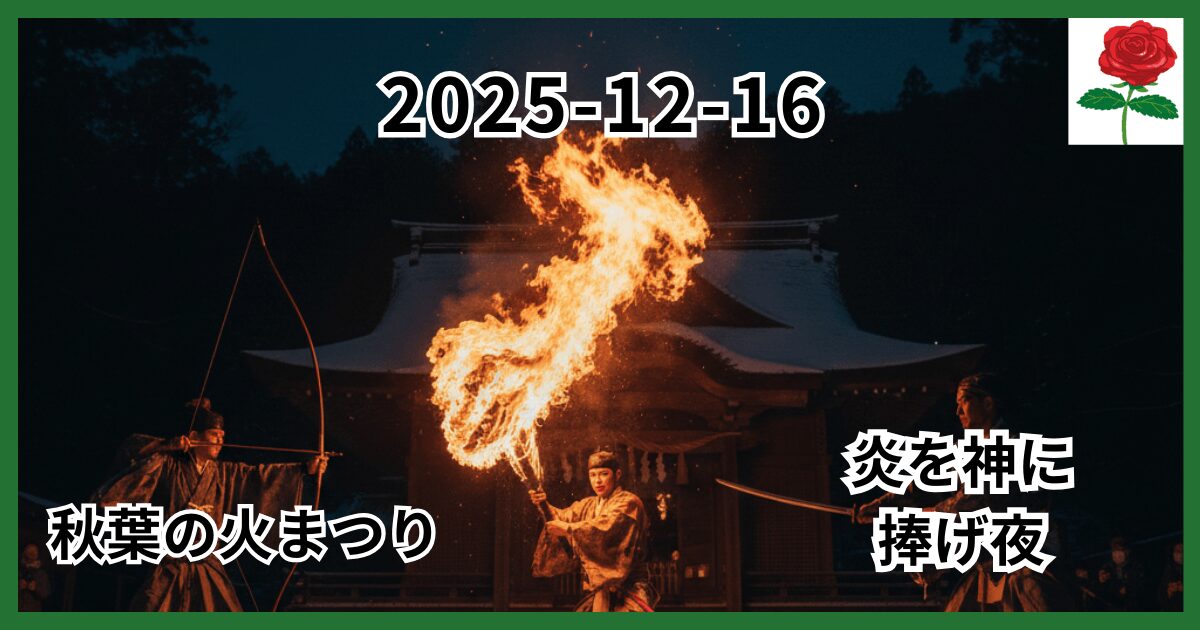
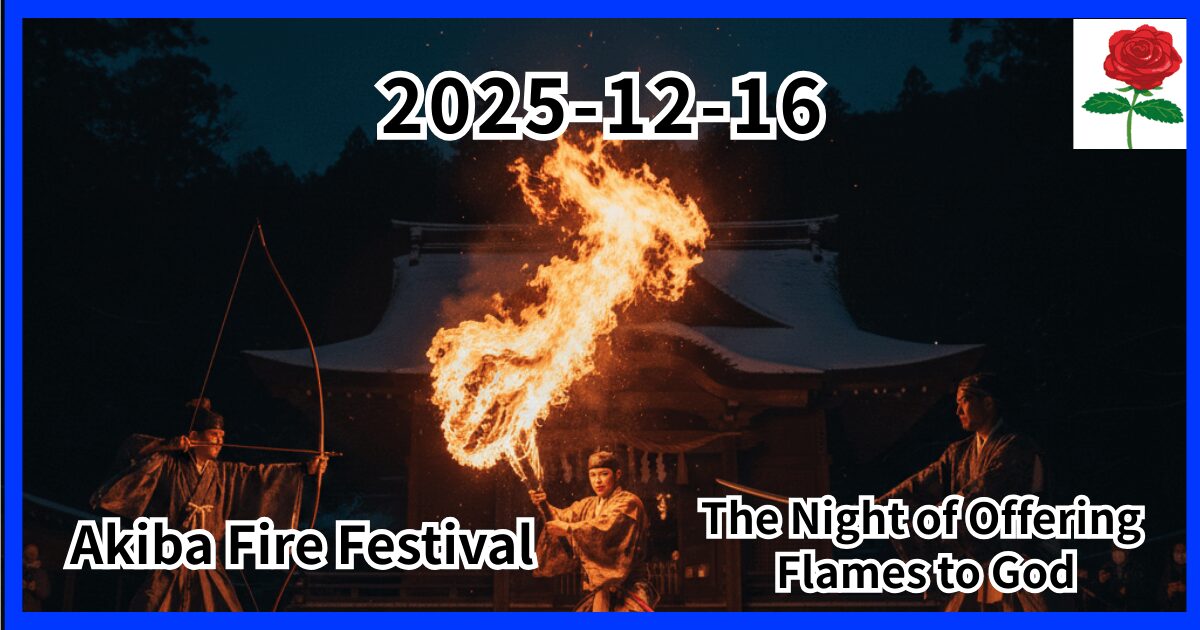
In the center of the stage, a massive, roaring flame rises, far surpassing the size of the surrounding bonfires. This flame is believed to symbolize the divine might of the enshrined deity, Hinokagutsuchi no Ōkami, itself.
Facing the surging flames, the dancer continues the ritual gestures calmly and gracefully, showing neither fear nor hesitation. The dancer’s posture, circling the fire with the flames behind them, suggests not an attempt to dominate the fire, but rather a complete acceptance of its fury and a desire to achieve harmony with it.
As noted in the Wikipedia description, the “Fire Dance” is the most important sacred ritual, dedicated to offering the sacred fire (Goshinka) to Hinokagutsuchi no Ōkami and pacifying the fire.
At the moment the flickering of the flames and the quiet, powerful movements of the dancer converge, the observers are struck speechless, simply standing rooted to the spot. The heat of the fire, the sound of the burning wood, and the silhouette of the dancer highlighted in the darkness appeal to all five senses of the audience, inspiring profound emotion.
Herein lies the essential power of the Akiba Fire Festival: the “unification of reverence and prayer”—pacifying the power of the Fire God, enjoying its blessings, and averting disaster. Through the Fire Dance, the urgent prayers of the people for fire prevention reach their zenith, ushering in the most sacred moment where the deity and humans commune through fire.
The Aesthetics of Silence
A striking feature of the Akiba Fire Festival is its Aesthetics of Silence. In modern festivals and events, loud sound effects and dazzling lighting are frequently used to excite the audience. However, the elements that seek such “flashiness” are intentionally eliminated from the Akiba Fire Festival.
The festival grounds are illuminated only by the light of bonfires (kagaribi), the flames before the altar, and the soft glow of lanterns. Everything else is enveloped in the deep winter darkness of the remote mountains. There is no sound equipment; the audience hears only the sound of the wind, the crackle of wood being consumed by the fire, the footsteps of the dancers, and the faint rustling of their robes.
Sensing the “Unseen Power” with the Five Senses
This composition, which deliberately omits extravagance, maximizes the power of the ritual.
- Auditory Sense (Hearing): The powerful sound of the flames devouring the wood allows one to simultaneously sense the energy of life and the force of destruction. This primal sound lets the observer physically feel the power of the natural world, a force often unnoticed in the clamor of city life.
- Visual Sense (Sight): In the darkness, only the flickering of the flames and the movements (shosa) of the dancer stand out. The contrast of light and shadow created by the fire focuses the viewer’s gaze intently on the dancer’s movements, allowing them to deeply perceive the meaning of prayer embedded in every action.
- Sensory Perception (Feeling): Standing before the hot flames in the extreme cold of winter allows one to physically experience the urgent reality of life being protected by fire.
This festival reminds us of our ability to “sense the unseen.” This is the domain—the existence of the deity, the sanctity of the space, and the spiritual intensity of the dancer—that cannot be grasped solely through words or visual information, and which Japanese culture has long valued as something to be “felt by the heart.” For us in modern society, living in an age saturated with information, the Akiba Fire Festival offers a precious opportunity to pause and sharpen our five senses.
Conclusion
The Akiba Fire Festival is a sacred ritual that heralds the beginning of winter in Japan—a ceremony that is quiet, yet possesses an unwavering intensity.
At the core of this festival is not entertainment, but the very act of “prayer.” The collective memory of people who lived alongside fire—fearing it while simultaneously revering it and appreciating its blessings—is certainly being passed down to the present day through the secret rites of the “Three Dances of Bow, Sword, and Fire.”
The Contemporary Significance of Fire Prevention Faith
Even in modern society, the threat of fire has not disappeared. Fire remains a constant companion to our lives, taking the form of high-rise building fires and massive forest blazes. The Akiba Fire Festival conveys more than just a lesson in fire prevention. It represents a uniquely Japanese way of life: one that does not seek to fully dominate the forces of nature but rather reveres nature and seeks harmony with it.
In today’s world, which is filled with busyness and digital information, where everything is quantified and efficiency is prioritized, the flames radiating from the Akiba Fire Festival grant us time to pause and engage in introspection. By gazing at the quiet, fiercely burning fire in the darkness, we can clear the clutter from our minds and reaffirm our heartfelt wishes for the safety of our own lives and that of our loved ones.
The profound depth of Japanese culture resides precisely in the powerful spirituality and force of prayer found within such silence.
On a winter night, if you ever have the chance, please visit Mount Akiba in Shizuoka and witness that sacred fire with your own eyes.
There, you will undoubtedly feel the vibrant essence of the Japanese faith—the very origin that connects the ancient past to the present day—a power that words alone cannot fully describe.
Career advancement
2025年12月16日。
December 16, 2025.
今日は、静岡県浜松市に伝わる伝統行事、「秋葉の火祭り」についてお伝えします。
Today, we’ll be reporting on the Akiba Fire Festival, a traditional event held in Hamamatsu City, Shizuoka Prefecture.
炎が闇夜を切り裂き、空気は張り詰めます。
Flames cut through the dark night, creating a tense atmosphere.
しかし、この祭りはただの火祭りではありません。
But this festival is more than just a fire festival.
舞台は秋葉神社。
The setting is Akiba Shrine.
ここでは、秘伝の「弓・剣・火の三舞」が披露されます。
Here, the secret “Three Dances of Bow, Sword, and Fire” are performed.
火を鎮め、火を敬い、火と共に生きる。
Extinguish the fire, respect it, and live with it.
山の民の信仰は今も息づいています。
The faith of the mountain people lives on today.
弓の舞は邪気を払うため。
The bow dance is to ward off evil spirits.
剣の舞は身を清めるため。
The sword dance is to purify the body.
そして、火の舞はクライマックスであり、神への祈りです。
And the fire dance is the climax, a prayer to the gods.
派手な演出はありません。
There are no flashy performances.
だからこそ、一つ一つの動きと揺らめく炎は、観る人の心に深く響きます。
Which is why each movement and the flickering flames resonates deeply with the viewers.
日本の冬は静かに、そして力強く始まります。
Japan’s winter begins quietly yet powerfully.
秋葉の火祭りは、私たちにそのことを教えてくれます。
The Akiba Fire Festival teaches us this.
今が旬の野菜は、大根、白菜、ほうれん草。
Vegetables that are in season right now are radish, Chinese cabbage, and spinach.
体を温めて冬を迎えましょう。
Let’s warm up our bodies and welcome winter.
朝食に感謝。
Thank you for breakfast.
応援と評価、宜しくお願い致します。
Thank you for your support and ratings.