[Japanese page]
[Previous article]
[Next article]
Self Lesson
Repeating the sentences out loud is the quickest way to train your Japanese brain!

2025年12月7日。
December 7, 2025.
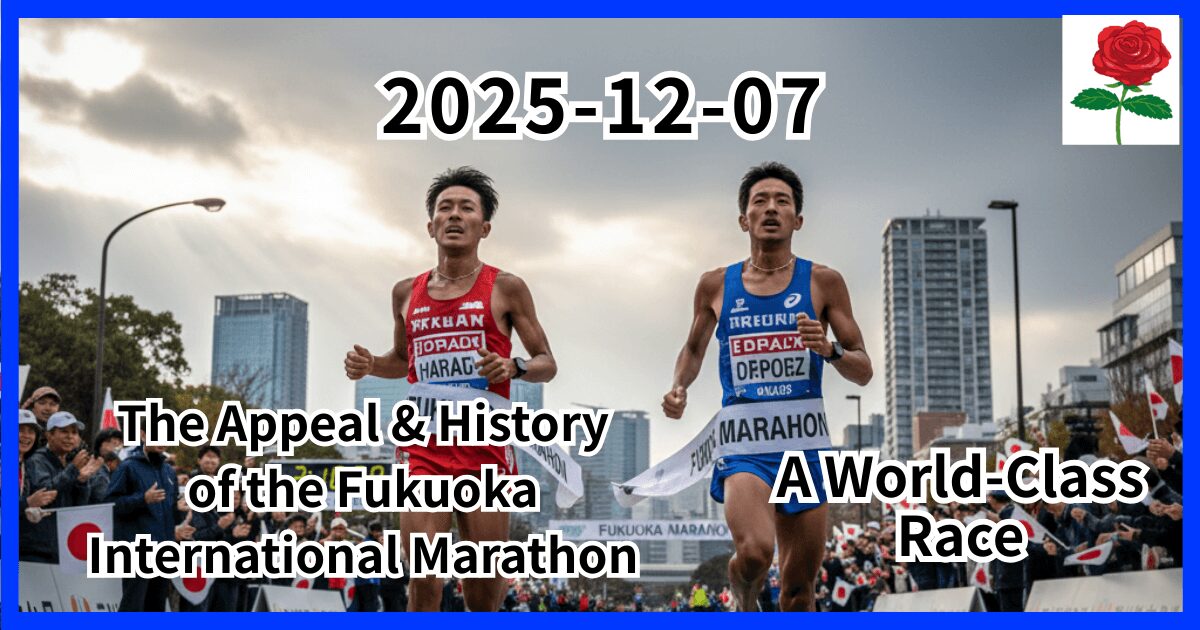
今日は、日本中を熱狂させるであろう福岡国際マラソンの魅力をお伝えしたいと思います。
Today, I would like to share with you the appeal of the Fukuoka International Marathon, a race sure to excite the whole of Japan.
まずは、聞いてください。
First, listen.
世界のトップランナーたちが、日本に「戦いの場」として選んだレースがあります。
There is a race in Japan that the world’s top runners have chosen as their “battlefield.”
それが、福岡国際マラソンです。
That is the Fukuoka International Marathon.
記録、歴史、伝統。
Records, history, tradition.
この「特別な42.195km」には、そのすべてが詰まっています。
This “special 42.195km” is packed with all of these.
1947年に始まった福岡国際マラソンは、日本を代表する伝統あるレースの一つです。
The Fukuoka International Marathon, which began in 1947, is one of Japan’s most prestigious and traditional races.
これまで多くの著名ランナーを魅了し、史上初の2時間10分切りの舞台として、世界中から注目を集めています。
It has attracted many famous runners to date and is attracting attention from around the world as the first runner to complete the race in under 2 hours and 10 minutes.
福岡の街を縦断する、フラットでスピード重視のコース。
The flat, speed-focused course traverses the city of Fukuoka.
選手たちは風と闘い、スタミナを消耗させ、大濠公園に戻る最後の直線で、一瞬の勝負が決まることもあります。
Athletes battle the wind, exhausting their stamina, and the final stretch back to Ohori Park can decide the outcome in a split second.
精鋭ランナーだけが立つことができるこのスタートラインには、「ここで勝った者が世界を走る」という力強いメッセージが込められています。
This starting line, where only the most elite runners can stand, carries a powerful message: “Whoever wins here will run the world.”
そして今年も、記録は?勝利は?歴史は?
And this year, what about records? What about victories? What about history?
様々な可能性が生まれる「12月の決戦」が始まりました。
The “December Showdown” has begun, a time when many new possibilities are born.
マラソンには、人々の努力と物語が詰まっています。
The marathon is filled with the efforts and stories of people.
今日のあなたの一歩が、きっと大きな違いを生むでしょう。
Your step today will surely make a big difference.
寒い朝には、温かいスープと根菜で、体を優しく温めましょう。
On cold mornings, warm your body gently with hot soup and root vegetables.
冬は特に甘みが増すニンジンやジャガイモがおすすめです。
Carrots and potatoes are especially sweet in winter.
しっかり食べて、良い一日を始めましょう。
Eat well and start your day off right.
The Records and Legends of the Fukuoka International Marathon
The Fukuoka International Marathon has established a powerful identity throughout its long history as a place to “compete against the world,” giving it a special status globally.
World Athletics Heritage Plaque Recognition
- Recognition: In 2020, World Athletics recognized the race’s 75 years of history and its significant contribution to the sport, awarding it the prestigious “World Athletics Heritage Plaque.”
- Significance: This title is granted to only a small number of historical events worldwide, confirming the global value and importance of the Fukuoka International Marathon.
A Stage for World-Changing Records
The First “Sub-2:10” Run in History
- At the 1967 race, Australian runner Derek Clayton set a world best time of 2 hours, 9 minutes, and 36.4 seconds (at the time), becoming the first person ever in a marathon to break the two-hour-ten-minute barrier, known as “Sub-2:10.”
- Fukuoka became globally recognized as a “fast course” where records could be set, further cemented by Robert de Castella (also from Australia) setting another world record there in 1981.
Japan’s First Double Sub-2:10
- In the 1979 race, Japanese runners Toshihiko Seko and Takeshi So both finished under 2 hours and 10 minutes—a world-first achievement at the time. This race, which also served as a qualifier for the following year’s Olympics, is remembered as a historic highlight: the intense battle of “Seko vs. the So Brothers.”
The Fierce Rivalries of Top Runners
- Frank Shorter (USA): Achieved an incredible four consecutive victories from 1971 to 1974, profoundly influencing Japanese athletics.
- Japanese Elite Runners: Many of Japan’s top runners, including Toshihiko Seko, Shigeru and Takeshi So, Takemichi Nakayama, and Atsushi Fujita, have set their personal bests here, earning their ticket to global competition. Fujita set a course record of 2 hours, 6 minutes, and 51 seconds in the 2000 race.
- Recent Years: The race continues to draw Japan’s finest, from Yuki Kawauchi, the runner known as the “Citizen Runner,” to Yuma Hattori, who secured Japan’s first victory in 14 years in 2018.
Information Related to Food (“Shoku”)
Winter Root Vegetables and Marathon Runners
- Nutrition: Root vegetables like carrots, potatoes, and daikon radish are ideal for marathon runners. They are rich in carbohydrates for energy, as well as vitamins and minerals that aid in fatigue recovery and boost immunity.
- Warm Soup: Warm soup is highly effective for raising core body temperature. It is excellent for pre-race conditioning and post-training recovery.
The Charm of Fukuoka’s Winter Cuisine
- Fukuoka is not just a marathon venue; it’s a treasure trove of delicious food. During the cold season, local hot pot dishes like Mizutaki (chicken hot pot) and Motsunabe (offal hot pot) are famous. These traditional meals are warming and highly nutritious.
Three Legendary Races
The First Man to Run “Sub-2:10” (1967)
This race became a true historical milestone in the world of marathon running.
- Event: 21st Edition (1967)
- Star: Derek Clayton (Australia)
- Time: 2:09:36.4 (A World Best Time at the time)
- The Legend:
- Clayton became the first person in human history to complete a full marathon in under 2 hours and 10 minutes, coining the term “Sub-2:10.”
- This record shocked the athletics world and cemented Fukuoka’s reputation as a fast course globally.
- Japanese runner Seiichiro Sasaki also set a Japanese national record (2:11:17) in the same race, highlighting the high-speed, world-class pace.
The Battle of Seko vs. The So Brothers, and the Double Sub-2:10 (1979)
Serving as a qualifier for the Moscow Olympics, this “three-way battle” remains a highlight of Japanese marathon history.
- Event: 33rd Edition (1979)
- Stars: Toshihiko Seko, Shigeru So, and Takeshi So (The So Brothers)
- Times:
- 1st Place: Toshihiko Seko (2:10:35)
- 2nd Place: Shigeru So (2:10:37)
- 3rd Place: Takeshi So (2:10:39)
- The Legend:
- The race was a fierce, three-way contest between Japan’s top runners—Seko and the So brothers—right up until the final moments on the track inside Heiwadai Stadium.
- Although Seko won the 1979 race, the following year (1980) saw a global first: Seko won in 2:09:45, and Takeshi So finished second in 2:09:49. This achievement, where two runners simultaneously ran Sub-2:10, proved Japan’s marathon running was at a world-class level.
The Final 100m Dash in the Olympic Qualifier (1983)
Known as the “Death Struggle with Ikangaa,” this race is the quintessential example of a final-stretch showdown.
- Event: 37th Edition (1983)
- Stars: Toshihiko Seko vs. Juma Ikangaa (Tanzania)
- The Legend:
- The race, a qualifier for the Los Angeles Olympics, featured an all-star international field.
- In the final stages, the race came down to a head-to-head battle between Seko and the formidable Ikangaa.
- Ikangaa made his move around the 40km mark, briefly taking the lead. However, Seko launched an astonishing kick in the last 100 meters before entering the stadium. Seko dramatically surged past Ikangaa to win the race and secure his Olympic spot.
- Seko reportedly ran the final 100 meters in a phenomenal 12 seconds, cementing his reputation for incredible competitive strength.
Beyond these highlights, the Fukuoka International Marathon has produced countless memorable moments, including Frank Shorter’s four consecutive wins (1971–1974) and Atsushi Fujita’s victory in the 2000 race where he broke the Japanese record and defeated the eventual Athens Olympic champion.