[Japanese page]
[Previous article]
[Next article]
Self Lesson
Repeating the sentences out loud is the quickest way to train your Japanese brain!

2025年12月6日。
December 6, 2025.
この美しさは、実は「保存技術」なのです。
This beauty is actually a “preservation technique.”
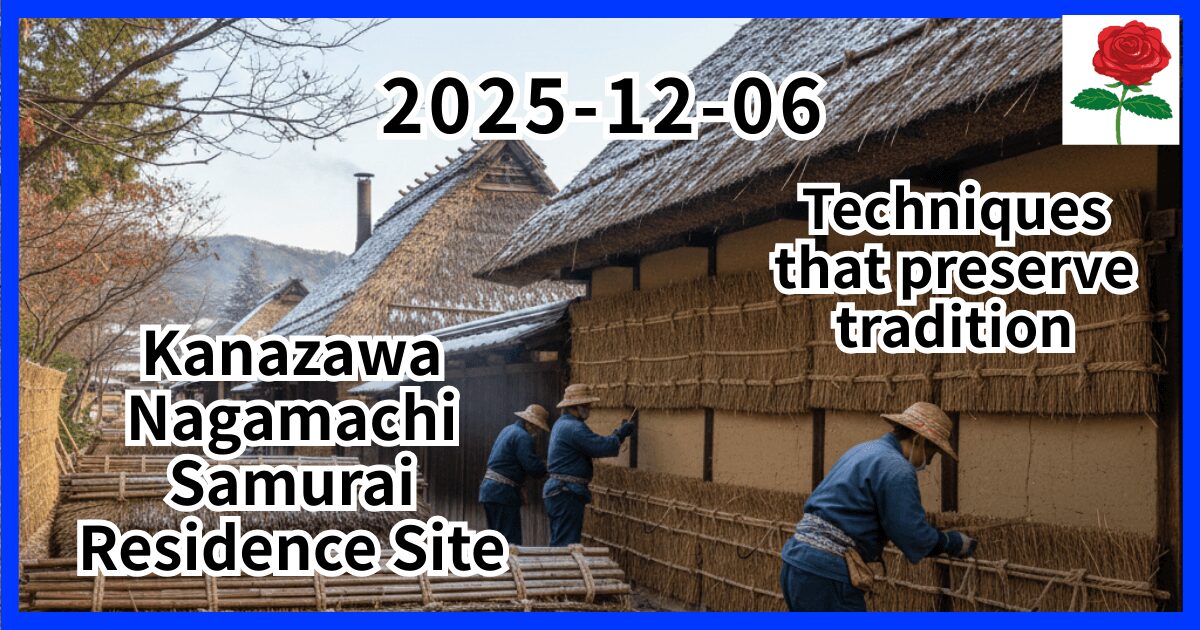
金沢・長町武家屋敷跡では、冬の到来とともに伝統的な作業が始まります。
At the Nagamachi Samurai Residence Site in Kanazawa, traditional work begins with the arrival of winter.
土壁を雪から守る「こもかけ」の作業が、今年も始まりました。
The “komokake” work, which protects the earthen walls from snow, has begun again this year.
これは単なる保護作業ではありません。
This is not just a protective job.
土壁が雪の重みで崩れないように、藁で丁寧に包まれていきます。
The walls are carefully wrapped in straw to prevent them from collapsing under the weight of the snow.
まるで町全体が冬の準備を整えているかのようです。
It’s as if the entire town is preparing for winter.
実は、この作業は江戸時代から受け継がれてきた知恵の集大成なのです。
In fact, this work is the culmination of wisdom that has been passed down since the Edo period.
藁には、断熱、防水、そして保護という3つの役割があります。
The straw has three functions: insulation, waterproofing, and protection.
すべて手作業で行われ、わずかな狂いも許されません。
It’s all done by hand, with not even the slightest deviation allowed.
特に注目すべきは、藁が締められる音です。
Of particular note is the sound of the straw being tightened.
藁を締める「キュッ」という音と、職人たちの静かな息遣い。
The “squeak” of tightening the straw and the quiet breathing of the craftsmen.
この光景からも、冬の空気を感じることができます。
Even from this scene, you can feel the winter air.
茅葺き屋根の立体感が際立ち、土壁の陰影が武家屋敷の雰囲気を醸し出しています。
The three-dimensional effect of the thatched roof stands out, and the shadows of the earthen walls create the atmosphere of a samurai residence.
茅葺きは単なる寒さ対策ではありません。
Thatching is not just a way to protect against the cold.
町の人々の冬を乗り切るための決意を体現する儀式ともいわれています。
It is said to be a ritual that embodies the townspeople’s determination to survive the winter.
雪国の静かな戦いを垣間見ることができます。
You can get a glimpse of the quiet battle of the snowy country.
そろそろ美味しい大根の煮物が美味しい季節です。
It’s almost the season for delicious boiled daikon radish.
朝食に軽く煮た大根と味噌汁を食べれば、金沢の冬景色を少し身近に感じられるかもしれません。
Eating lightly boiled daikon radish and miso soup for breakfast may bring Kanazawa’s winter scenery a little closer to home.
Kanazawa’s Winter Traditions: Protecting the Samurai District and Gardens
The following information summarizes the historical traditions of “Komo-gake” (straw mat wrapping) in the Nagamachi Samurai District and “Yuki-tsuri” (snow hanging) in Kenrokuen Garden, along with Kanazawa’s winter cuisine.
“Komo-gake” (Straw Mat Wrapping) at Nagamachi Samurai District
“Komo-gake” is a characteristic winter scene in Kanazawa, primarily focused on protecting the historic townscape.
- Object of Protection: Primarily the earthen walls (tsuchi-bei) surrounding the samurai residences.
- Main Purpose: To shield the walls from damage caused by the heavy, moisture-laden “botan-yuki” (peony snow) characteristic of Kanazawa, as well as from freezing temperatures. It prevents water deterioration and the peeling of earth caused by accumulated snow.
- Materials Used: Komo (mats woven from rice straw) and ropes.
- Timing of Installation: The work traditionally begins around the first weekend of December (scheduled for December 6th and 7th in 2025), signaling the start of winter.
- Duration: The mats remain in place until around mid-March of the following year, dressing the district in its winter attire.
- Scale of Work: The mats are painstakingly installed by hand along approximately 1.1 kilometers of walls by professional artisans and trainees from the Kanazawa College of Crafts, who are commissioned by the city.
- Historical Context: The city has been officially undertaking this work for nearly 40 years to promote tourism and preserve the unique historical landscape, embodying a fusion of traditional craft and cultural preservation.
“Yuki-tsuri” (Snow Hanging) at Kenrokuen Garden
Along with “Komo-gake,” the practice of “Yuki-tsuri” contributes significantly to Kanazawa’s winter atmosphere, particularly in its famous garden.
- Location: Primarily the trees in Kenrokuen Garden (one of the Three Great Gardens of Japan) and other garden spaces throughout the city.
- Purpose: To prevent the branches of valuable garden trees from breaking under the weight of the heavy, wet snow unique to the Hokuriku region. It’s a traditional technique for bracing the branches with ropes suspended from a central pole.
- Timing: The work is carried out by skilled gardeners annually from November to mid-December.
- Aesthetic Feature: Especially at Kenrokuen, the sight is enhanced by evening light-ups, creating a magical, picturesque scene.
Details of the Yuki-tsuri Technique
- Technique Used: The unique “Ringo-tsuri” (Apple-hanging) method. Ropes are radiated from the top of a central “Shinbashira” (main pole)—often an Ate cedar log—and attached to hundreds of individual branches, providing support.
- Scale at Kenrokuen: The work begins annually on November 1st (a widely reported event). The grand Karasaki Pine (Karasaki no Matsu), known for its sprawling branches, receives one of the most extensive installations, with a central pole reaching about 14 meters and roughly 800 ropes attached.
- Visual Appeal: Beyond its functional role, the perfectly balanced, geometric conical shape of the finished Yuki-tsuri is highly valued as a distinctive form of winter garden artistry.
Kanazawa’s Winter Cuisine and Delicacies
As noted, Kanazawa’s food culture flourishes in winter, offering several seasonal delicacies:
- Crab Dishes:
- Kano-gani: The brand name for snow crabs caught off the coast of Ishikawa Prefecture.
- Koubako-gani: The smaller female snow crab. Its fishing season is brief, lasting only from November to late December, making it a highly prized winter delicacy.
- Kanazawa Oden: A local version of the Japanese stew, featuring unique ingredients like Kuruma-fu (wheel-shaped wheat gluten), Akamaki (red-rolled fish cake), Fukashi (steamed fish cake), Hirozu (fried tofu mixed with vegetables), Baii-gai (whelk), and the local Kaga vegetable, Gensuke Daikon radish. It’s a comforting dish perfect for cold weather.
- Kabura-zushi: A traditional New Year’s dish, this is not a sushi roll but an item closer to a pickle. Salted turnip (kabura) is sliced, stuffed with winter yellowtail (buri) or salmon, and then fermented.
- Nodoguro (Blackthroat Seaperch): A high-end fish enjoyed in various ways, including grilled, as sashimi, or simmered in a rich broth.
These two practices, Komo-gake for the earth walls and Yuki-tsuri for the trees, are essential expressions of the wisdom used to protect both historical architecture and natural beauty, defining the spirit of Kanazawa’s winter landscape.